Model railway enthusiasts from all over Gloucestershire travelled to the Cheltenham GWR Modellers April 2019 Exhibition in aid of CLIC Sargeant at St Margaret’s Hall, Coniston Road, Cheltenham, GL51 3NX on Saturday 6 and Sunday 7 April 2019 to raise money by enjoying the following attractions.
GARE DE BRINDILLE
by Chris Hopper
SM32NG Gauge 16mm Scale

Gare de Brindille was Chris Hopper’s first attempt at an SM32 layout and was also something of an experiment as the locomotives were track powered rather than radio controlled. It was a simple test track laid out as an “Inglenook” or shunting twig and was built using Peco track. It was designed to allow the operators to play trains by shunting various War Department Light Railway wagons built from kits as a result of an increasing interest in the WDLR 100 years on from the First World War. The publication of the “WDLR Album” compiled by Roy C Link and the chance purchase of the Swift Sixteen “Protected Simplex” or “Tin Turtle” at “Tracks to the Trenches” at Apedale in 2015 were major factors in the development of the layout. It contained a number of scenic elements typical of the World War 1 narrow gauge railways and very loosely represented a small loading point some way behind the trenches. The layout was run with an NCE DCC system and the locomotives were sound chipped with Zimo decoders from Digitrains. They represented the small petrol engine locomotives typical of the era and were built from kits by Swift Sixteen and PDF models. The wagons were kit-built plastic, resin and wooden kits from makers including Swift Sixteen, Andel, Red Star and Slaters.
END OF THE LINE
by Tim Crockford Sodbury Vale MRC
0/014 Gauge 7mm Scale

Originally built by Giles Favell, The End of the Line represented the distribution point of a very small coal mining operation in the early 1960s. Never very busy, the output of the mine was divided between distant industry – transported away by rail – and local demand handled by road haulage. The coal from the mine was delivered to the distribution point by a 2′ narrow gauge railway. The excellent KB scale tipper wagons were made to operate and discharge their loads into either a conveyor or direct into a waiting standard gauge mineral wagon. The narrow and standard gauge locomotives were mainly kit built but there are also some 3D printed bodied models from Shapeways and ready to run models from Ixion and Bachmann Brassmasters. The layout had a scenic area of 5′ x 3′ with grass created by a mixture of Polak and MiniNature static fibres and DCC controlled locomotives, Tortoise point motors and the heavily modified Hornby conveyor. The moving radio-controlled lorries were converted from commercially available 1/43 scale die cast models and powered by an iPod Nano battery. The gearbox was of a type used in miniature robotics and a micro servo was used for steering. A Deltang receiver under the bonnet obeyed signals from a toy indoor helicopter controller.
TONY’S FOREST
by Robin Edwards
16mm Gauge 7mm Scale
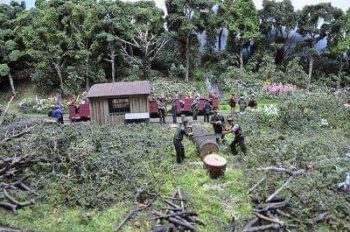
This was the first outing for local modeller Robin Edwards’ new layout.
Tony was the owner of this forest in the 1890s and he built a narrow gauge railway to bring timber down to his own sawmill. The line was extended during the Great War when there was an increasing need for all raw materials. After falling out of use from 1919 to 1939, parts of the railway was reactivated timber and quarry stone traffic during World War 2.
The layout portrayed the line coming up the hillside to a passing loop with the old track forward now disused and overgrown. The line reversed and continued up the hillside while a newer branch led to a quarry which supplied Shropshire County Council with road stone. The area is still known as Tony’s Forest, but the railway remains known only to a few enthusiasts and the local population. There were some rare locomotives still in use and unknown to railway fandom. However, this was the late 1950s and modernisation was on the way. Who knew how long this little backwater would survive before being noticed by someone in the Council? The future was very uncertain.
Emphasis was placed on scratch built scenery and structures while most of the rolling stock was built from kits.
Track was hand built using Peco nickel silver rail on copper clad sleeper strip obtained from the 7mm Narrow Gauge Association. Buildings used wood, embossed card or plastic sheet and Grandt Line windows again from the 7mmNGA. Locomotives and rolling stock were mainly kit built and locomotive chassis were fitted with high ratio gearboxes and flywheels where possible. Passenger coaches were converted Bachmann 0n30 Trolley bodies mounted on bogies from the 7mmNGA while the quarryman’s open coaches were from S&D Models. Wagons were from KB Scale and Wrightlines. The Greenwhich couplings were activated remotely by permanent magnets set into the track bed.
BILSTON ROAD ENGINE SHED
by Cheltenham GWR Modellers
00 Gauge 4mm Scale
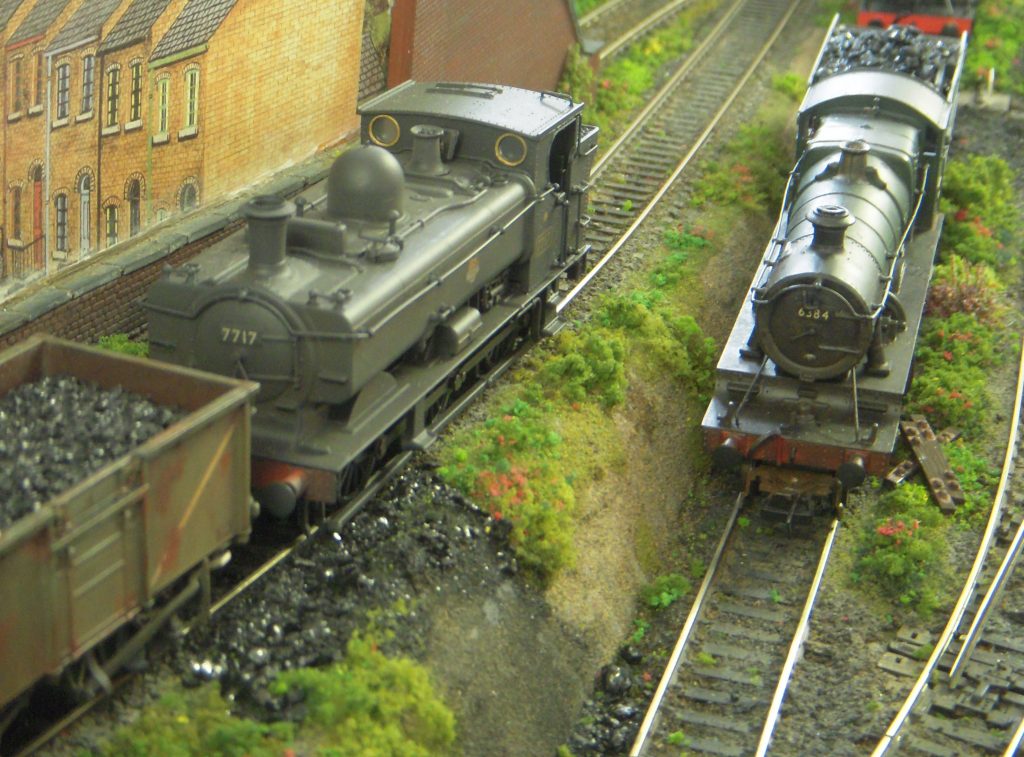
This layout was built by Peter Cullen when he was a member of Solihull MRC. It represents a typical sub-shed located somewhere in the industrial West Midlands on the Western Region of British Railways during the mid-1960s. Locomotives return for overnight servicing and simple running repairs. Some locos have been re-numbered and the majority have real coal added. Since the layout was sold by Peter, Robert Webb has spent time re-furbishing it.
DENT
by Bristol East MRC
00 Gauge 4mm Scale
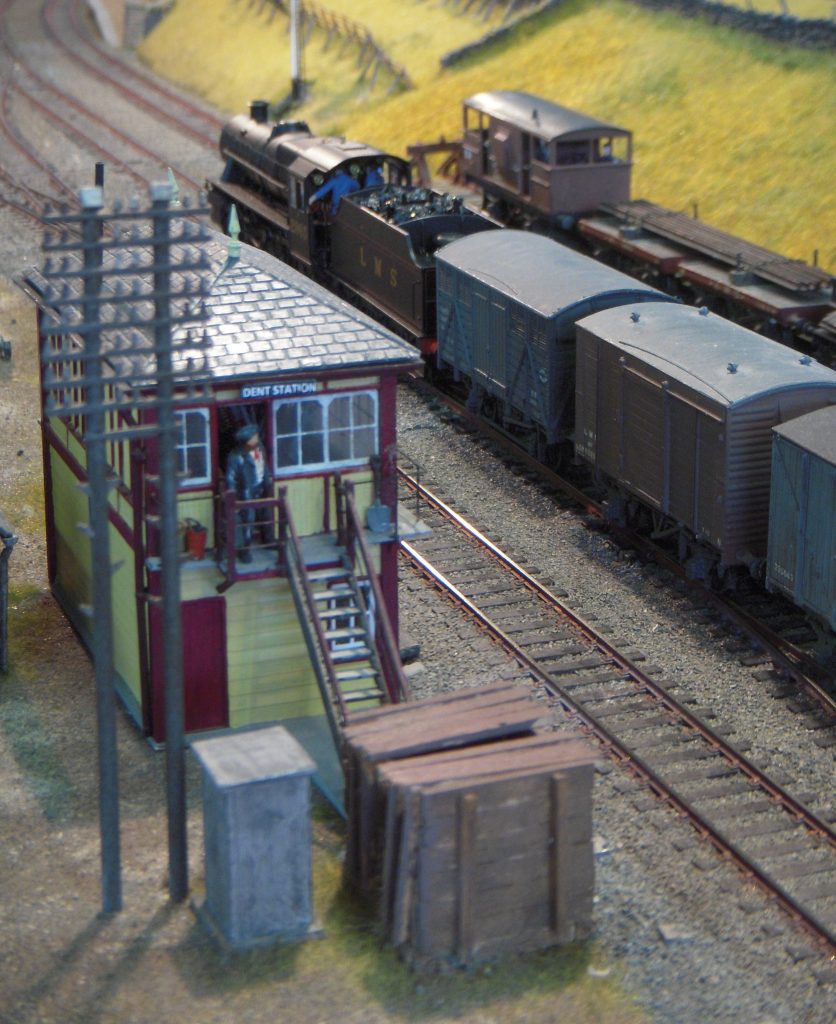
Completed in 1877 the Midland Railway’s Settle to Carlisle line is renowned for the rugged Moorland, its tunnels, viaducts, amazing scenery and snow. Along the way, Dent station serves the villages of Cowgill and Dent. Cowgill village is half a mile away while Dent itself is nearly 5 miles further to the west. The lack of passengers reflect this. The stone station building – complete with Up platform waiting room – itself is famous for being the highest on the English railway network at 1,150 feet and must also be one of the most modelled stations on the British Railways network! The layout – with its Blea Moor style landscape of dry stone walls and snow fences – was inspired by the work of David Jenkinson and built to provide a circular layout so that Phil could sit back and watch trains run round. Construction featured Peco fine scale track and point motors and Ratio signals.
Passing Dent Station signal box with a train of vans is LMS Stanier 2-6-0 2965,one of a class introduced in 1933 with Walschaerts valve gear actuating piston valves fed with superheated 225 psi steam by a taper boiler.
THOMAS
by Cheltenham GWR Modellers
00 Gauge 4mm Scale
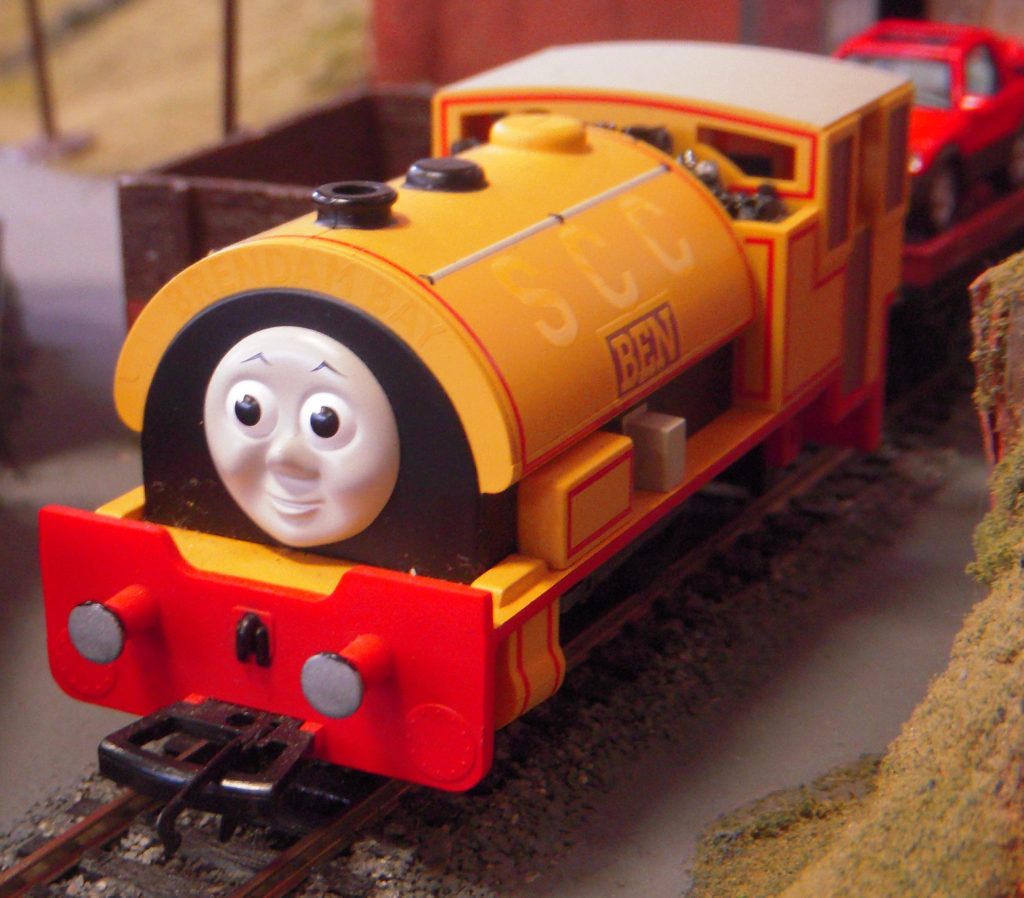
Bill and Ben are based on the Bagnall 0-4-0STs “Alfred” and “Judy” of Par, Cornwall, who are both preserved and in working order at the Bodmin and Wenford Railway. According to the lore of the Reverend Awdry’s Railway Series, Bill and Ben are Sodor’s mischievous saddle tank engine twins, who have great fun in teasing other engines of the railway. The two have four wheels, a tiny chimney and dome, and a small squat cab. They often work in the China Clay pits and quarries. Their loads of clay can be used for many things such as paper, paint, and pottery. They take trucks for engines on the main line and ships in the harbour and are regularly seen around Brendam Docks. They enjoy attention and love taking visitors and being photographed. They tend to work together, like most twins, but even this youthful pair can have their arguments among themselves and can squabble with one another – particularly about whose fault one of their follies was. They are highly prone to playing tricks and being cheeky. They have even teased Gordon on more than one occasion. Duck has called them “the bees” before, for being terrors when they start buzzing around. Edward and BoCo are the only engines who can really keep them in order enough to put a stop to their games and make them scamper along and behave. There is no real harm to them, but even Edward admits that they are maddening at times. Despite their cheeky and mischievous antics, if a dangerous event occurs, such as a rockslide, they are shown to be quick-witted and capable to act to rescue anyone in trouble. This was shown when they saved a group of workman and Thomas from many different rockslides.
WHITECLIFFE QUARRY BRANCH
by Rob Mills
00 Gauge 4mm Scale
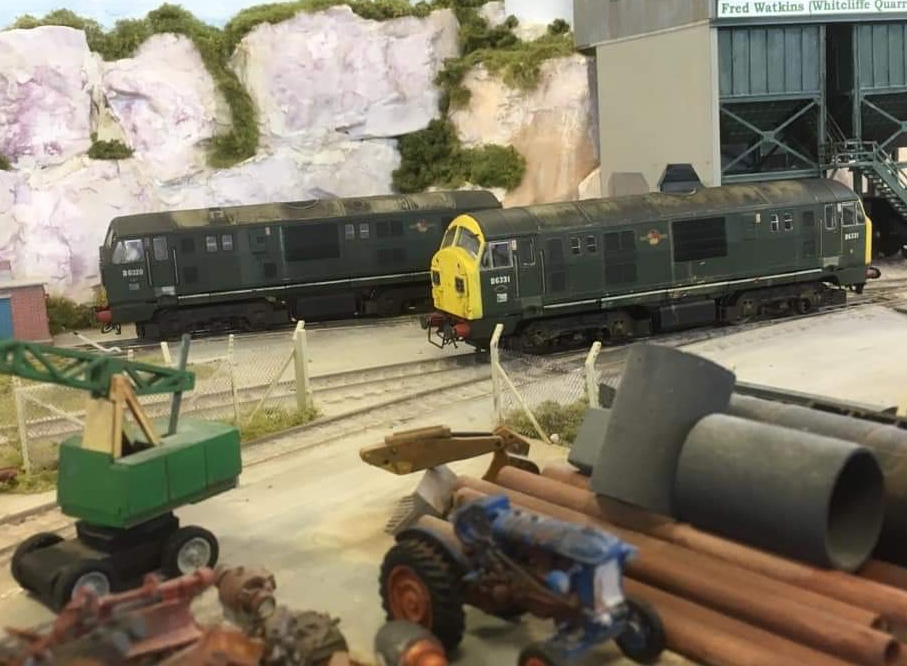
This layout was inspired by various locations in the Forest of Dean. Whitcliff Quarry is an actual place to the south west of Coleford but the prototype is much larger than the model – although the 4mm version did feature Fred Watkins’ engineering works and scrapyard which were at the end of the Sling branch in real life. The layout also featured a sand siding and abandoned horse drawn tramway wharf – similar to the one at Bicslade near Cannop Ponds – for loading stone blocks from local quarries. Stock operated on the layout was what was actually used on the Coleford branch but was expanded to what could feasibly have been seen if the full service had been maintained until closure of the line to the quarry in 1957. Diesel hydraulic B-Bs D6320 and D6331 were the twins for Gloucester trip workings in the late 1960s and early 1970s. Their workings would have included Forest trips….and they returned to Whitecliffe Quarry at the show courtesy of Phil Bullock and Abbotswood: The Background Story !
HILLSIDE MINE HERITAGE RAILWAY
by David and Sue Griffin
009 Gauge 4mm Scale
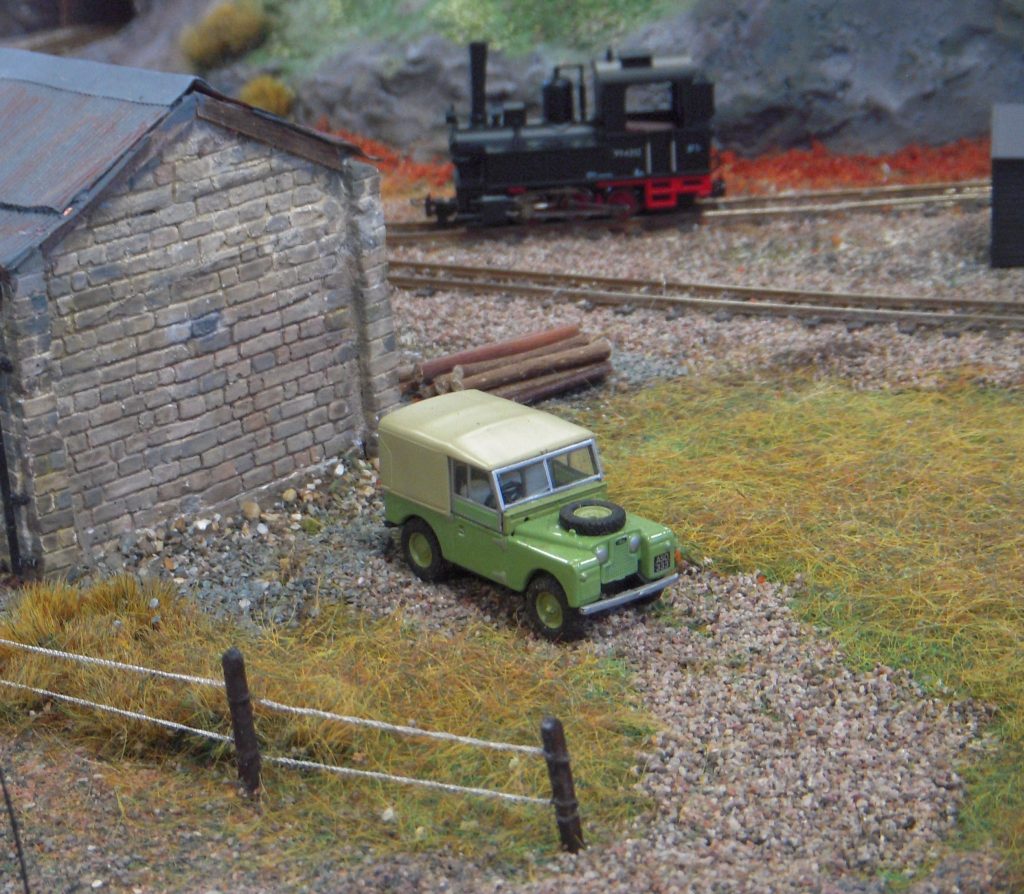
Hillside Mine Heritage Railway was a narrow gauge railway in 4mm scale, constructed using Peco 009 proprietary track. The location was set in the Welsh borders, inspired by the Brecon Mountain Railway and the mining heritage of the surrounding countryside. The premise was that the drift mine was reactivated during the 1972 Miner’s Strike.
The concept and design of Hillside was purely fictional and an enormous amount of modeller’s license was used during all design and construction phases. The idea was to create an easily portable layout which provides sustained operational and scenic interest for the viewing public.
Rolling stock was a mixture of kit built and converted ready to run items mostly from RICO and Parkside Dundas. The buildings were both kit and scratch built using Ratio and Wills materials, with various scatters from the “Woodland Scenics”, and “Greenscene” ranges.
The trees were constructed using the traditional wire frame method, which was then hand soldered and covered in a plaster mix and painted to represent the bare branches that are to be found in the late Autumn countryside of this region.
YATE ROCKS TRAMWAY
by Sodbury Vale MRC
009 Gauge 4mm Scale
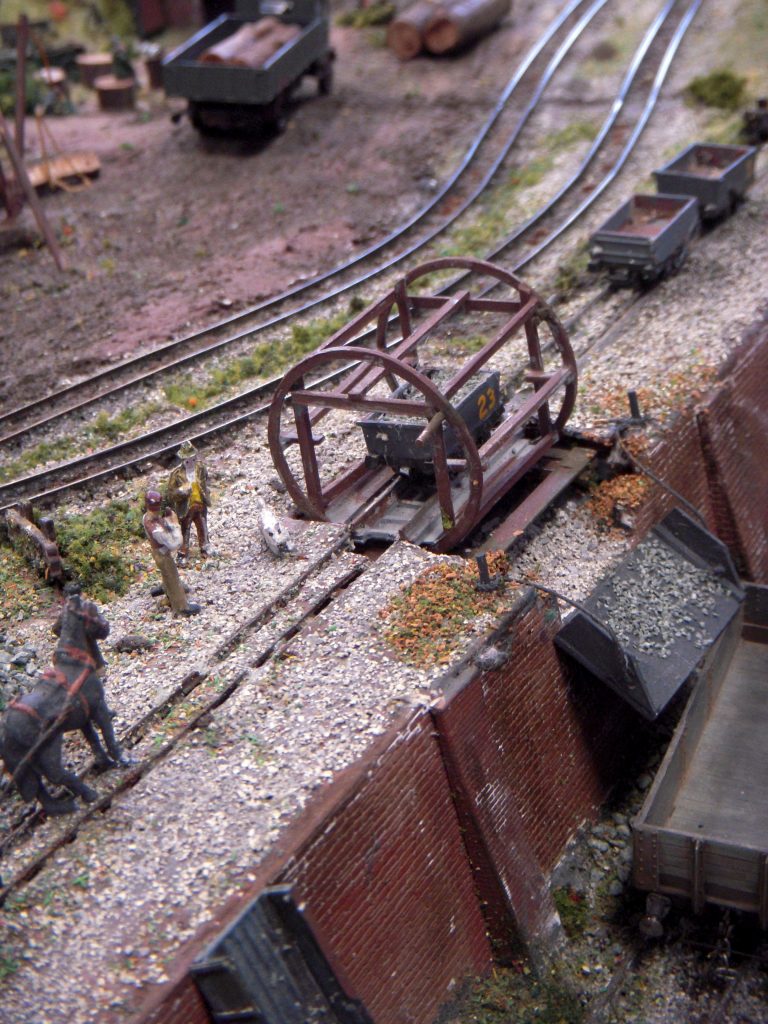
In the late 19th century there was a tramway, probably horse drawn and about three foot gauge, that linked two limestone quarries just north of the east end of Tan House Lane north of Yate (now in South Gloucestershire) with some limekilns alongside the Midland Main line just south of where the existing Limekiln Lane crosses the railway line. The tramway continued to serve the limekilns until 1925 before being closed and dismantled. However the route is still easily discernible across the fields and on Google Earth. As he has yet to establish if it had a name, Colin named it the Yate Rocks Tramway. The 009 scale layout, took the former tramway as its basis and was set in circa 1950 to enable the presence of a Bedford OB Bus, perhaps bringing in a party from the Railway Correspondence and Travel Society. Yate Rocks Tramway was now a steam and diesel hauled 2 foot 3 inches gauge mineral light railway bringing limestone from the quarry to a stone processing works connected to the British Railways Bristol to Gloucester line (the former Midland Railway/LMS route) via an exchange siding with a cylindrical cage type rotary tippler to invert the narrow gauge wagons and tip the limestone into the standard gauge wagons waiting below. The works had recently been extended and featured a passing loop, a new exchange siding and a timber yard. There were also the remains of two of the old limekilns. The buildings on the layout were mainly from the area, the idea being to create an image of part of the quarrying history of the area as it might have been in circa 1950, the year the last coalmine in the Yate area closed. The Tramway had a selection of wagons some full, some empty; whilst the locomotives are mainly by Paul Windle and Minitrains.
WINTERWELL
by John Thomas
TT Gauge 3mm Scale
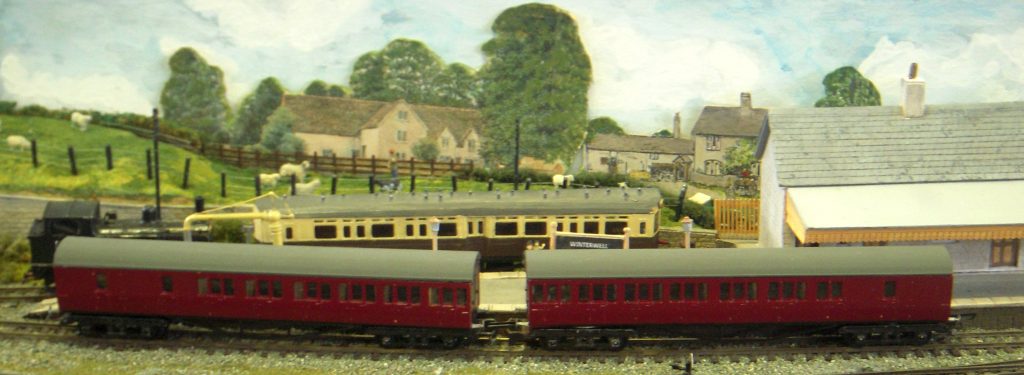
Winterwell on the Fosse was a fictional small Cotswolds market town in the 1950s and was named after a real farmstead near Northleach. It was envisaged that the branch line was once part of the Midland and South Western Junction Railway and would have seen GWR, Midland and Southern railway trains. In this case a maroon liveried Great Western B set (a pair of coaches with brake compartments outermost) stands in front of a chocolate and cream auto trailer coupled to a suitably fitted pannier tank. Both trains could claim to be ancestors of modern diesel and electric multiple units.
Most of the buildings on the 13’x 2′ layout were scratch built and based on Cotswold prototypes.
BURNHAM ON SEA
by John Perrett
2FS Gauge (9.42mm) 2mm Scale

Situated on the Somerset Coast, Burnham on Sea was once the important northern terminus of the Somerset and Dorset Railway, linking the Bristol Channel with the English Channel. The pier at Burnham received rails from Welsh steelworks to be carried onward to the expanding rail network in southern England on paired bolster wagons while pleasure steamers such as the PS Waverley would also call during the summer. Burnham Pier was also used by the oar-powered lifeboat, which had its own private siding and was launched and recovered on a special railway wagon by a winch which could rotate to face either towards the sea or inland. The first Burnham lifeboat was operated by the Bridgwater Harbour Trust from 1836 to 1857, after which its lifeboat house closed. This facility was re-opened by the Royal National Lifeboat Institution in 1866 but closed again in 1930. The house for the rail-mounted boat and associated siding opened in 1874. The first RNLI Burnham Lifeboat was paid for by public subscription among the people of Cheltenham and launched on Pittville Lake on 10 October 1866. The 32’ long, 7’4” beam vessel cost £ 650/10/7d and remained on duty until 1887. In 21 years it put to sea 14 times and saved 36 lives. RNLI Lifeboat 138 then served Burnham on Sea from 1887-1902 only to be replaced by Lifeboat 498 – named “Phillip Beach” and represented by the layout model – from 1902 to 1930. The railway station, opened on 3 May 1858, unusually featured a short overall roof and a long platform for excursion trains. It closed to normal passenger workings on 29 October 1951 with excursion traffic continuing to 8 September 1962 and goods to 20 May 1963. The layout was made and exhibited by the late Denys Brownlee and is being rejuvenated by John Perrett with the ultimate aim of depicting the Somerset and Dorset Joint Railway scene in the 1920s and 30s. Current stock was mainly borrowed or adapted N gauge.
GRAVELLY OAK
by Ed Purcell
N Gauge 2mm Scale
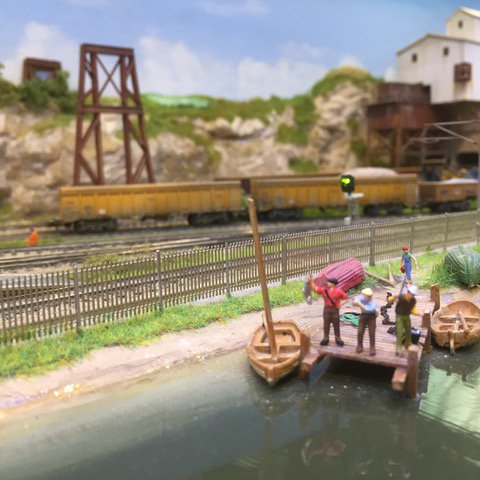
This 4’9″ NCE controlled DCC modern image layout featured a station and industry set on a former GWR branch between the West Midlands and Shropshire sometime between 2000 and 2017. As well as London Midland passenger services a nearby quarry loaded trains with specialised aggregate and locomotives could be fuelled and serviced at the stabling point.
Track was by Peco and Gravelly Oak also featured Seep point motors with frog switching by autofrog units as well as modified resin and kit built structures. Other scenery was by Woodland Scenics and rolling stock included Graham Farish and Dapol products.
LLANGURIG PLANT
by Peter Lee
1/50 Scale

Robert Wynn, from whom the company takes its name, was only fifteen when he inherited the already successful haulage business his father, Thomas, had founded in 1863, the year of Robert’s birth. Thomas had been a carriage cleaner, who had recognised that the traditional transport of heavy loads by canal was being replaced by the developing railway system. Robert was one of ten children and it was said of him that he was too small to harness the teams of several dozen shire horses that regularly transported flour from the mills in Newport, Wales and had to be aided by his elder sister Emma. But he expanded the business rapidly, buying his late father-in-law’s timber haulage business and intensifying his own operation to meet demand from the increasing number of steel mills in the area. Robert invested heavily, in 1890 building the first boiler wagon capable of carrying 40 tons and in 1902 moving his entire operation, including over two hundred horses, to premises in Shaftsbury Street, Newport. It was from here in 1923 that he incorporated the firm as Robert Wynn and Sons Ltd. Robert Wynn died in the November of that year but he left behind five sons who ran an increasingly strong family business that continued into the 1980s, when successive amalgamations saw the name gradually disappear. In those sixty years, Robert Wynn and Sons made a reputation for finding new and innovative solutions to the specific problems posed by the transport of difficult and indivisible loads. Not only did they have a permanent place in the Guinness Book of Records, but they pioneered huge developments in the field of heavy transport and achieved many ‘firsts’. Wynns Limited, founded by Robert’s great-great grandson Peter Wynn, has continued this pioneering transport tradition. 137 years ago Thomas Wynn’s first vision and mission was to compete with the railways and the canals. Now, with the restoration of Robert Wynn and Sons in 2000 as a subsidiary company responsible for the delivery and -where none previously exists – the creation of specialist equipment to make best use of the nation’s waterway network, the wheel has come full circle.
ABBOTSWOOD THE BACKROOM STORY
by Phil Bullock
00 Gauge 4mm Scale

Abbotswood – The Backroom Story” allowed visitors to talk to Phil Bullock and learn more about one of the most impressive and best loved 00 gauge layouts on the Gloucestershire model exhibition circuit. People enjoy the opportunity to discuss Digital Command Control systems and some of the younger visitors can have fun on the test track. Here, two classic Western Region diesels line up in front of some BR Mark 1 and Pullman carriages. D1669 (rear track) was delivered new to Swansea Landore depot on 20 March 1966 and was named “PYTHON” without ceremony on 31 March 1966 at Old Oak Common depot in west London although from the start of April 1966 it became a Bristol Bath Road locomotive. At least one plate was noted as missing on 5 April 1972 and both were removed in September 1973 prior to renumbering under TOPS. D7007 – characterised by the large round roof fan – meanwhile was one of the numerically much smaller and less powerful “Hymek” class of Western Region diesel hydraulics
TO THE MANOR BURNT
by Martin Nash
4mm Scale

One of the great joys of the Cheltenham GWR Modellers Group Exhibitions is the unexpected takes on engineering. A visitor might have anticipated different presentations on the Great Western Railway or moving coal but how about a manor house burning down? Fire is a good servant but a bad master, and ever since man – uniquely among animals – first discovered how to create it the two have had a difficult relationship. On one hand, fire kept mankind warm, cooked food and warded off dangerous animals before boiling water to make steam. On the other hand, it required containment in stone or brick to avoid setting wood or other combustible material alight. Out of control, fire has burned down forests, entire cities and even parliaments – sometimes with truly horrific results. To counteract this, fire fighting technology has progressed from human water bucket chains to the kind of diesel powered ladder and pump appliance seen on Martin’s diorama.
MODEL BUS FEDERATION AND NATIONAL ASSOCIATION OF ROAD TRANSPORT MODELLERS Represented by Paul and David Mellor
TRAVEL 2000 by Andy Peckham
4mm Scale
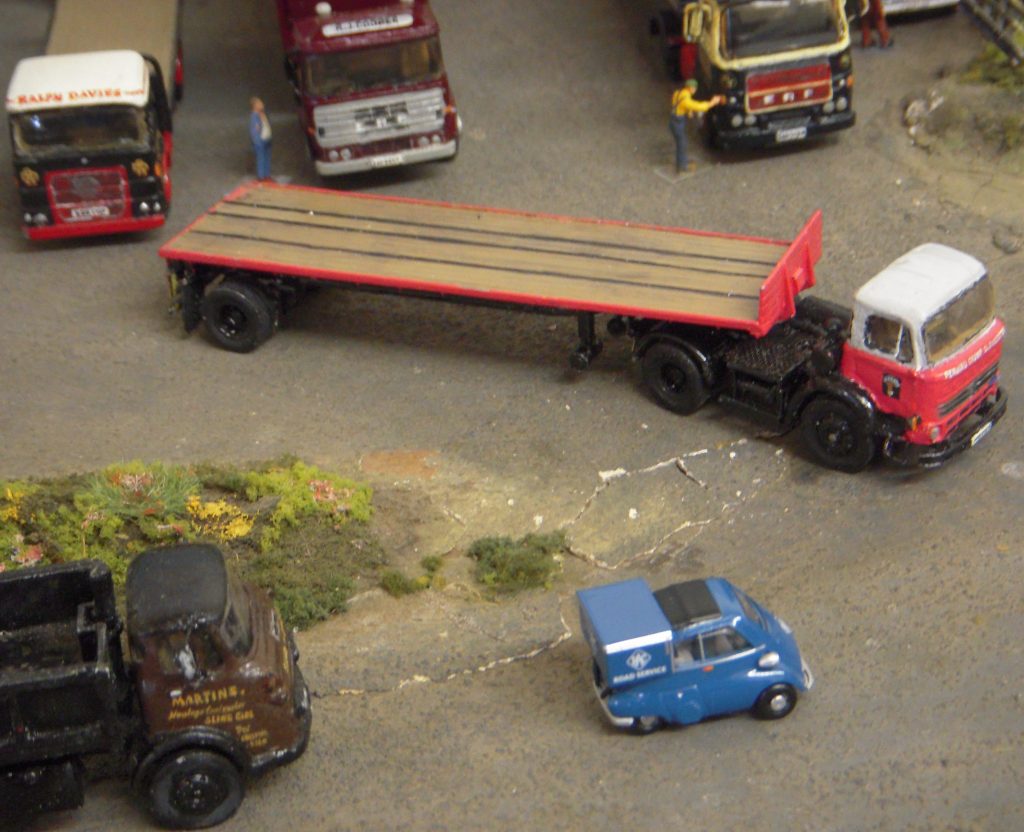
Over the years, Paul and David Mellor have evoked the lorries of some of the most famous of Gloucestershire based firms and one of the most fascinating – yet least known – is the Permali Group of Gloucester.
Permali Gloucester Ltd. was founded in 1937 and is now a market leader in the manufacture of composite materials for the aerospace, defence, rail, automotive and medical markets. Products include Permaglass laminated composites, sandwich panels, Plasticell foams, and also components and assemblies manufactured using these materials. Permali operate an approved quality controlled design and manufacturing process. Materials handled include aramids, GFRP, UHMWPE, solid core foams, PU, TPU, ceramics and metallics. The company operates from a 10,500 m2 facility to the south of Gloucester city centre and close to the M5 motorway.
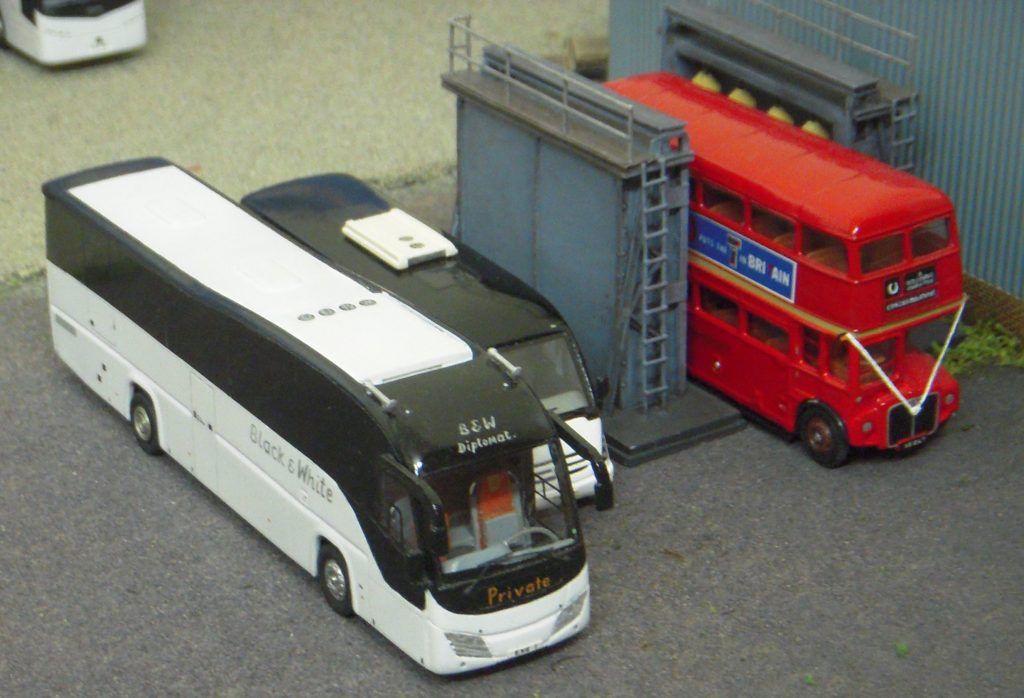
The innovative Routemaster, seen with its wedding ribbons here in Travel 2000’s washing plant, served Londoners with style and reliability for more than half a century and millions of passengers still cherish the double-decker for its graceful curves and hop-on, hop-off ease well into the era of driver-only operation.
Yet the qualities that ensured its survival against the odds were less visible – bold technology that allowed unequalled fuel economy for a London bus, along with ease of maintenance and a smooth ride. Designer Colin Curtis always emphasised the team effort that went into it from the moment the brief went out in 1951 to the construction of a bus capable of taking on the car for comfort and style, and also replacing London’s trolley buses.
A TASTE OF AMERICA
by Vincent Tweed
1/87 Scale (3.5 mm to the foot)
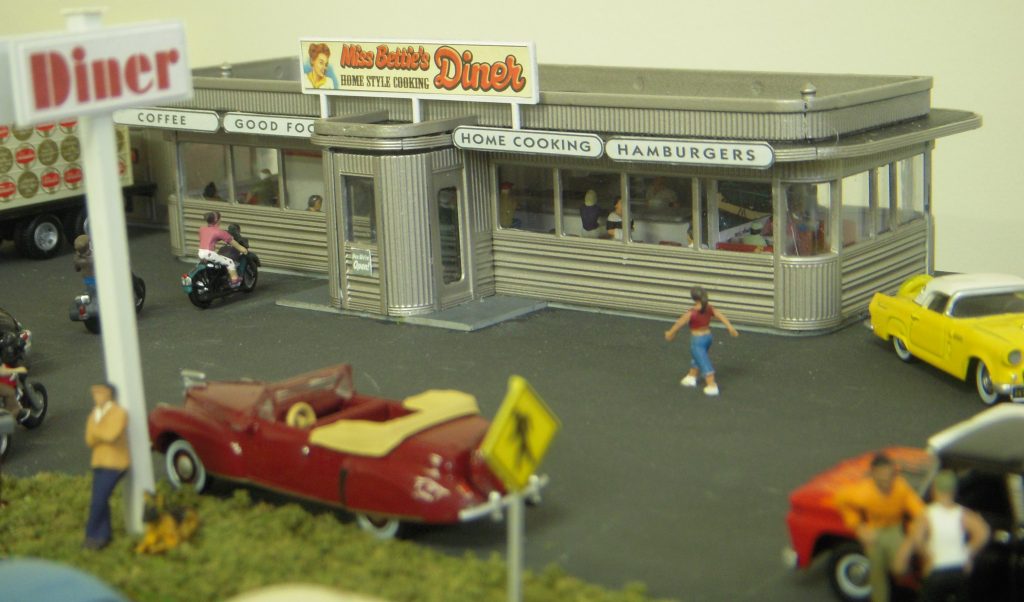
Having impressed us over the years with his Southdown buses and transport rally dioramas, Vincent took visitors to St Margaret’s Hall to Miss Bettie’s Diner, Colorado, USA with a dazzling array of chrome and tailfins parked outside. He commented:
“Since my first visit to the United States I have held a fascination for diners, especially those constructed with a stainless steel finish. Miss Bettie’s Diner is found on a busy highway sometime in the 1960s. The now disused rail track will eventually become an extension to a nearby preserved railroad. The ranch is a stud for breeding racehorses and also houses a collection of vintage tractors and farm machinery which is open to visitors at weekends. The diner is a grey Walther’s Cornerstone kit sprayed to achieve a stainless steel finish and with added detail. The cars are from the Oxford Diecast range and various US manufacturers with the majority of figures by Woodland Scenics.”
OILY END IN THE BUSHEY AREA
by Alan Drewett
N Gauge 2mm Scale
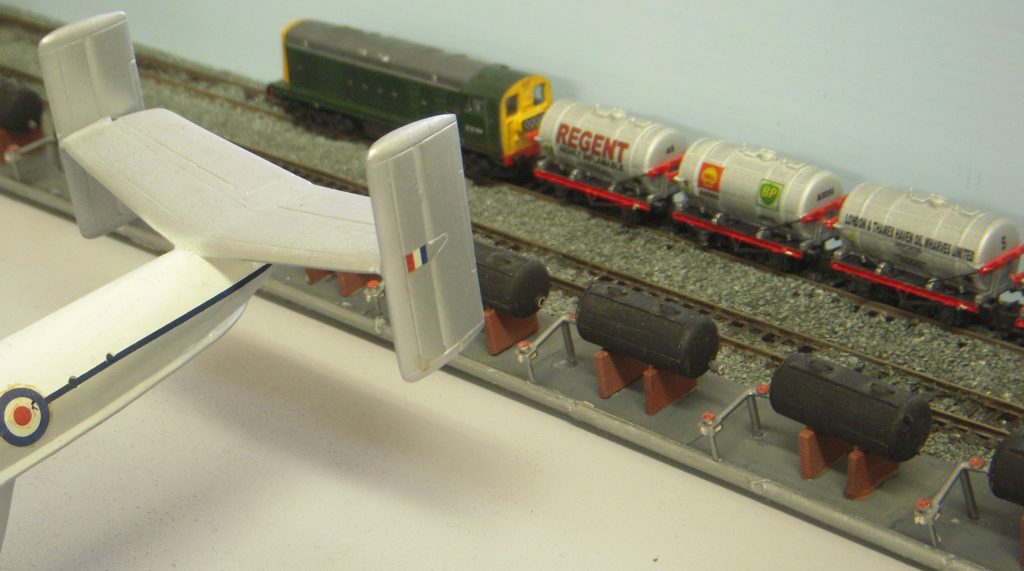
Oily End in the Bushey Area began with the concept of an easily accessible and transportable test track to which other components could be added to form a layout. These initially comprised a concrete airfield to display 1/144 scale aircraft from the Jet Age Museum Reserve Model Collection and an oil tank farm recycled from components previously used on another N gauge layout. This had been a “roundy” with British Railways late crest era freight trains held in a fiddle yard at the rear, moving to the front to cross on the passing loop of a single line. Without such a fiddle yard, locomotives and brake vans would have to be reconfigured out of public view at either end of the straight track. But rather than tunnel mouths or over-line buildings I opted to use wooded hillsides – the bushy areas of the title – made from scrap wood, Gorilla glue, paint, trees, flock powder and lichen. I also decided to describe the layout as being a branch line somewhere in rural Hertfordshire. Hence the play on the town of Bushey, within easy flying distance of both the Handley Page works at Radlett and those of de Havilland at Hatfield. In this picture an RAF Blackburn Beverley awaits refuelling from the tank farm while in the background English Electric Type 1 Bo-Bo D8144 hauls a train of Shell, BP and Regent petrol wagons.
Also contributing to the show were Mini Scenes by Tracey Lippett, the Gloucestershire Warwickshire Railway and modelling demonstrations by Andi Dell, Mark Begley, Trevor Hale, John Emerson and Steve Harrod.

Trade support was from Cheltenham Model Centre (Saturday only), RCSW Pre enjoyed model railways, Penduke Models scenic products and Stewart Blencowe books, pictures and railway ephemera.