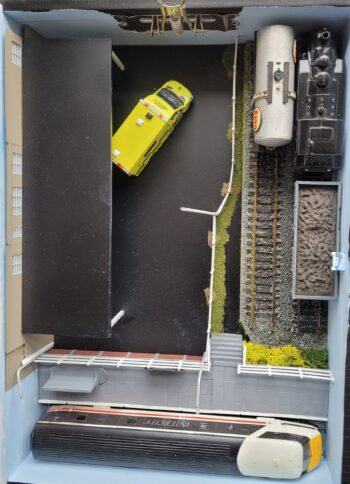
Following the success of the first Economics Diorama Box that I built for him, Mark Brassington asked me to make another to feature the beneficial-to-society merit goods of a hospital and a railway station as well as the negative externalities of power generation.
Externalities
An externality is a cost or benefit of an economic activity experienced by an unrelated third party. The external cost or benefit is not reflected in the final cost or benefit of a good or service.
Therefore, economists generally view externalities as a serious problem that makes markets inefficient, leading to market failures.
The primary cause of externalities is poorly defined property rights. The ambiguous ownership of certain things may create a situation when some market agents start to consume or produce more while the part of the cost or benefit is inherited or received by an unrelated party.
Environmental items, including air, water, and wildlife, are the most common examples of things with poorly defined property rights.
Generally, externalities are categorized as either negative or positive.
A negative externality is a negative consequence of an economic activity experienced by an unrelated third party.
The majority of externalities are negative. Some negative externalities, such as the different kinds of environmental pollution, are especially harmful due to their significant adverse effects.
Negative externalities are divided into production and consumption externalities.
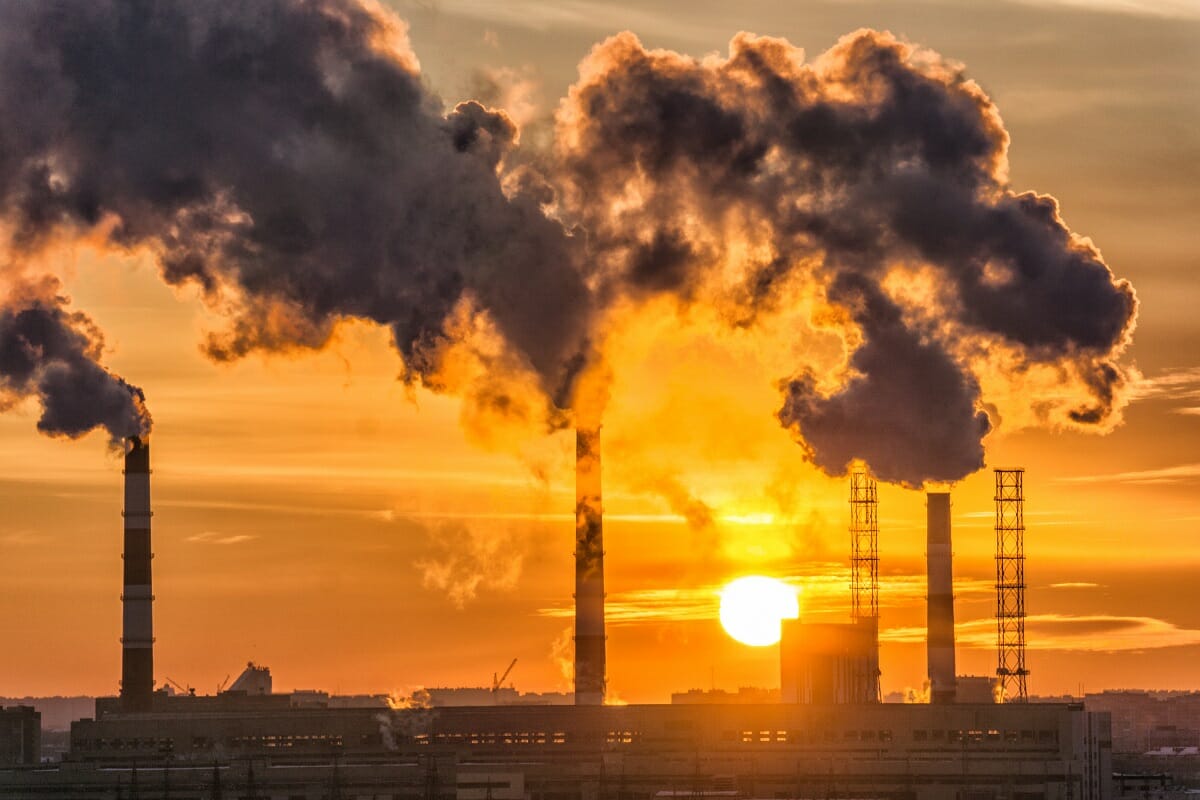
Examples of negative production externalities include air pollution. For example, if a factory burns fossil fuels to produce goods, the people living in the nearby area and the workers of the factory suffer from the deteriorating air quality.
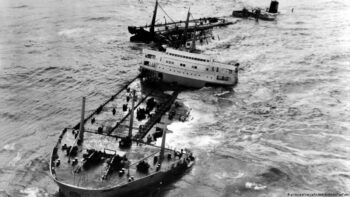
Similarly, water can be polluted if a tanker spills oil, destroying the wildlife in the sea and affecting the people living in coastal areas.
Likewise, people living near a large airport can suffer from high levels of noise pollution.
Some examples of negative consumption externalities meanwhile include passive smoking. Smoking results in negative effects not only on the health of a smoker but on the health of other people nearby.
Similarly, the more people that use cars on roads, the heavier the traffic congestion becomes. This makes travel slower and less pleasant and can lead to increased air pollution.
However, externalities can also offer positive benefits to an unrelated third party. Despite the benefits of economic activities that involve positive externalities, the externality also creates market inefficiencies.
Positive externalities can also be distinguished as production and consumption externalities.

Positive production externalities include infrastructure development. An example of this is the way that the Metropolitan Railway expanded from central London into the countryside of the Home Counties and created ‘Metro Land’ with garden suburbs near to stations. Property prices increased and estate agents earned higher commissions.
Similarly, a company that discovers a new technology as a result of research and development creates benefits that help society as a whole. One example of this is Sir Frank Whittle inventing the jet engine which now permits cheap overseas tourism and fresh foreign fruit in supermarkets – albeit at the price of aur and noise pollution.
Examples of positive consumption externalities meanwhile include individual education. The increased levels of an individual’s education can also raise economic productivity and reduce unemployment levels.

Similarly, vaccination against infectious diseases benefits not only the person vaccinated but other people in the community because the probability of being infected decreases. The investment in the vaccine is outweighed by the overall improvement in society.
Due to the adverse effect of both negative and positive externalities on market efficiency, economists and policymakers strive to address the problem. The “internalization” of the externalities is the process of adopting policies that would limit the effect of the externalities on unrelated parties. Generally, the internalization is achieved through government intervention.
Possible solutions include defining property rights. A strict definition of property rights can limit the influence of economic activities on unrelated parties. However, it is not always a viable option since the ownership of particular things such as air or water cannot be unambiguously assigned to a particular agent. Notice that, in the diorama, the sidings are fenced off from the hospital and station to help localise oil drips and discarded fire and smokebox ash and clinker although smoke, steam and diesel exhaust can still drift in the wind.

A government may also impose taxes on goods or services that create externalities. The taxes would discourage activities that impose costs on unrelated parties.
Approaching the issue from another direction, government can also provide subsidies to stimulate certain activities. The subsidies are commonly used to increase the consumption of goods with positive externalities.
Fitting out the box
With only two and three quarters of an inch headroom available, a 4mm scale coal fired power station of the type available in resin from Bachmann Scenecraft was not feasible so instead I used a steam locomotive and locomotive coal wagon and diesel shunter and fuel tank wagon to represent the fossil fuel pollution of old fashioned electricity generation.
In turn, these and the sidings they stood on had to fit in alongside the hospital and station, which in fact defined the box file needed due to the passenger vehicle used.
Given that this diorama box is designed to be used by teenage students, anything less than a modern train would be open to misinterpretation. However, most modern passenger trains are multiple units with models sold as sets and even the slightly larger lever arch box files sold by Rymans would only have room for one vehicle.
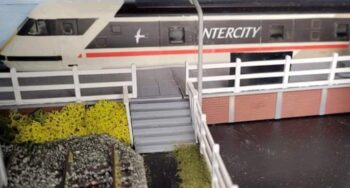
Happily, the solution was a single Mark 4 Driving Van Trailer (DVT), purchased second hand from Cheltenham Model Centre and which just fitted the width of the box. This featured a streamlined driving cab, indicating that it was one end of a passenger train, with the implication that more carriages and a locomotive were further along the two sections of Dapol (ex Airfix) platform.
The only other alternative that I could think of was building the Dapol (again ex Airfix) Park Royal four wheeled railcar and claiming that it was powered by hydrogen or some other new, clean technology.
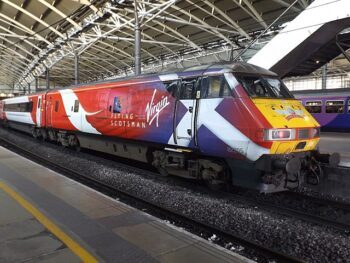
As it happens, Mark 4 DVTs are still very much in use, with 82205 still based at Bounds Green and used by LNER on the East Coast Main Line, albeit in a special Flying Scotsman advertising livery rather than the original InterCity 225 of the Hornby model.
Built from 1988 by Metropolitan Cammell with Swiss SIG bogies from 1988, the Mark 4 DVTs, do not have any passenger accommodation due to health and safety rules in place at the time of construction that prohibited passengers in the leading carriages of trains that run faster than 100 miles per hour (160 km/h). Historically, it was believed that a train would be unstable at high speeds unless pulled from the front but extensive testing, and the experience of high speed trains with central power cars such as have altered this view.
With body shells built under sub contract by Breda in Italy, the Mark 4 DVTs were designed to work with Mark 4 carriages and Class 91 electric locomotives although they have also been hauled by electric classes 89 and 90. The standard practice is for the DVT to be marshaled at the southern end of each IC225 set, adjacent to the first class carriages and nearest the buffer stops at King’s Cross.

After Hitachi Azuma Class 800 and 801 sets entered service with LNER in 2019, eight four-car Mark 4 sets with DVTs began operating the Premier Cardiff to Holyhead service, powered by Class 67 diesel electrics.
The Premier Service had formerly been known as the Gerald of Wales and had run via Crewe as a conventional train of carriages with a Class 57 locomotive at the front. The addition of DVTs allows the Premier Service to easily reverse at Chester and so take a more direct route from Shrewsbury via Wrexham.
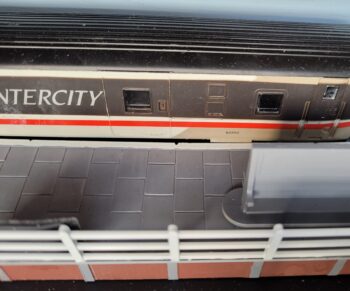
Placing DVT 82205 between the platform and the sky-blue box wall meant that the track it was stuck to didn’t need to be weathered and could even be inferred to have its own third rail electrification.
The platform itself was made of one and a half of the level sections supplied with the Dapol kit, sprayed Halford’s matt primer grey and with the hand detailed brick wall facing outermost.
The combined bench and running in name board was an old Triang item sourced from Jill’s Trains in Quedgeley, Gloucester, and decorated on the railway side by the word Hospital cut from a magazine advertisement. There is in fact a station with the name Christ’s Hospital in Sussex and how meritous would a station taking staff and patients to a hospital be?
Stopping further casualty admissions due to falls from the platform to the ambulance turning area, the rear of the platform was fenced with Dapol (ex Airfix) lineside kit C023. I chose this rather than C013 -Platform fencing and fittings – as I was on a budget, the set contained items I didn’t need and would have given a modern station an old fashioned look. I had also used more of the more bucolic C023 to fence off the sidings, but shorn of the lower parts of the vertical posts the elements work well as more modern platform fencing. The lower horizontal members glued firmly to the platform edge and the structure was amenable to advertising signs as additional windbreaks.
Further C023 offcuts were used as bannisters for the steps, which were made of square section extruded plastic rod. The steps and fence bases were then weathered with lichen bushes and flock grass.

Lack of time and money also influenced my choice of a steam tank engine to represent the externalities of ash, clinker and soot. I had thought of a Lancashire and Yorkshire Pug with the smokebox door open but while visiting Jill’s Trains in Quedgeley I noticed what I always thought of as a Triang clockwork 0-4-0T. This was in a distressed faux British Railways green livery, didn’t work and had a chunk out of the water tank on one side. However, it was priced at just £4.00. It didn’t need to work and if it was parked with the damaged side against the wall only the livery mattered.
It later turned out to be a Playcraft product originally and based on French locomotive practice but I always thought of it being American or, most convincingly, German. For this reason I sprayed it with Halford’s Gloss Back and then added the red, white and brass detail with Humbrol enamels.
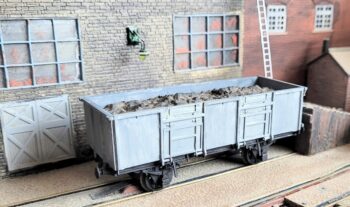
Also posed on my well lit Capital Works layout was a model of a steel locomotive coal wagon built from a kit. Originally assembled by the late Ron Brooks, this represented one of the long bodied trucks reserved for delivering highly calorific coal to locomotive depots.
1000 of the 21 ton coal wagons were built to diagram 1/110 in 1950/51 for British Railways by the Metro-Cammell company. Many were still in service in the late 1970s. Meanwhile, 2,150 of the larger 24 ton wagons were built in 1953 – 1956. Used to carry coal for steel works, power stations and engines sheds, they were intended as a replacement for the standard 16 ton mineral wagon, but were too large for many customers.
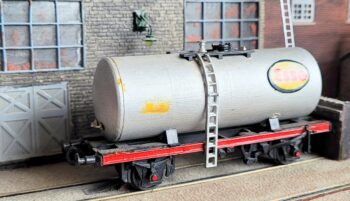
Having featured a number of ex Airfix Dapol kits, mention must be made of arguably the most famous tank wagon ever to appear as a 4mm scale injection moulded product: Esso Class B wagon 3300. This has a simple yet elegant twin-saddle attachment between cylinder and chassis although the 22′ 6″ cylinder noticeably stops short of the full length of the chassis ( 27′ 9 3/4″ over buffers ) and is far enough inside the loading gauge to permit sub-solebar length ladders to be attached amidships. Other visible refinements include roller bearing axle boxes and two brake blocks acting on each wheel. The latter were applied either by manual lever during shunting or by twin vacuum cylinders as part of a vacuum brake fitted train. Like later airbraked monocoque tank wagons, the buffers were either hydraulic or pneumatic.
This 15′ wheelbase Class B wagon was designed with the post 1955 Modernised British Railways in mind and intended to be run at over 45 mph without frequent inspection stops during transit. Such special treatment was made necessary by the general age and obsolescent design of Britain’s tank wagon fleets, which had not been Nationalised along with the rest of British Railway in 1948.

In 1956 the Esso Petroleum Company Limited approached British Railways to design a maximum capacity four wheeled tank wagon within the existing 35 ton gross laden weight limit and more than 800 examples of this pattern were constructed by various builders to carry both Class A and B liquids. Load discharges were to be controlled by an internal rod and plug operated by a handwheel on top of the tank barrel, some 12′ 6″ above rail level. The same wagon design was also built for operators such as TSL in the early 1950s by Powell Duffryn of Cardiff, later to absorb the remains of the Gloucester Railway Carriage and Wagon Company.
In the case of Esso’s black liveried Class B variants the loads would have included diesel fuel and kerosenes with steam coils fitted to assist the offloading of heavy fuel oils.
Unlike Class A tank wagons, Class B vehicles were permitted to be coupled next to guards vans and locomotives without any intervening barrier vehicle. As larger 100 ton bogie tank wagons became more prevalent in the 1960s, a number of the 15′ wheelbase wagons would have found their way on to private industrial railways, perhaps retaining their silver petrol livery and Esso branding.
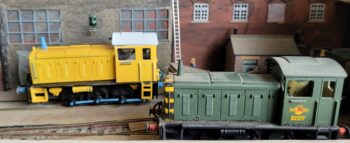
Introduced in 1952, the 141 diesel mechanical 0-6-0s numbered D2200 – D2340 and later known as Class 04 were among the first diesel locomotives mass produced for British Railways. However, although ordered from the Drewry Car Company, sub-contraction saw them actually assembled by other manufacturers. D2277, the green liveried subject of the 1959 vintage Airfix (now Dapol) kit seen above, had a service life of less than a decade due to the amount of wagon load freight being lost to road haulage. Despite this, a diesel shunter had the advantage over an equivalent steam tank engine that, like a bus or lorry, it could be instantly started and switched off. No early morning fire raising or disposal with dropping the fire and raking out clinker at the end of a working day. A well maintained diesel engine would also create less noise and pollution than a steam locomotive, offer greater thermal efficiency and a cleaner, more comfortable working environment.
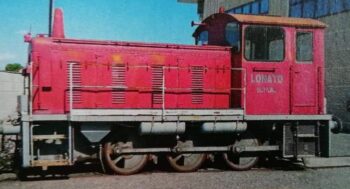
If further proof was needed that locomotives can move between countries, D2289 was recorded as withdrawn from Eastleigh in September 1971 and probably remained at the depot until moving to Shipbreaking (Queenborough) of Queenborough, Kent, about April 1972. It was then exported by sea in May 1972 to the port of La Spezia, Liguria, Italy, thence to Acciaierie di Lonato SpA, Lonato steel works, Brescia, Italy (company now known as Lonato SpA) and was still in use on 31 October 2009. When observed in 2015 it was no longer in working condition, the steelworks having become a sugar warehouse. In early 2018 an appeal to repatriate D2289 was launched. This was successful and it departed by road for England on 10 June 2018 and arrived at its new home, the Heritage Shunters Trust at Rowsley, Derbyshire three days later.
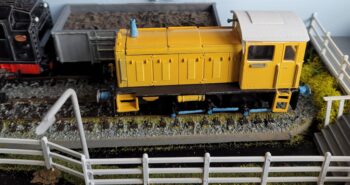
As no suitable spare plastic models of Class 04 were available ready built, I purchased one of the Dapol kits and built my own. This had the advantage of allowing me practice detailing and glazing the cab as well as inventing my own industrial livery – avoiding the fiddly black and yellow ‘wasp stripes’ of the green British Railways markings which are moulded into the radiator and cab back.
After an undercoat of primer, the cab roof and interior was painted white both as a practical feature to keep the crew cool in summer and also a stylistic nod to British Railways’ Stratford Depot in East London. Most of the wheels, frames and solebars were given a matt black finish while the outside of the cab and engine bonnet and steps, sand boxes and fuel tanks still on the sprue were sprayed Nissan Solar Gold with a rattle can left over from a previous project. This was economical, made the shunter highly visible and allowed the coupling rods, buffer beams and exhaust pipe to be painted blue in solidarity with the brave people of Ukraine.
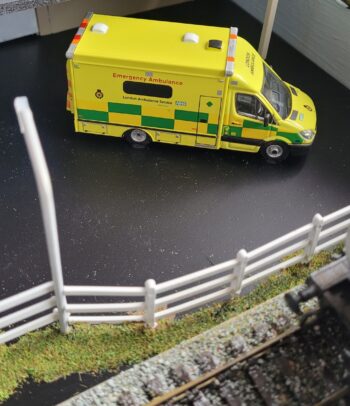
The four railway vehicles representing negative externalities were stuck to sections of track with rusted rails, the track being ballasted and stuck to a suitably sized piece of plywood. This in turn was stuck to the base of the box, partly overlapping with an A4 sheet of black plastic card representing a tarmac turning area for ambulances delivering patients to one entrance to the hospital.
As well as using different levels of ground to create interest, the spare Ratio modern lamp posts added detail to the diorama.
Considering the time and budget restrictions imposed on this project, one of the most satisfying parts was the low relief hospital building. I originally planned to order the Kingsway kit of the ambulance bay based on the BBC TV series ‘Casualty ‘ but then realised that I could make my own using the front and sides of the Dapol Modern Shop and Flat.
The lower half of this was obscured by a porch couchere made from black plastic card, stiffened and supported by square section extruded plastic rod, thus allowing patients to be unloaded without getting wet.
However, the gap where the shop front should have been was filled with translucent plastic card to represent frosted glass sliding doors and all the window frames filled but shorn of the heavy ledges and left unpainted as a contrast to the walls sprayed with Halford’s Camouflage Khaki, which is not so different from Cotswold stone.
Finally, the hospital had to be defined by an ambulance and a modern one at that. Luckily, the up to date Mercedes now seen all over Britain is now portrayed by Oxford Diecast. Among the regional versions, 76MA02 is as used by the London Ambulance Service, registered LX11 AFZ and decorated in the contemporary green and yellow ambulance colour scheme with red and yellow chevron effect across the rear and with side and rear windows masked black. The chassis and interior are both black.