
This diorama started as a simple box, covered in bent perspex, featuring a grass field bisected by a straight edged watercourse. Its original aim was to display some bridge laying Churchill tanks, variants of the 764 which were made by the Gloucester Railway Carriage and Wagon Company Limited during World War 2.
However, although the diorama can still be dismantled back to its basic state, it is even more interesting with modules representing an 00 gauge railway running line crossing a Dapol (previously Airfix) girder bridge and, behind it, a marshalling yard with one raised track, ideal for displaying the kind of two axle short wheelbase wagons that are now rarely seen on main lines in Britain.

For the 2019 Gloucestershire Steam Extravaganza though, Canal Bridge Yard represented the era of transition that began in the late 1960s.
Stylistically, monastral blue, the double arrow logo and rail alphabet were taking over from Brunswick Green, totem and hawkeye signs and the “Ferret and Dartboard” crest as seen on Class 04 diesel mechanical shunter D2277. In fact the 1959 vintage 0-6-0 had a service life of less than a decade due to the amount of wagon load freight being lost to road haulage.
Newer freight wagons however were being expected to run faster and carry heavier loads. And freight trains were operating in more efficient ways.
Rather than running from point of origin to destination via marshalling yards and different slow trains of many wagon types, wagons of one kind were being operated together direct between where the goods were located and where they were needed.

As well as “merry go round” coal trains constantly top loading hopper wagons at pits and unloading them by gravity at power stations, trains carrying standardised containers of dry goods were typical of the new way of operating freight railways.
Containerised freight had been used as far back as the 1830s on the Liverpool and Manchester Railway. But the container design recognised by the International Standards Organisation from 1968 was not only adopted by railways, road hauliers and shipping lines across the globe but could be safely stacked.
The containers also allowed consignments to be moved securely and efficiently from manufacturers to consignees without being broken down into smaller loads for dockside cranes and stevedores to handle. In 2010 ISO shipping containers accounted for 60% of the world’s seaborne trade and by 2012 there were over 20 million of them in varying twenty foot equivalent units.
British Railways operated its first Freightliner train from London to Scotland in 1965, the millionth container was moved in 1972 and Freightliner as a company itself was privatized from Railfreight Distribution in 1996.
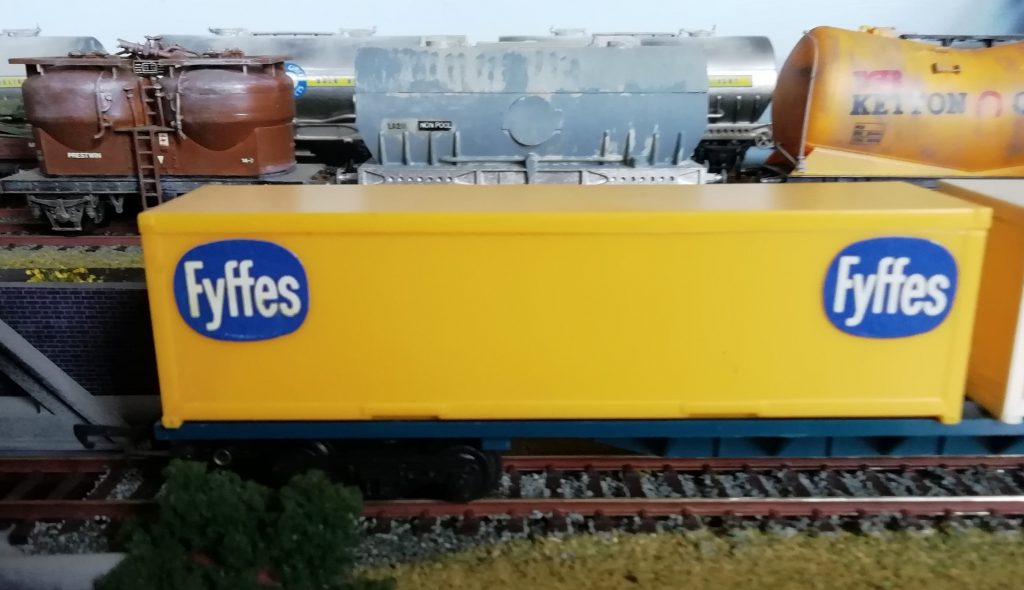
Early adopters of containerisation included Fyffes fruit and Tartan Arrow express parcels.
In 1888, Edward Fyffe, a London food wholesaler, began commercial imports of bananas. Then in 1897 he merged his business with Hudson Brothers, another importer to form Fyffe Hudson & Co. The business became so successful that they purchased land in the Canaries to be cultivated as banana plantations. Meanwhile, Elder Dempster & Company (a large shipping firm which traded in the Canaries) had observed the success of Fyffe & Hudson and followed suit. In 1898, Elder Dempster’s fruit importing business was extended to Jamaica.
To protect the island’s economy, the British government agreed to pay a subsidy of £40,000 a year to Elder Dempster to run a regular steamer service to Jamaica and bring large quantities of bananas to the British market. In May 1901 the firms merged and Elders & Fyffes Ltd was established in London. The following year 45% of the capital was purchased by the United Fruit Company of America. Thereafter, the business went from strength to strength using specially constructed ships that ensured the fruit arrived in good condition after the long Atlantic crossing.

Elders and Fyffes even inspired Britten-Norman Ltd of Bembridge on the Isle of Wight to build and evaluate their Cushioncraft CC1 – Britain’s second hovercraft – to study the potential of this type of vehicle for the carriage of bananas from overseas plantations
In May 1969, the company was renamed Fyffes Group Ltd, recognising the diversity and importance of its subsidiary companies. It became an Irish company following takeover by the Irish group FII plc in 1986 and was then acquired by the Japanese sogo shosha Sumitomo in February 2017 after which it was delisted from stock exchanges and became a private company.

Tartan Arrow meanwhile began container services in December 1966, as reported in Commercial Motor magazine of 16 December 1966
“DAILY trial of parcels containers railed by Tartan Arrow Service Ltd. at Kentish Town for road delivery ex-Bridgeton in Glasgow began this week.
Containers loaded at Tartan depots at Hackney Wick and Townmill Road are transferred by gantry crane at Kentish Town on to railway wagons. These are coupled to scheduled trains but Tartan will run its own special trains early next year.
The company has given broad details of the operating system envisaged. The special Tartan Arrow trains will be drawn up in each depot in two halves, each 650 ft. long. One half will comprise vans for parcels and packages weighing up to one ton. The other will consist of flat trucks for containers which have been packed by the consigner and collected by Tartan Arrow vehicles or delivered direct to the depot by customers. Discounts encourage customers to bring in their own goods.
Trains will be loaded between 9 a.m. and 8 p.m. daily. They will be made up to customers’ requirements and refrigerated and other specialized containers will be available.

Consignment note details, perhaps as many as 25,000 in any one night, are fed into a computer and the complete loading record is automatically transmitted from London to Glasgow (or vice versa) by landline, being available at the other terminal five minutes before the train leaves.
The computer in Scotland (or London) prints the delivery notes automatically. Parcels may be destined for up to 20 different areas in Glasgow and area cards produced by the computer will determine the number of vehicles required for each day’s deliveries.
It is planned to off-load the trains between 5.30 a.m. and 8.30 a.m., by which time all delivery vans will be away. To facilitate offloading the trains will again be broken into halves. Containers will be transferred to waiting lorries by crane, and parcels will be off-loaded by mechanical handling gear and moved on an automated conveyor to destination vehicle bays.
Off-loading will be directed by a controller in a control room equipped with closed-circuit television. He will be able to observe the progress of the operation and will be in touch with three assistant controllers on the unloading bays.”
Tartan Arrow eventually merged with National Carriers Limited in 1976.

Although Anglo Scottish Tartan Arrow services were mainly hauled by air braked Class 47 diesel electrics, I decided to please local diesel hydraulic enthusiasts by putting D1049 “Western Monarch” at the front of my Freightliner.
Introduced between the Decembers of 1961 and 1963, the Westerns were the most powerful diesel hydraulic class constructed for British service, the longest lasting of such in BR ownership and the pinnacle of non-steam locomotive design at Swindon.
By 1958 both national and regional echelons of British Railways saw that 2 200 horsepower diesel locomotives would not be sufficient to improve future train timetabling with extant loads. In particular the Paddington-Birmingham route was still too arduous for D800 Warships to supplant Great Western Kings and running the new diesel hydraulics would have been prohibitively expensive.
Searching for new motive power, Western Region management looked again to the German company of Krauss-Maffei whose latest produce was ML3000 – a 3000 horsepower C-C diesel hydraulic. Just as Deutsche Bundesbahn’s V200 class had been reinvented to create the D800 locomotives, so the Swindon Works drawing office set about designing a 2 700 bhp six axled machine to fit inside the British loading gauge.

Of the 74 units ordered in October 1959 D1000 – 1034 were to be Swindon built with the rest scheduled for construction at Crewe. As it turned out the Cheshire works also erected D1030-1034 but not before plans had been sent up from Swindon and stressed-skin building techniques taught.
Mechanically the new locomotives used all the best parts of the D800 series. The paired Bristol Siddeley Maybach MD 655 V12 powerplants of 1 350 horsepower at 1 500 rpm were developed from the MD 650 engines used in Swindon’s Warships. In contrast, NBL’s MAN prime movers had proved highly troublesome – although their Voith three stage transmissions were much smoother than the Mekydro equipment installed in Wiltshire. Gear changes in this semi-mechanical system could often be felt in the trains! Voith production for the D1000 programme was eventually split between North British in Glasgow and the parent company in Heidenheim, who had also supplied the V200s.
Meanwhile the appearance of the 108 ton 68′ long machines was created by Dr Sir Misha Black – also responsible for street name signs in the City of Westminster – and his assistant J. Beresford-Evans with styling concepts originally turned down for use on the D800s. A highly symmetrical shape emerged with crisp yet subtle lines and a bodyside curved to match Mark One coaching stock. Enhanced by long, proportionate sans-serif nameplates, the Westerns looked good in Desert Sand, green, maroon, golden ochre and Rail Blue liveries and gave their drivers an unrestricted forward view.

It is also interesting to note that before Western names were plumped for a Bulleid-like array of West Country beauty spots was considered: Cheddar Gorge being one choice for D1000 instead of Western Enterprise!
As with the B-B Warships, the C-C Krauss-Maffei bogies on the Westerns were found to be unstable at over 75 mph with torsional vibrations damaging transmissions. V200s had rarely run above this speed and so this fault had not been anticipated. Although adjustments were able to overcome this high speed hunting, the National Traction Plan of the 1960s condemned WR diesel hydraulics as difficult to maintain and non-standard with the rest of the BR fleet.
Despite being fitted with both AWS and, more importantly, train air brakes the Western’s light, compact fast-turning engines could not feasibly supply ETH current as well as the requisite oil-both torque.
Withdrawn between May 1973 and February 1977 – long before their useful lives were over – the Westerns (along with the Type 3 Hymeks) were the only diesel hydraulics to survive into the era of TOPS but – like the GWR steam locomotives they replaced – the cast number plates of the Westerns ensured that they kept their original numbers to the end.
D1049 “Western Monarch” was completed at Crewe on 14 December 1962 and was scrapped on 3 February 1977 at Swindon Works.
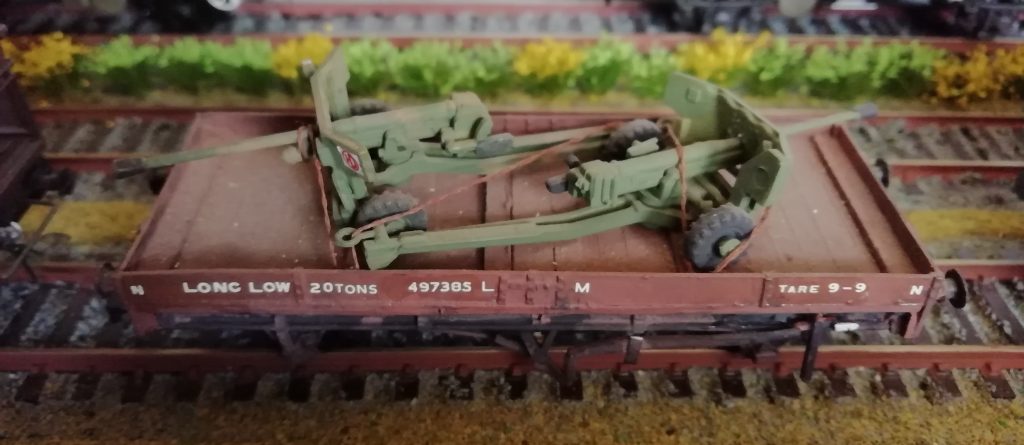
“Long Low” was the name given by the London Midland and Scottish Railway to their 22 ton plate wagons built on a 15′ wheelbase. Although the earliest examples had two plank wooden bodies, steel construction was standard by the late 1940s and examples of this type lasted into the early 1970s. British Railways developments of these wagons – designed to carry steel plate – even had roller bearing axleboxes, hydraulic buffers and vacuum brakes. Their drop sides also allowed road vehicles to be driven or rolled on to them from a loading dock.
497305, pictured above, is loaded with a pair of six pounder anti tank guns, in British army service from 1942 to 1960. However, they were also licence built in South Africa, Canada and the USA – as the 57mm M1 – and served with a number of foreign armies into the 1970s. In addition, Quick Firing 6 pounders – based on a 19th century naval design – could easily be on their way to Territorial Army or Army Cadet units, or even a museum.
Although work on a replacement for the earlier 2 pounder anti tank gun began in 1938, defeat at Dunkirk and the possibility of invasion in 1940 delayed production and deployment of the Ordnance 6 pounder until 1942, when it most often towed by the tracked Universal, or Bren gun, Carrier. Although nominally replaced by a brand new 17 pounder anti tank gun in 1943, the 6 pounder still proved a nimble and effective weapon.
The 6 pounder first saw action in May 1942 at Gazala, North Africa, where its armour piercing rounds could penetrate any enemy tank then in service. Although the standard 6 pounder shot was ineffective against the front armour of Germany’s later Panther and Tiger (pictured above) tanks it still proved effective on the less armoured sides and rear.
In fact 6 Pounder gunfire accounted for the first Tigers disabled in North Africa and from 1944 sabot rounds became available which could penetrate the Tiger’s frontal armour. However, by the end of World War Two, self propelled guns were favoured more than towed artillery as battle fronts became more fluid. The Airfix model Six Pounders are L50 barrelled Mark IV variants with muzzle brakes.

Machine wagons – known in many railway circles as “Lowmacs” and originally as Loriots on the Great Western – were built by all the Big Four British railway companies and ranged in capacity from 12 to 21 to 25 tons, as seen above in a vacuum brake fitted LNER variant designated Lowmac EP: the E denoting that the wagon’s movements had to be reported to Eastern Region wagon control. After Nationalisation, the Lowmac EP was adopted as a British Railways standard with the Diagram 2/242 and 28 examples were built by P W McLellan to Lot 2187 in 1950.
Normally Lowmacs had a warning board at one end prohibiting loose shunting and some Lancing built SR examples featured a solebar pocket where chains for securing loads were kept. Other BR built Lowmacs were adapted with air brakes, extra coupling chains and special buffers for Continental working and some LNER built wagons were later adapted to carry the waste from Britain’s first nuclear power stations.

The Airfix (now Dapol) kit is based on the 14 ton Lowmac EK, originally a Great Eastern Railway design and identified as Diagram 2/244. 52 were built by British Railways at Shildon to Lot 2475 in 1953 and Lot 2553 in 1954. Many were scrapped at the end of the 1960s and the few survivors often had mechanical diggers permanently attached.
The Lowmac EK – numbered B905021 in the Dapol model’s decal sheet – differs from the integral channel-section deck and solebar construction of the EP variant depicted above by having a higher cantilevered deck with more sharply tilted ramps, the flat section being supported by by five triangular brackets on each side.
Another recognition feature is the four inverse U-section metal buffer covers, allowing a vehicle to be driven along a rake of Lowmac EKs closely coupled together in a straight line. Without these covers, the EK resembles a smaller version of the 25 ton Great Western pattern Lowmac WE, built at Swindon to Lot 2975 in 1957 and with very similar Wiltshire-designed axleboxes.

Although now synonymous with earth moving equipment in the same way that all vacuum cleaners are called Hoovers, J.C. Bamford (Excavators) Limited began in 1945 with just Mr Joseph Cyril Bamford building agricultural trailers and Jeep conversions in a lock-up garage in Uttoxeter, Staffordshire, with a 50 shilling welding machine.
In 1948 he built what was probably the World’s first two wheeled hydraulic tipping trailer and then the first hydraulic loaders in Europe before designing and building his first hydraulic excavator, the JCB Mark 1, in 1954. This was essentially a farm tractor with a back hoe and stabilisers to take the weight off the rear wheels balanced by a system of weights between the wheels and at the front.
The more compact, elegant and useful JCB 3 of 1961 however featured dual hydraulics to work both a shovel at the front and a three-in-one backhoe loader which could dig square holes up to 11 feet deep. Indeed, the JCB 3’s other breakthrough was that the backhoe’s king post could slide on rails along the width of the vehicle and be locked to work in any position. A range of other attachments were also available, with power coming from a 51.8 bhp Fordson Super Major diesel engine to give a total lifting capacity of 4 600 lb.
Nowadays though it is rare to see road vehicles being moved on freight wagons, certainly open ones. The only major exceptions are new cars and smaller military vehicles. And many of these go from manufacturer to dealership or depot to barracks by lorry on motorways.

A whole range of BR built and pre-Nationalisation covered vans would have been in daily use in the 1950s – some planked, some plywood and some with corrugated ends – and used to carry anything from fruit to bagged cement: traffic that nowadays mainly goes by road.
For moving animal carcasses which did not require insulation, British Railways built 200 standard 10 ton Ventilated Meat vans in 1953 and 1954 to Diagram 1/250 – some of them at Wolverton to Lot 2320 – which were later the subject of an Airfix kit (seen below and heavily weathered) still available from Dapol. In later years when these wagons were put to more general use the end and side vents were sometimes removed.

On the left of the picture above is the Ministry of Transport slope-sided variant of the classic all-steel 16 ton mineral wagon. During the Second World War the Ministry of Transport had taken over Britain’s huge fleets of private owner coal and mineral wagons and many slope sided “16 ton mins” were built for it as part of the war effort by Charles Roberts of Wakefield, although Metropolitan Cammell also erected examples.
Many of these wagons also had bottom discharge doors, indicated by the presence of two sloping white lines on a black panel on the lower part of the side doors. However, by 1968 the slope-sided 16 ton mineral wagon would have been something of a rarity compared to the more numerous straight sided versions, some of which were built with bottom discharge doors but, similarly, no drop flaps above the side doors by the Royal Ordnance Factory at Woolwich as part of the run-down of ammunition manufacturing after the Second World War.

In the early 1950s The Gloucester Railway Carriage and Wagon Company also produced a steel 16 ton mineral wagon for the Ministry of Supply as well as a rivetted take on the basic format for British Railways Western Region and a corresponding all welded design for London Midland Region where the type had originated in the 1930s.
The arguably definitive variant of the 16 ton Mineral wagon, built by Derby Works under both LMS and BR ownership, lacked bottom discharge doors but did feature drop flaps above the side doors, the two ends of the wagon thus being held together by a steel bar in between. Enshrined as BR Diagram 1/108, these vehicles also lacked continuous vacuum brakes but were fitted with hand operated Morton brake gear applying one shoe to each wheel on one side only. In fact between 1950 and 1958 over 200 000 wagons were built to Diagram 1/108 by BR workshops and private builders in the biggest wagon building spree in British railway history. The 16 ton mineral wagon was also the basis for later doorless iron ore tippler wagons.
The 16 ton mineral wagons that were fitted with vacuum brakes actuating first four and then eight brake shoes – and were painted Bauxite rather than grey – were used for industry rather than individual small coal merchants, where the all-steel wagons had finally supplanted wooden bodied ex-Private Owner types by 1964. Indeed, as much wagon load traffic was lost to road transport at the end of the 1960s, many unfitted but welded 16 ton mineral wagons were rebuilt with vacuum brakes and continued to carry large amounts of coal until replaced by even larger hopper wagons in the 1970s.

By this time, too, although early pressed steel variants had come and gone, there were still a range of detail differences to be found on 16 ton mineral wagons including disc and spoked wheels, plain or ribbed brake levers, axleboxes, three link and Instanter couplings ( screw couplings being reserved for vacuum fitted vehicles ).
As well as wagon load traffic falling from two thirds of BR freight tonnage in 1968 to one fifth in 1976, the 1984 Miner’s Strike caused many 16 ton mineral wagons to be damaged by being stored loaded for long periods of time. After this time, too, the closure of many coalfields made large fleets of 16 ton mineral wagons redundant, most coal now being carried in merry-go-round trains of hopper wagons straight from ports to power stations.
The final use of the 16 ton mineral wagon was thus as a departmental ballast carrier, notably with rectangular holes burned into the sides half way up the bodies to prevent over-filling with spent ballast which is considerably more dense than coal.
As might be expected, the numerous and widely distributed 16 ton mineral wagon was soon represented in the 00 gauge railway boom of the 1950s with the Airfix kit being the best way to create an accurate model with the correct 9′ wheelbase. Early ready to run Wrenn, Graham Farish and Palitoy versions however had a body stretched to fit their standard 10′ wheelbase wagon chassis but recent releases seem to have rectified these issues

Although featuring some of the most modern and also most traditional freight wagons operating on British Railways in the late 1960s, my Canal Bridge Yard presentation also offered a chance to showcase models illustrating my article Gloucester RCW and Cement Wagons. These included the Blue Circle marked Presflo and bauxite liveried “twin tub” Prestwin but focused even more on the evolution of models of the later Cemflo.

Triang Hornby’s R 564 Bulk Cement Wagon model was re released in a totally fictional bright yellow plastic livery in 1972. But even in its earlier grey guise the body was hideously shortened to fit an existing long wheelbase chassis and moulded with ‘false’ solebars which were too wide just so that they fitted over those on the basic underframe. Furthermore, the chassis that Triang chose to use was fitted with a brake lever rather than control wheels and leaf spring rather than coil suspension. One of the special features of the Cemflo was that it was designed to be run in block trains and so would require little or no loose shunting. Similarly, the advanced suspension installed on Metropolitan Cammell examples would be the cause of the design’s downfall.
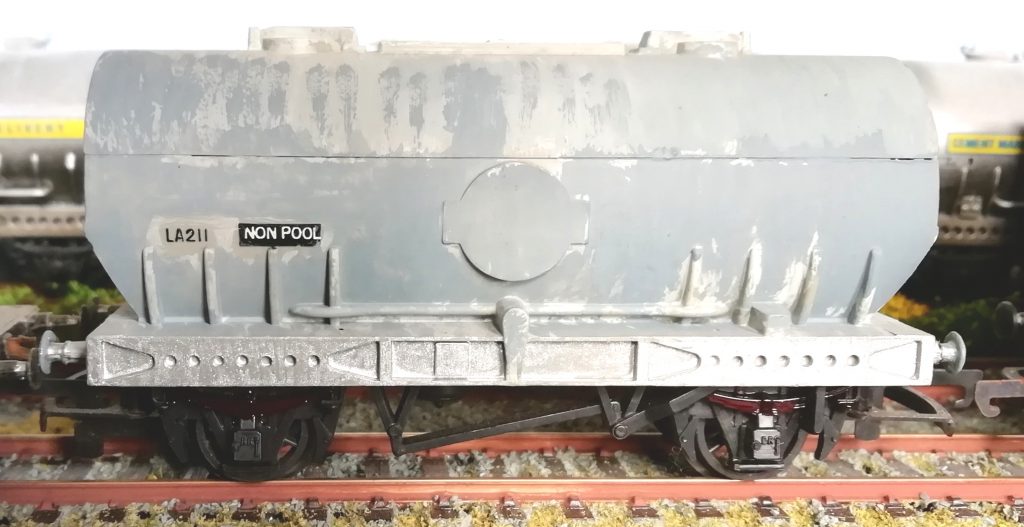
As a result, when I acquired a second hand grey example of R 564 missing many of its decals, I decided to experiment with weathering and also applied a version of the unique livery applied to Metropolitan Cammell built Cemflo LA236. This comprised of silver solebars and maroon suspension.

In all, 285 Cemflo wagons were built. The original batch of 190 light alloy vehicles, numbered LA 001 to LA 190, was built in 1961 by the Gloucester Carriage and Wagon Company Ltd.
The wagons were fitted with eyebolt and rubber auxiliary suspension,and originally incorporated 8-plate laminated springs. These were very stiff and, in combination with the naturally stiff tank body, produced a torsionally stiff vehicle which was prone to derailment when running empty. The suspension was then modified twice, in consultation with the British Railways Board. First to incorporate softer 9-plate springs and later 10-plate Duplex springs. The tyre profiles were also to the British Railways’ Number 9 standard.
A further batch of 94 Cemflos, numbered LA 200 to LA 293, was built by Metropolitan-Cammell Ltd. between 1963 and 1965. These wagons are fitted with a double-link suspension of the International Union of Railways (U.I.C.) type. The suspension was designed by Metropolitan Cammell and incorporated laminated springs. The tyres had Continental type profiles. This new design was again approved by the British Railways Board.

The Cemflo wagons are best known for use on cement traffic from Cliffe in Kent to Uddingston in Glasgow which saw them hauled by Kent to York by pairs of Class 33s. They were also seen on flows from Holborough Cement Works in Kent to Widnes in Lancashire.
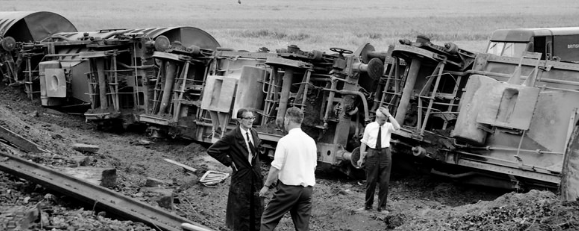
However by 1969 – and after the 1967 Thirsk disaster – they had been moved north and served Eastgate in Durham, Hope in the Peak District and Oxwellmains works near Dunbar amongst others. Traction included classes 25, 26, 27, 31, 33, 37, 40, 45, and 47 as well as BR ‘9F’ 2-10-0s and Gresley ‘A4’ 4-6-2 have all been noted hauling Cemflos.

Despite this history – and being the ancestor of all modern British cement wagons – only the 1960s moulded Triang Hornby caricature of the Cemflo was available for over half a century.
In 2015 however, the appearance of brand new Blue Circle transfers from both Cambridge Custom and Railtec brought me into contact with Mr Robert Bage of Tyne and Wear who very kindly built me an improved version of R 564.
Originally destined for display at the Jet Age Museum, this retained the inaccurate short body length but was transformed by new metal axleboxes, coil springs, brake wheels, above solebar piping and under solebar discharge equipment.
LA 101, pictured above with Butterley built Presflo PF20, featured the original open I-section solebars.

However, even better was to come as Mr Bage then built me a set of six correct-length Cemflos. Two of these – numbered 26 and 102 – were later displayed at the Jet Age Museum while numbers LA 19, 28, 49 (pictured above) and 76 were selected for Canal Bridge Yard. They feature all the refinements applied to LA 101 as well as 3D printed filler hatches and catwalks and the 14 round hole type solebar stiffeners applied to both Gloucester and Metropolitan Cammell built Cemflos. In line with their numbering, Bob’s weathered six also have the correct Gloucester type vacuum brake cylinders and suspension.
In early 2019, Accurascale Models brought out a ready to run Metropolitan Cammell Cemflo, similar to the sole survivor now at the Darlington Railway Preservation Society. This conforms to Diagram 6/430 but presents an additional challenge to any modeller hoping to convert it to a Gloucester RCW Cemflo. Further research has revealed that while Metropolitan Cammell wagons had round discharge pipes with a square flange reinforced by triangular fillets (furthest from the camera in the picture above) the Gloucester equivalents had bigger two – piece rectangular orifice. If any readers have any more pictures or other data on this subject please email me at alandrewettcityoftruro2000@yahoo.co.uk

The most modern wagon on the diorama is orange Ketton Cement liveried 9470, one of a batch of 15 built by BREL Doncaster in 1975. Numbered 9460 to 9474 and owned by Tiger Rail Leasing, they had the design code PC009B and the three character designation PCA, indicating a two axle cement wagon with air brakes. Fitted with Gloucester Pedestal suspension and Oleo buffers, they had a tare weight of 12.45 tonnes but a gross laden weight of 50.95 tonnes. Length was 27′ (8229 mm) and maximum speed 60 mph.
Originally the whole batch was outshopped in Ketton Cement’s light green livery but by 1992 only the first three of the batch were working to and from Ketton, now for Castle Cement. The rest, including 9470, were leased by CAIB to Albright & Wilson for their Whitehaven to West Thurrock sodium tripolyphosphate traffic flow and reliveried in blue green. By 1995 twelve of the batch had been stored but 9470 was noted at Bescot in Spring 1997.

The depressed centre, or chevron, design of cement wagon used by 9470 however dates back to 1966 when 51 examples were built by Metropolitan Cammell for Associated British Portland Cement. Numbered 9025 to 9075, their depressed centres encouraged the cement powder to fall into the central discharge area.

The two ton Karrier Bantam first appeared in the mid 1930s but – like the later Ford Fiesta and Volkswagen Golf – evolved in terms of capability and styling over the years until it was finally discontinued in 1970. Karrier began in 1908 as a car marque of the company founded by Herbert and Reginald Clayton in Huddersfield, West Yorkshire, in 1904 with Clayton and Company being changed to Karrier Motors Limited in 1920. Karrier became part of the Rootes Group in 1934 with production being moved to Luton, Bedfordshire and the Huddersfield factory closed.
Under Rootes ownership, Karrier trucks were generally smaller size than their sister, Commer brand, with “Bantam” models using 13 inch and “Gamecock” models using 16 inch wheels, to give lower loading height. Partly because of this, they were particularly popular with local authorities for varied applications, including highway maintenance tippers, refuse collection vehicles and street lighting maintenance tower wagons. Karrier trucks and chassis were also popular with airport operators and airlines for baggage handling trucks, water bowsers and toilet servicing.
In 1965 Commer and Karrier were merged with Dodge (UK) as part of Chrysler Europe and production moved to Dunstable, with Dodge branding becoming ubiquitous during the 1970s.