
Although we associate aerial bombardment by manned aircraft with the years following 1914, the technique can trace its origins to the First Italian War of Independence in 1849.
Venice, as a maritime empire, had been independent for more than 1 000 years before it was conquered in 1797 by Napoleon, who ceded it to Austria. In 1848 the Italian patriot Daniele Manin declared Venice a Republic and the Austrians retaliated with a blockade.
As the Venetians held out despite starvation and disease, young Austrian officer Franz von Uchatius noticed that the prevailing wind blew from the sea. As a result, the Austrian army launched 200 unmanned bomb carrying hot air balloons towards Venice both from land bases and the paddle steamer SMS Vulcano.
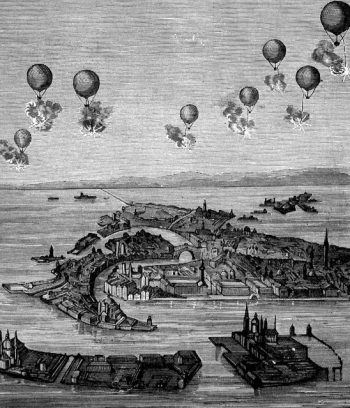
Unfortunately no records survive of the release mechanism of the 30 lb bombs carried by these paper balloons but it is thought that they used a timed fuse of some sort.
Although one of the bombs exploded in St Mark’s Square and caused little damage, most of the balloons missed their target and as the wind unexpectedly changed, sending a number back to explode over the besiegers.
Eventually the Austrians brought in heavy artillery, bombarding Venice with more than 1 000 rounds a day before its eventual surrender.
Similarly, aerial bombardment as a practical military tactic would have to wait for flying vehicles to be precisely guided, be they heavier or lighter than air. Following the Wright Brother’s Flyer of 1903, the first bombs were dropped from an aeroplane by Italian pilot Guilio Gavotti during the Italo Turkish War on 1 November 1911. The First Balkan War of 1912 saw more widespread use of aerial bombardment.
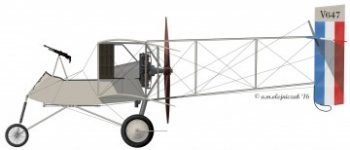
The first recognised dedicated bomber aircraft was the French Voisin III but the first bombing raid of the First World War was carried out by a German Zeppelin airship on Liege, Belgium, on 5 and 6 August 1914.
24 December 1914 saw a German seaplane make the first aerial bombardment of Britain although more destructive Zeppelin raids began in January 1915, reaching London by May 1915.
In all, 51 German bombing raids were carried out on Britain during the First World War with 5 000 bombs dropped, 557 people killed and 1 358 injured.
To begin with, the Zeppelins, flying at up to 10 000 feet, seemed unassailable by either fighter aircraft or artillery.
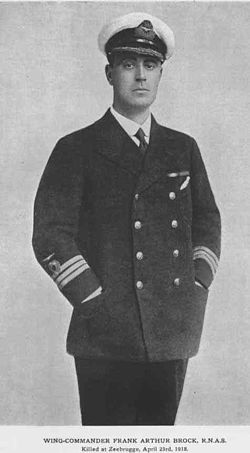
But the Germans had not reckoned on Frank Arthur Brock. A scion of the Brock family who had made and displayed fireworks for eight generations since the early 1700s, Frank Brock had blown up a stove at London’s Dulwich College before staging pyrotechnic shows all over the world as a teenager.
These displays included one at Spithead in 1905 to welcome the French Fleet, causing the Royal Navy to co opt Frank into their secret development department. By the time that war broke out he had invented smoke screen devices, and on the afternoon of his wedding day in October 1914 Lieutenant F. A. Brock left for France on a hazardous top secret mission.
Posing as commercial travellers, Frank and another officer used false papers to cross into neutral Switzerland before waiting for nightfall. They then rowed across Lake Constance to survey the Zeppelin base at Friedrchshafen, knowing that they would be shot as spies if they were caught.
After a tense 24 hours on German soil, they returned to Switzerland with a detailed map of the installation, which allowed First Lord of the Admiralty Winston Churchill to order the World’s first strategic bombing raid.

On 21 November 1914 three French based Avro 504 biplanes of the Royal Naval Air Service bombed the Zeppelin hangars at Friedrichshaven on the shores of Lake Constance. Taking off from an airfield at Belfort from 0930, the aircraft of Squadron Commander Edward Briggs, Flight Commander John Babington and Flight Lieutenant Sydney Sippe each carried four 20 lb bombs.
Later widely used as training aircraft, the 504s were converted to carry these bombs by Avro employee Roy Chadwick, later to design the Anson, Lancaster and Vulcan bombers.
During the raid, Briggs was forced to crash land after shrapnel punctured his fuel tank. A crowd of angry Zeppelin workers rushed towards him and he only escaped a beating when a German army officer threatened to shoot anyone who laid a hand on him.
The raid by the three Avros caused relatively little damage but the attack made the German government realise that their airships were vulnerable and that they were best defended by being used in attack, despite Kaiser Wilhelm II’s reluctance to destroy the historic buildings of London, the capital city of his cousin King George V.

By this time however, Frank Brock was at a secret base on the Hoo Peninsula, Kent, developing a Zeppelin busting bullet. He knew that punctures to the outer skin of an airship could be quickly patched by the sail makers on board but that an incendiary bullet exploding on contact could ignite hydrogen and surrounding air into a fireball. After a more than a year of shooting experimental bullets from a rifle at special targets, Frank’s new ammunition was ready to go into service.
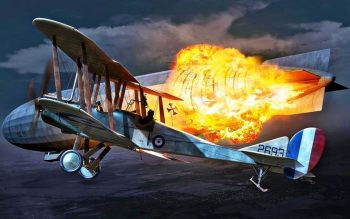
At 0200 on 4 September 1916, 39 Squadron’s Lieutenant William Leefe Robinson – flying at 10 000 feet – became the first man to shoot down a German airship – the plywood framed Schutte-Lanze 11 – over British soil when it burst into flames and crashed behind The Plough Inn, Cuffley, Hertfordshire. For this act he was promoted to Captain and awarded the Victoria Cross two days later.
Never one to rest on his laurels, Frank Brock declared to a relative, “I have finished the Zeppelins. Now I am going to do for the submarines”.
From the earliest days of the conflict, German U-boats had sunk vast amounts of British shipping and threatened to blockade the island nation. Of particular concern was the largely unrestricted passage of surfaced U-boats through the Straits of Dover at night.
Frank’s solution was the Dover Flare, a ship launched explosive device which, in the words of one observer, lit up the Channel at night “as bright as Piccadilly”. This forced the U-boats to dive among an array of nets and sub surface mines, the first one being destroyed within hours of the first Dover Flare being used.
As he had already proved on Lake Constance, Frank was just as much a man of action as a back room boffin. A qualified pilot, he was also an excellent swimmer, golfer, boxer and rifle shot and played football and rugby.
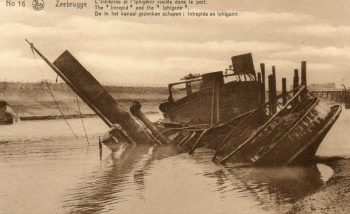
All these skills came in useful on St George’s Day 1918 when he joined a Royal Navy raid on the German U-boat base at Zebrugge, Belgium. Frank had already developed the most powerful smokescreen ever to hide the attacking fleet but rather than waiting in the relative safety of a ship, he leapt ashore.
With a cry of “Come on you boys” and armed with two pistols, a cutlass, a knuckleduster and several hand grenades, Frank singlehandedly scattered a gun crew before taking on a torpedo boat crewman in hand to hand combat. This was quite possibly the last time that a British Naval officer used a cutlass in action.
But Frank was never seen again. He may have been one of two unidentified British officers whose bodies were later retrieved by the Germans and buried in Zebrugge.