
From their foundation in a recognisably modern form between Liverpool and Manchester in 1830, railways revolutionised the world of land transport by the end of the Nineteenth Century. Unlike the often poorly maintained roads of the period they offered the bulk carriage of goods at speed and allowed ordinary people to travel and think beyond the confines of their own villages. They were also easier and cheaper to build than canals and could climb hills without locks.
However, despite the passage of the Light Railways Act in 1896 and the addition of narrow gauge feeder lines such as the Lynton and Barnstaple, railways could not economically or practically go everywhere.
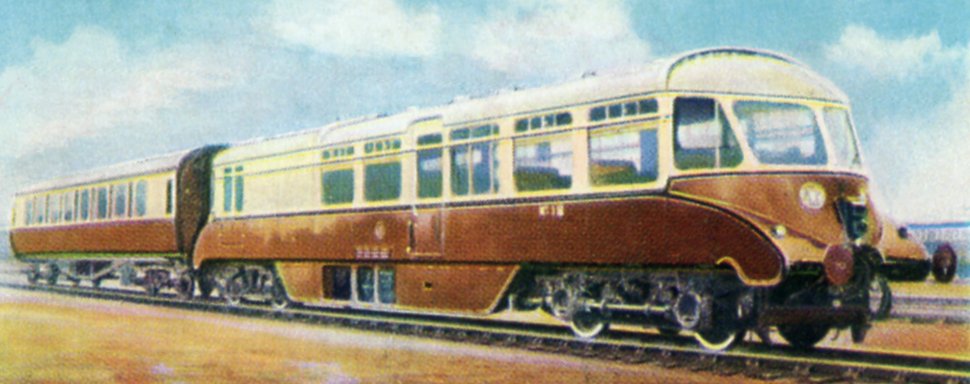
In urban areas horse and – from 1885 – electric tram networks offered an alternative to conventional railways, prompting the introduction of rapidly accelerating autocoach and steam railcar services on many local lines. These in turn were supplanted by petrol and diesel railcars – which shared the advantage of being able to be driven from either end and added the bonus of greater thermal efficiency, cleaner conditions and easier use by smaller numbers of personnel.
Gloucester RCW’s railcar 18 of April 1937 also broke new ground as it was fitted with conventional buffers, drawgear, vacuum brake hoses and a lower geared transmission to allow it to haul a 60 ton trailing load. It was also mounted on more substantial bogies – designed not to be covered by air-smoothing valences – which took its weight to 33.6 tons and even had control lines to work with a Great Western auto-trailer and be driven from an auto-trailer’s cab.
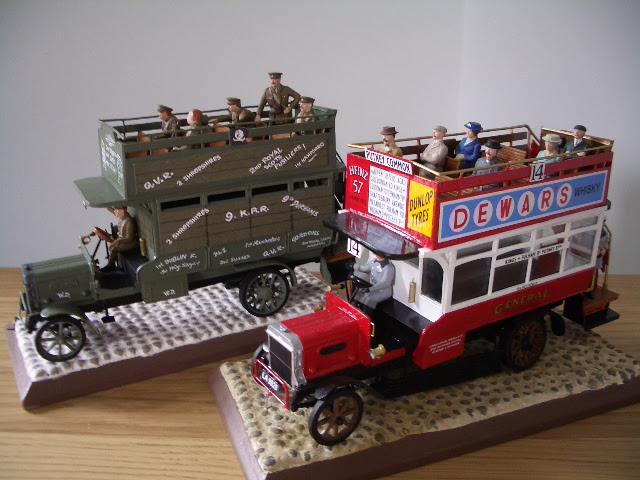
But even by 1914, the roads of Britain were being travelled by trolleybuses – still dependent on overhead electric wires but steerable – and truly independent motor buses, lorries and vans. These latter vehicles came into their own during the two World Wars of the Twentieth Century with the resultant post War vehicle surpluses and large numbers of people being able to drive.
At the same time, railways were first grouped into four large companies in 1923 and then taken into public ownership in 1948. But in each case the ravages of war were not countered by appropriate rebuilding and investment.

On the face of it, cheaper and more flexible cars, lorries and buses appeared to be the natural enemies of railways. And under laissez-faire capitalism this situation has sadly come to pass. From the opening of the Preston Bypass ( now part of the M6) in 1958, Harold Macmillan’s Conservative government invested heavily in a network of motorways and bypasses which in turn paved the way for Margaret Thatcher’s “Great Car Economy” of consumer choice and factories adapting to “just in time” production methods rather than stockpiling components. At the same time, despite the 1955 Modernisation Plan, the nationalised railways of Britain were denied the same levels of investment that had been lavished on the post War rebuilding and electrification of railways in Germany and France.
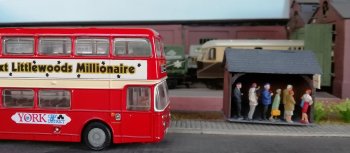
Indeed, on Continental Europe, a better “joined up” approach to public passenger transport united long distance and local trains with civic bus networks and in turn reduced the demand for private car use.
However, due to the nature of local demand, joined up buses, trains, trams and even cable cars have long been the hallmark of London Transport. Not least in their progress in ticketing. From the Twopenny Tube of 1900 and Oyster Cards, Transport for London’s “tap in tap out” debit card system now looks set to be rolled out across Britain as a more modern alternative to paper and cardboard.
Integration Station celebrates this kind of partnership with buses of many companies arriving at the bus stop outside Universal Works, where railway passenger and freight vehicles also work in harmony.
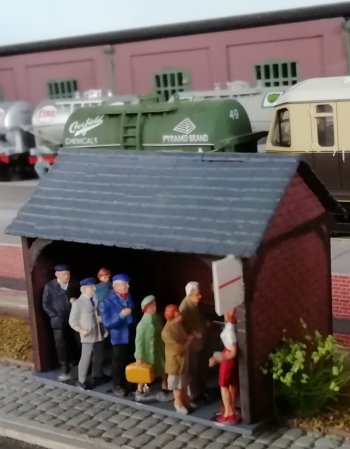
One of the conundrums of promoting public transport is that the fewer people that use buses, trains and trams the less money governments are prepared to spend on both vehicles and infrastructure. But most people would only willingly leave their cars at home if public transport was reliable, frequent, affordable and comfortable. Many modern bus operators frequently update their fleets with PSVs offering air conditioning, wi-fi and phone charging but waiting for a bus also has to be appealing.
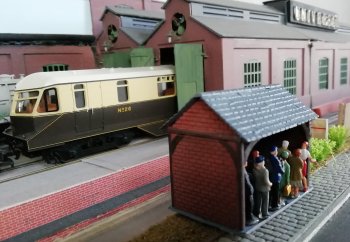
The ideal bus stop would be instantly identifiable, offer some kind of shelter from the elements, possibly with a seat for less frequent services, be well maintained and crucially keep potential passengers updated on the arrival time of the next bus. This should at least be an up to date timetable but better still an electronic display with real time information.
The most cost effective method of providing these features is through standardised pre fabricated units but bus stops that compliment their immediate environment help bring joy to life.
Classic examples are the stops outside Miss Selfridge in Birmingham and the Art Deco De La Warr Pavilion in Bexhill on Sea. In light of this, I selected Wills SS75 pattern bus shelter kit to echo the red brickwork and grey tiled roofs of Universal Works itself, adding a grey concrete base and white bus company stop sign made of plastic card. The horizontal red stripe is in fact a leftover decal from the Revell 1/144 scale kit of the black liveried Grumman F-14 Tomcat. This shelter was designed to be portable for use on other dioramas and layouts as the need arises.
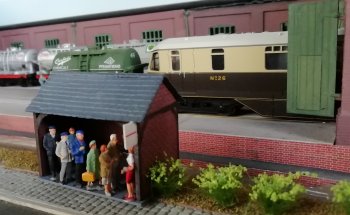
Hornby model R2524A represents GWR railcar 26. Following the success of Gloucester RCW bodied railcar 18, in February 1938 the GWR Chairman told the company’s annual meeting that 20 more diesel railcars were being ordered. With almost a million miles run by the first 18 examples, he said that:
“Whilst the original intention was to use them to provide additional services where the traffic was insufficient to justify the working of a train, our experience is that owing to the increasing cost of operating steam locomotives considerable economy can be effected by replacing them with diesel cars on certain sections”.
Railcars 19-38 were constructed in-house at Swindon with AEC supplying transmissions and pairs of AEC direct injection engines rated at 105 bhp. Deliveries – from July 1940 to February 1942 – also coincided with the early years of the Second World War and this final batch of railcars had clasp instead of drum brakes, more angular utilitarian bodies and 48 seats in 2+2 formation. Weights for railcars 19-33 were 35.65 tons and costs £ 6 240 apiece.
The performance of Gloucester RCW built car 18 had proved so influential that all but 19 and 20 of the Swindon built batch were permanently geared for a maximum speed of 40 mph and sufficient tractive effort to haul a trailing load. Railcars 19 and 20 had special dual-range gearboxes which gave the options of 60mph fast running or a higher tractive effort at low speed.

Railcar 26 was built in September 1940 and, along with the rest of number block 21-27, was stored at Cherry Orchard near Cardiff until being introduced to Cheltenham depot in March 1942. Built to GWR diagram A1 and carriage lot 1635 it was allocated to Lemington Spa in 1947 and was withdrawn from Worcester in October 1962.
As new Modernisation Plan DMUs began to flood onto British Railways in 1961 many of the ex GWR railcars became concentrated in the Worcester, Severn Valley and Tenbury Wells areas.
All ex GWR railcars were retired in 1962 but three survive in preservation: AEC/Park Royal built 4 at Swindon and Swindon built numbers 20 and 22 on the Kent & East Sussex Railway and at Didcot respectively
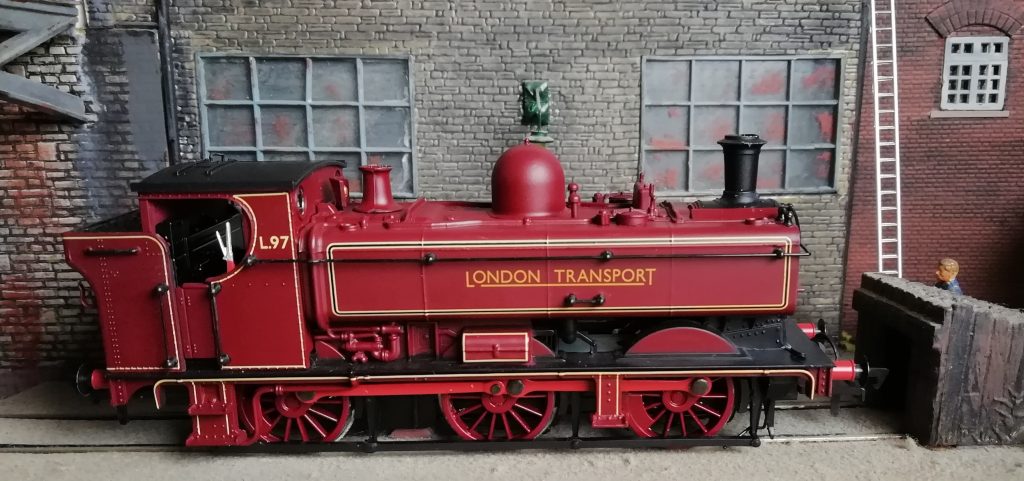
Meanwhile 863 examples of the 5700 Class 0-6-0PT were built between 1929 and 1950, making them the most prolific class of GWR locomotives and one of the most numerous classes in the annals of British steam.

In fact side mounted 0-6-0 pannier tank designs were a distinctive feature of the Great Western Railway , offering the ability to utilise the efficient Belpaire firebox while retaining access to the cylinders, rods and valve gear between the frames without a significant loss of water capacity. These were developed from older designs of saddle tank, many of which were later adapted with pannier tanks to accomodate new Belpaire boilers.
The thirteenth 5700 class locomotives sold to London Transport were also the last steam locomotives to work ‘in service’ on the national railway network.
Although the London underground network had been electrified for many years (the then Metropolitan railway was electrified in 1905) a small number of steam locomotives were retained for engineering and ballast trains.

By the 1950s the locomotives were past their prime and expensive to maintain, and the planned quadrupling of part of the Metropolitan Main Line would require reliable locomotives. London Transport considered replacing the steam fleet with diesel shunters, and had also tested (unsuccessfully) a Great Northern Railway Class J52 locomotive in 1955.
The first Class 5700 locomotive, Great Western Railway number 7711, underwent trials from January to April 1956, first running between Finchley Road and Baker Street.
Modifications were needed to the cab for clearance and the tripcock brake valves after problems were found when running in reverse. Curtains were also fitted to the cab to reduce smoke and fumes in tunnels. In May, the 5700s became standard for engineering trains on London Transport when they bought GWR number 7711 (for £3,160), decided to buy another ( GWR number 5752), and planned to buy more in the future.
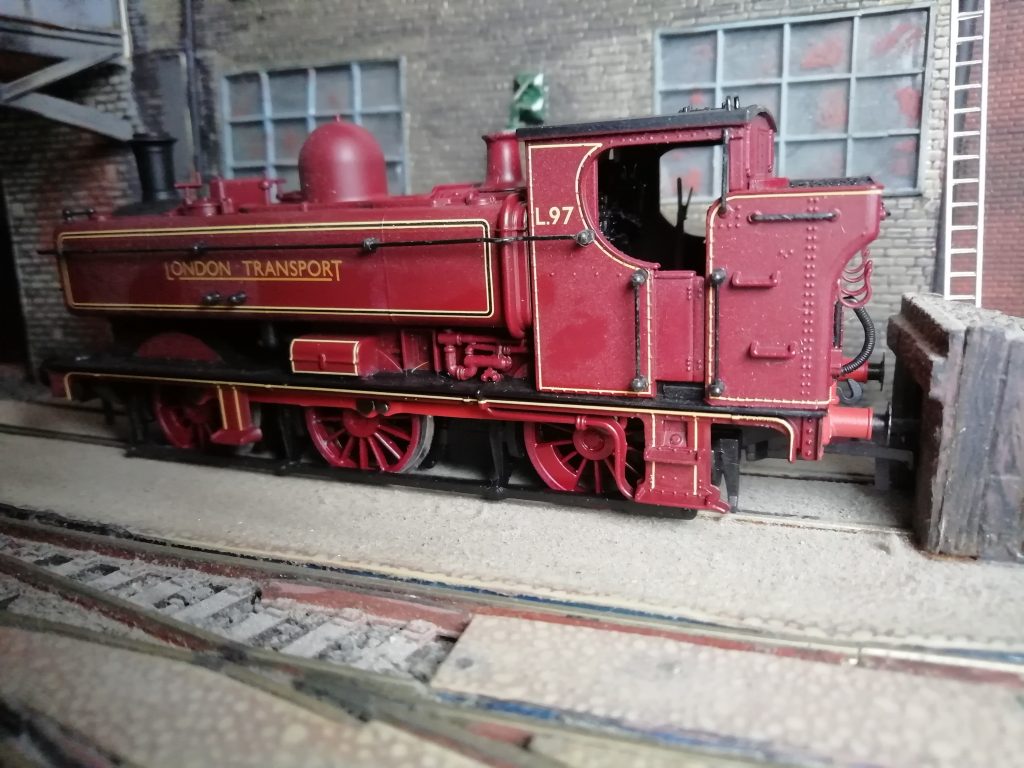
In all, thirteen 5700s were bought by London Transport from 1956 to 1963. They were numbered L89 to L99 and were allocated to the depots at Lillie Bridge, Fulham and Neasden.
Only eleven were running at any one time, the original L90 and L91 were withdrawn for repairs but scrapped instead and replaced by other locomotives which carried the same number.
They worked permanent way trains and were never used on normal passenger services. Main line running included trips between depots, to Acton Works and runs out to Croxley Tip, near Watford.
Three of the LT 5700s lasted until the end of steam on London Transport in 1971 and were the last steam locomotives used for regular mainline working in the UK.
London Transport commemorated the end of operating steam locomotives with a special run from Moorgate station to Neasden depot. The train was hauled by pannier tank L94 (formerly GWR 7752) and a selection of maintenance rolling stock. London Transport shunting was then performed by three diesel hydraulic locomotives.
L97 was the last but two of the Class 5700 0-6-0PTs acquired by London Transport, the 1930 built former 7749 leaving British Railways Western Region in 1962 and unfortunately being scrapped in 1970. However, a number of other ex London Transport Class 5700s have survived into preservation.