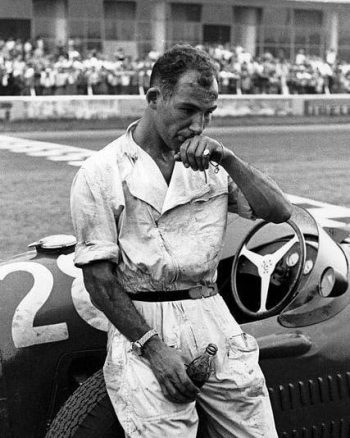
When Sir Stirling Moss died on 12 April 2020, not only did the world of motor racing lose a legend but I realised how much his career had influenced my writing on the subject.
As such, with a wealth of new information becoming available, I would like to present a tribute to the 90 year old British icon.
Having first driven aged seven, Stirling Craufurd Moss won his first Formula 3 motor race on 18 September 1948, the day after his 19th birthday. Driving a Cooper-JAP at the brand new Goodwood circuit, he won the three lap six minute race by nearly 30 seconds.
Moss’s career, but luckily not his life, was also to end at Goodwood on St George’s Day 1962 when, chasing Graham Hill, his V8 hybrid F1 Lotus left the track and hit an earth bank at 130 mph. The crash put him in a coma for a month and paralysed the left side of his body for six months.
After recovering from the physical and neurological injuries of the Goodwood crash, Moss, then 32, said that he was retiring because he could no longer drive and simultaneously wave at a pretty girl in the crowd.
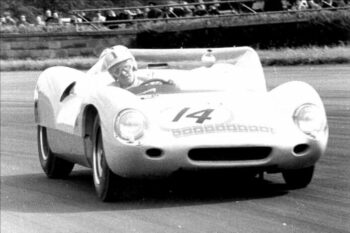
In fact April 1963 saw him return to Goodwood to test his post recovery reactions in a 1960 Lotus 19 Monte Carlo that Jim Clark had driven to a Silverstone win in 1962.
Despite being only a few tenths of a second slower than normal in the 240 bhp pistachio coloured speedster, Moss decided not to return to competition.
The Lotus 19 Monte Carlo was also driven by Graham Hill and was sold by Silverstone Auctions on 27 March 2021 along with original race programmes and papers.
2021 also saw the Matra MS 670 racing car in which Graham Hill and Henri Pescarolo won the 1972 Le Man’s 24 Hour Race sell for £ 6 million.
In Formula One alone, Stirling Moss achieved 67 starts, 16 wins, 24 podiums, 16 pole positions, 19 fastest laps and 185 points. Stirling Moss was also runner up to the F1 World Champion four times (1955 to 1958).
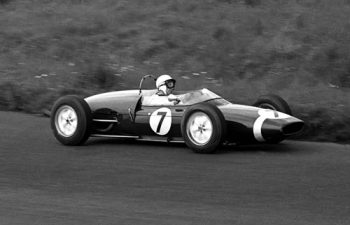
Although Stirling Moss never won a Formula 1 World Championship his skill on the track was impressive, not least his victorious defiance of Ferrari at the Nurburgring in 1961 in a vastly inferior Lotus with admittedly his favourite number 7.
His spirit of sportsmanship also shone out at the 1958 Portuguese Grand Prix when he persuaded race officials to reinstate his rival Mike Hawthorn after a technical infringement. Hawthorn went on to win the F1 World Championship by one point.
Although having driven Mercedes in distance races, Moss said of F1 that it was better to lose honourably in a British car than win a foreign one.
In all Stirling Moss won 212 of his 529 career races in 84 different cars – more than a third.
What is even more remarkable is that the figure of 529 races does not include Stirling’s participation in hill climbs ( his first being at Prescott in Gloucestershire) , rallies, speed records or speed trials. In fact the only form of motor competition that eluded him was the Indianapolis 500, despite his father Alfred having entered the event twice. Stirling’s younger sister Pat also became a successful rally driver.
The credo of Stirling Moss was “As a racer, one should go for it, as fast as possible”
Because he was often forced to retire, Stirling Moss, he generated a reputation as a car breaker, but this was unfair as he often preferred to drive for independent, non-factory teams, few of which were well equipped or funded and thus often unreliable. However, until being reconciled with Enzo Ferrari in 1961, Moss enjoyed beating the Modena factory team in a number of privately entered Ferraris, which he unreservedly praised.
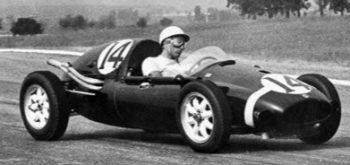
The 1958 Argentine Grand Prix for example saw Stirling Moss take the chequered flag in Rob Walker’s privately entered Cooper T43 (race number 14) ahead of the entire Ferrari works team of Dino 246s, a situation that he would replicate twice at Monaco. Had it not been for Moss’s permanent retirement after Goodwood in 1962, Ferrari might well have built a team around him.
As it was, Argentina in 1958 was the first F1 win for a rear-engined car, the first for a privateer team and the first for a chassis built by the Cooper Car Company.
Stirling was not only one of the few professionals at his chosen sport in the 1950s, it was his only activity. Many of his contemporaries funded their own racing through the motor trade or industry connections or simply because they were leisured or sponsored. But Moss always paid, sometimes handsomely, for his efforts and he was regarded as a sound investment for his insights as a development driver as much for his wins. He was also teetotal, which was an advantage against some opponents.
Before Goodwood in 1962, Stirling Moss crashed at Naples, Castle Coombe, Silverstone, Caracas, Monza and Spa – in the last instance in 1960 breaking both legs and his back. He told his authorised biographer Robert Edwards ” A racing driver will crash, if he’s doing his job properly”.
As he progressed through the minor motor sport formulae, some regarded him as being too fast for his own good, but the great Italian driver Tazio Nuvolari was said to have commented in 1949: “Watch him. He will be one of the great ones”.

As it happened, Moss had struggled to obtain good works drives until he won the wet and windy 1950 Ulster Tourist Trophy race at Dundrod in a borrowed Jaguar XK120, having been turned down for a factory entry. He was promptly invited to lead the Jaguar works team, which he did until 1954. In fact Moss would go on to win the Ulster TT in Jaguars, Aston Martins and Ferraris.

In 1953 Tony Rolt and Duncan Hamilton finished first at the Le Mans 24 Hour Race in a C Type Jaguar with second place going to another C-Type driven by Stirling Moss and Peter Walker. Stirling Moss also won the 12 hours of Reims in 1953 and 12 hours of Sebring in 1954.
Despite this, Formula One success eluded Stirling Moss until he bought his own Maserati, in which he campaigned as a private entrant unless it suited the works to support him. His efforts – thirteenth place in the World Championship – earned him a contract with Mercedes Benz for the 1955 season, at which point his career took off.
He was teamed with the great Juan Manuel Fangio who became his friend and mentor.

Derived from Rudolf Uhlenhaut’s W194 Grand Prix design in 1954 was the Mercedes Benz 300 SLR (Sports Light Racing) with a straight-eight three litre engine and two seats rather than one with the aim of competing at Le Mans and other long distance races.
At 0722 on the morning of 30 April 1955, one of the nine 300 SLRs built began the Mille Miglia (1 000 mile race) at Brescia, Italy, and returned in triumph ten hours, seven minutes and 48 seconds later. Stirling Moss and Denis Jenkinson had driven race number 722 to Rome and back at a never-to-be-surpassed average speed of 97.94 mph, with Jenkinson, a motoring journalist, giving Moss guidance from prepared geographical notes written out on a toilet roll. In fact as the 300 SLR reached speeds of 180 mph, Jenkinson was frequently sick out of the car and even lost his famous round spectacles at one point. Luckily he had a spare pair
Stirling Moss later told GQ journalist Jason Barlow “Winning the Mille Miglia was a more difficult challenge than Le Mans (24 hours). The stress on the car was much higher and you were racing on public roads. I could learn the Targa Florio (the Sicilian equivalent) but I couldn’t for the Mille Miglia. You can’t learn 1 000 miles. To be honest, it was the only race that frightened me, at least until the moment the flag fell.”
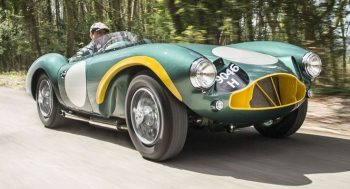
At the end of 1955, following that year’s Le Mans catastrophe, Mercedes Benz withdrew from motor sport but in 1956 second place at Le Mans went to Stirling Moss and Peter Collins in an Aston Martin DB3S.
Within Formula 1, Moss stuck to his own Maserati 250F but the retirement of Fangio after the 1958 French Grand Prix gave Stirling the real chance of taking the F1 driver’s championship with Vanwall along with the inaugural Constructor’s Championship.
As related above though, Moss spoke up for his rival Mike Hawthorn who, after spinning off the track, had technically rejoined against the racing direction and faced being disqualified.
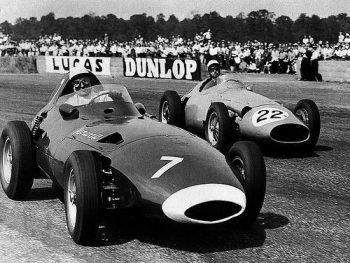
Although losing the 1958 F1 World Driver’s Championship to Mike Hawthorn by one point, Stirling Moss (race number 7) did win the first ever Constructor’s Championship for Vanwall. Had he been driving under the modern points system however, Stirling Moss would have been four times World Champion. He was however BBC Sports Personality of the Year in 1961.
As it was, after 1962, Stirling Moss made a living mainly by being himself in the field of race commentary, public relations, guest appearances – even providing some voice overs for the animated children’s TV series Roary the Racing Car.
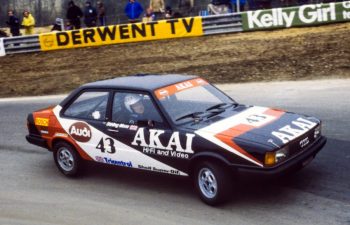
He did make a competitive comeback in 1980 with the Audi team in the British Saloon Car Championships but was disappointed by the lack of courteous sportsmanship compared to earlier eras. From then on he stuck to driving historic race cars.
On 2 December 2017 The Sun reported that a 1954 D-Type Jaguar capable of 173 mph and raced at Le Mans by Sir Stirling Moss was for sale at £11 million by Sotheby’s in Arizona. It has the racing number 12 and the registration OKV2
Current 5 times F1 World Champion Lewis Hamilton called Stirling Moss – a Knight of the Realm since 2000 – “a legend”. He continued, “I will miss our conversations… It was such an unusual pairing. We were two people from massively different times and backgrounds, but we clicked and ultimately found that the love of racing we both shared made us comrades.”
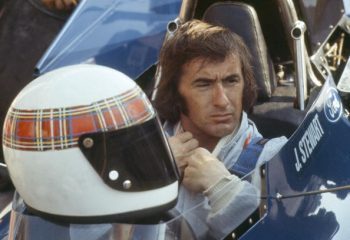
Three times F1 World Champion Sir Jackie Stewart said of Sir Stirling Moss “He walked like a racing driver, he talked like a racing driver, and he set a standard that I think has been unmatched since he retired”
And if anyone drives excessively fast, and es if they are caught speeding by the police, the comment is still, “who do you think you are, Stirling Moss?”