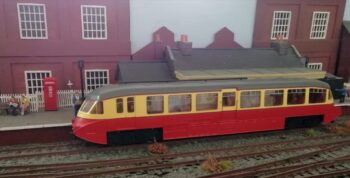
In the expansive year of 1960, a young Cassius Clay won Olympic boxing Gold at the Rome Olympics. Anthony Armstrong Jones punched above his weight by marrying Princess Margaret, two Russian dogs returned safely from outer space and Granada’s “Coronation Street” became a television fixture.
On the branch line to Garfield, London Transport steam was expanding its operation in the spirit of the Metropolitan Railway, exchanging wagons with a rapidly dieselising British Railways. Like the passenger and parcels railcars on the branch, some of these were built by the Gloucester Railway Carriage and Wagon Company.
The 73 inch by 13 inch analogue layout was the last ever built by George Lovell of Clevedon in 00 gauge and the second that I purchased from him, the first being the much smaller Capital Works.
The scenery of Garfield was re imagined by Roger and Robert Webb who, like Malcolm Bell, helped me enormously with the electrics. It is the first layout that I have ever owned with working lights! The isolating points on the scenic section work on the rod in tube principle.
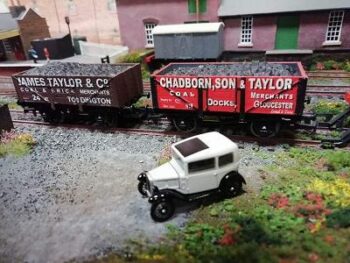
The low relief factory, justifying such a large station building, was made from two Dapol engine shed kits while the traction and rolling stock for 1960 are a mixture of kit and ready to run.
In fact just by changing the trains and road vehicles, Garfield can represent any period from the 1920s to the 1970s. Garfield’s first exhibition appearance, for example, at Cheltenham in Autumn 2018, was 1930s themed.

In my geographical back story, Garfield represented the very small terminus of a joint GWR/LMS branch line in the North Cotswolds, not far from the Great Central and Metropolitan railways. Coal, stone, cloth and agricultural produce were the original freight flows although as time progressed from the 1930s to 1960s oil, cement and military traffic also appeared.
However, before scenic remodelling by the Webbs, one possible styling concept had been a Scottish branch line.
As such I could not resist writing the layout up in the style of Victorian poet William Topaz McGonagall of Tay Bridge fame…
Ooh branch line now lying derelict
Closed in the year of Nineteen Sixty Six.
A victim of Doctor Richard Beeching
Despite so many passenger’s beseeching
Opened in Eighteen Ninety Six in fact
Following the passage of the Light Railways Act
To deliver passengers, goods and coal
To the town of Garfield in the north
Cotswolds.

Through Victoria’s reign and that of King Teddy
The small tank engines were always ready
To take away limestone and produce and cloth
When Kaiser Bill unleashed his Great War’s wrath.
But after Armistice in Nineteen Eighteen
England had changed from what it had been.
Lorries and buses competed with trains
And at the end of the Thirties war came again.
Instead of the idleness endured in The Slump
Workers were needed to build a fuel dump
For petrol for Hurricanes, Spitfires and tanks
And after Pearl Harbor, an army of Yanks.
When swords turned to ploughshares
The nation’s will bent,
To houses and hospitals
Made of limestone cement
From Garfield ‘s deep quarries all over the nation
Rolled the Presflo wagons of Modernisation.
Coming to Garfield, brought by jobs and marriage
New folk filled the bungalows, each with a garage
They took to the roads in their Austins and Fords,
And slow and infrequent, the trains they ignored.
Pairs of small wagons, time consuming to shunt
A single old carriage with steam at the front
Will no longer rattle to Garfield Junction
Part of our history with no current function.
This part of our heritage, now seen as such
Is modelled before you
BUT PLEASE DO NOT TOUCH!
GARFIELD 1960 MOTIVE POWER

863 examples of the 5700 Class 0-6-0PT were built between 1929 and 1950, making them the most prolific class of GWR locomotives and one of the most numerous classes in the annals of British steam.
In fact side mounted 0-6-0 pannier tank designs were a distinctive feature of the Great Western Railway , offering the ability to utilise the efficient Belpaire firebox while retaining access to the cylinders, rods and valve gear between the frames without a significant loss of water capacity. These were developed from older designs of saddle tank, many of which were later adapted with pannier tanks to accomodate new Belpaire boilers.
The thirteen 5700 class locomotives sold to London Transport were also the last steam locomotives to work ‘in service’ on the national railway network.

Although the London underground network had been electrified for many years (the then Metropolitan railway was electrified in 1905) a small number of steam locomotives were retained for engineering and ballast trains.
By the 1950s the locomotives were past their prime and expensive to maintain, and the planned quadrupling of part of the Metropolitan Main Line would require reliable locomotives. London Transport considered replacing the steam fleet with diesel shunters, and had also tested (unsuccessfully) a Great Northern Railway Class J52 locomotive in 1955.
The first Class 5700 locomotive, Great Western Railway number 7711, underwent trials from January to April 1956, first running between Finchley Road and Baker Street.
Modifications were needed to the cab for clearance and the tripcock brake valves after problems were found when running in reverse. Curtains were also fitted to the cab to reduce smoke and fumes in tunnels. In May, the 5700s became standard for engineering trains on London Transport when they bought GWR number 7711 (for £3,160), decided to buy another ( GWR number 5752), and planned to buy more in the future.

In all, thirteen 5700s were bought by London Transport from 1956 to 1963. They were numbered L89 to L99 and were allocated to the depots at Lillie Bridge, Fulham and Neasden.
Only eleven were running at any one time, the original L90 and L91 were withdrawn for repairs but scrapped instead and replaced by other locomotives which carried the same number.
They worked permanent way trains and were never used on normal passenger services. Main line running included trips between depots, to Acton Works and runs out to Croxley Tip, near Watford.
Three of the LT 5700s lasted until the end of steam on London Transport in 1971 and were the last steam locomotives used for regular mainline working in the UK.
London Transport commemorated the end of operating steam locomotives with a special run from Moorgate station to Neasden depot. The train was hauled by pannier tank L94 (formerly GWR 7752) and a selection of maintenance rolling stock. London Transport shunting was then performed by three diesel hydraulic locomotives.
L97 was the last but two of the Class 5700 0-6-0PTs acquired by London Transport, the 1930 built former 7749 leaving British Railways Western Region in 1962 and unfortunately being scrapped in 1970. However, a number of other ex London Transport Class 5700s have survived into preservation.

Garfield has a short length of track running into a loading bay which lends itself to the display of static rolling stock and for this 1960 presentation I have taken the opportunity to include a model of British Standard Class 4 2-6-0. This started life as a Kitmaster moulding, was assembled by the late Ron Brooks and finally painted by my good friend and excellent modeller Tim Mansfield.
The 115 British Standard Class 4 2-6-0s were designed at the ex LNER Doncaster works which also built 25 examples, the rest being erected at either Horwich or Derby. In fact 76114, an option on the later Dapol decal sheet, was the last steam locomotive ever to be built in Doncaster.
The design was heavily influenced by the LMS Ivatt Class 4 Mogul and featured 5′ 3″ driving wheels optimised for freight work. A 17 tonne axle loading allowed the Standard 4 Moguls to work almost anywhere and they were allocated to every BR Region except the Western.
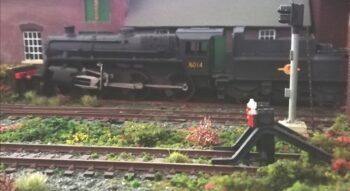
In addition to the weathering applied to the valve motion, cylinders, smoke box and tender of the Mogul, Tim was able to adapt the Dapol decal sheet offering the numbers 76000, 76093 and 76114 to represent 76014, one of 15 Horwich built British Standard 4 2-6-0s allocated to the Southern Region.
In all, 37 members of the class were allocated to the Southern and of these 17 examples were paired with high sided BR1B tenders. The BR1B tender was needed for longer distance trains as the Southern had no water troughs.
76014 was allocated to Eastleigh in 1959 but retained its as-delivered BR2 tender. 76xxx duties took them as far afield as Cardiff, Reading and Brighton as well as the boat trains between Waterloo and Lymington as they were small enough to fit the turntable at Brockenhurst. 76014 was withdrawn in 1966.

Both the British Thomson-Houston Class 15 and North British Class 16 “hood” Bo-Bos evolved from LMS 10800 and the Class 15s – introduced in October 1957 – continued the pairing of British Thomson-Houston electrical gear with a Paxman engine, albeit a 16YHXL powerplant developing 800 bhp at 1 250 rpm. Styling, meanwhile, was by Allen Barnes, Bowden Limited – who modified BTH’s curvier original concept – and the ten pilot batch locomotives were constructed by Yorkshire Engine at Attercliffe, Sheffield.
They were initially allocated with the first Class 20s to Britain’s first all-diesel depot at Devon’s Road, Bow, and were mainly used on transfer freights across London – hence the not-implausible appearance of D8233 at Feltham.
Unlike the ten Glasgow built pilot batch of Class 16s, the better-designed Class 15s were selected for a production run of 34 examples with the first leaving Clayton Equipment of Tutbury, Derbyshire in October 1958 and the last in February 1961. Allocated to Eastern Region – Finsbury Park included – the BTH Bo-Bos were however known to haul occasional summer seaside excursions.

By March 1971 however, Class 15 had been totally withdrawn. Unlike LMS 10800, D8200 – D8243 had been envisaged as freight locomotives with no train heating boiler yet were still built with a central cab. This meant that visibility was limited in both directions, in contrast to the English Electric Class 20 design with a cab at one extremity. These locomotives had a superb look-out one way and the problems of sighting along the bonnet length was overcome by pairing them with cabs outermost. In addition, the English Electric 8SVT Mark II powerplant of the Class 20s was far more reliable than the V-16 Paxman on the Class 15s. Dirty, prone to piston seizure, engine fires and excessive maintenance, these pressure charged prime movers were the undoing of both the D800s and their NBL Class 16 cousins.
Despite being used on King’s Cross outer suburban and Liverpool Street carriage pilot duties, the Class 15s were deemed surplus to the requirements of the 1968 National Traction Plan following the decline of wagon load freight traffic and withdrawals began in September that year.

Four Class 15 locomotives – D8203/33/37 and 43 remained after 1971 as departmental carriage heating units and one of these was deployed at Cheltenham, being used on Alstone siding north of Lansdown station to keep the carriages of locomotive hauled London trains warm between journeys.
However, only D8233 ( latterly ADB96801 ) survives into preservation while Class 20s are still hauling trains on Network Rail.
D8233 was built as BTH / Clayton works number 1131 and was introduced to traffic in August 1960 at 30A Stratford Depot in the east end of London and was withdrawn from there after 3090 days in traffic in February 1969. It is currently being restored at Bury on the East Lancashire Railway and further details can be found at http://www.d8233.org.uk/

The Class 08, or Class DEJ4 as it was originally designated, owes its genesis to early experiments carried out by the LMS for diesel powered shunting engines as early as 1932. By 1945, a standard design of 0-6-0 shunter had been developed, and British Railways adopted this as the mainstay of its shunting fleet, albeit after implementing further alterations to to conform to their standard L1 loading gauge. This allowed for greater operational versatility in all regions. Construction of the locomotives took place between 1953 and 1968 and totalled 894 units. These included air, vacuum and dual braked units.
The LMS favoured the use of a six cylinder English Electric 6KT engine Type 506 traction motors and associated equipment while both the GWR and LNER had experimented with Brush engines in their equivalent 0-6-0 diesel electric shunters. Some outwardly similar engines received Crossley or Lister Blackstone powerplants, later to become Class 10 under British Rail’s Total Operations Processing System. D3729 was built at BR’s Crewe Works and allocated to 64A (St Margarets) in January 1959, becoming 08 562 in November 1973.
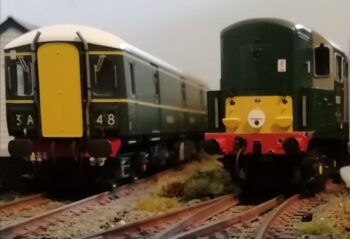
Following the success of Gloucester RCW built Great Western diesel parcels unit 17, British Railways ordered a fleet of similar vehicles in the 1950s.
Three of these were built by Cravens of Sheffield while ten more came from GRCW: six with gangwayed ends and round buffers for Western Region and four with oval buffers and three piece windscreens at each end for London Midland Region.
The six Western Region machines, numbered W55991 to W55996, later joined M55987 to M55990 on Midland Region and the ten GRCW units would also eventually work on Eastern Region. By 1988, all British Rail diesel parcels units were based at Cambridge.
Two 230hp Leyland Albion engines made each 40/41 ton single car unit very powerful, although some vehicles were later fitted with TL11 prime movers.
The GRCW DPUs had a payload of 10 tons, and could take a tail load of up to 64 tons. Like the contemporary “bubble car” passenger diesel railcars, the DPUs of what would become Class 128 featured two exhaust stacks on one end only.
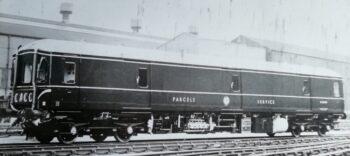
The DPU fleet enabled a through parcels service to be provided where there was not a regular passenger service, or where station times were not sufficient to permit the loading and unloading of mail from regular passenger services.
Perhaps the finest hour of the Class 128s came in 1980 when the famous Barmouth Bridge in Wales had been attacked by shipworms. It was not strong enough to take the weight of a locomotive but wagons still had to serve the explosive sidings at Penrhyndeudraeth in the isolated section. Only the 128s were light yet strong enough to haul the stock across before the bridge was strengthened.
Blue square multiple working allowed them to be coupled to most other DMUs and the last DPUs were not withdrawn until November 1990.
The first Great Western railcar with Park Royal bodywork on an AEC chassis entered service in December 1933. Three more improved versions, 2 to 4, followed in 1934 while GWR railcars 5-18 were bodied by the Gloucester Railway Carriage and Wagon Company from 1935 to 1937.
Following the success of Gloucester RCW bodied railcar 18, designed to haul trailing vehicles, the GWR Chairman told the company’s annual meeting in February 1938 that 20 more diesel railcars were being ordered. With almost a million miles run by the first 18 examples, he said that:
“Whilst the original intention was to use them to provide additional services where the traffic was insufficient to justify the working of a train, our experience is that owing to the increasing cost of operating steam locomotives considerable economy can be effected by replacing them with diesel cars on certain sections”.
As new Modernisation Plan DMUs began to flood onto British Railways, many of the ex GWR railcars became concentrated in the Worcester, Severn Valley and Tenbury Wells areas by 1961. 1936 vintage W8W was in fact withdrawn in January 1959, having served most of its life based at Stourbridge depot.
All ex GWR railcars were retired in 1962 but three survive in preservation: AEC/Park Royal built 4 at Swindon and Swindon built numbers 20 and 22 on the Kent & East Sussex Railway and at Didcot respectively.
GARFIELD 1960 WAGONS
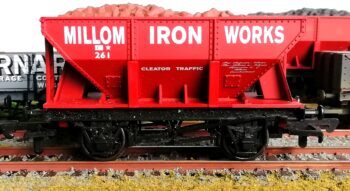
24 ton hopper wagon 261 took ore to Millom Ironworks before its closure in 1968.The most southerly town in the old county of Cumberland, Millom began life as the small hamlet of Holborn Hill and the 1841 census gave the population of 356. By 1855 however, Millom had a population of over 10 000 due to the expansion of iron, shipping,brick, tile and rail industries in the area. A licence to search for minerals was then granted by the Earl of Lonsdale and iron ore was discovered in 1856. By 1864 local mines had produced one million tons or ore, the first Millom iron smelting furnace opened in 1866 and the town boomed until the second half of the Twentieth Century.
Thousands of tons of coke arrived by rail at Barrow in Furness and Millom ironworks each day, travelling from West Auckland via Barnard Castle, Stainmoor summit, Kirkby Stephen East, Tebay, Oxenholme, Hindcaster Junction and Arnside. During the 1950s too, a train full of Durham miners would follow the same route for convalescence near Ulverston.
The additional wagon legend “Cleator Traffic” refers to another source of iron ore further north in Cumberland which sparked some local controversy in 1878.

Millom, Barrow in Furness, Ulverston and Arnside are south of Sellafield along the coastal railway
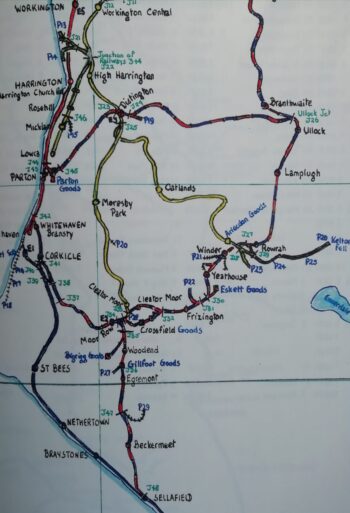
The Whitehaven, Cleator and Egremont Railway had built an extension in 1869 from Egremont to join the existing Furness Railway line at Sellafield in order to obtain an outlet to the south for the Cleator district iron traffic. The W. C. & E., although a small company, had prospered and its shareholders had come to regard dividends of 10% as commonplace.
However, in 1878, the W. C. & E. found their considerable north-bound mineral traffic threatened by the Cleator and Workington Railway, authorised on 27 June 1876. Furthermore the local traders were pressing for a reduction in the carrying rates. Just about the same time the London & North Western Railway made overtures to the W.C. & E Company. The L. N. W. had their stake in West Cumberland in shape of the line from Whitehaven to Workington, Cockermouth and Maryport, as well as their working of the Cockermouth, Keswick and Penrith Railway, and it is possible that Euston was concerned about the damage which the Cleator & Workington line might do to their traffic.
For much the same reason, the W. C. & E. accepted Euston’s offer and was leased to the L. N. W. R. in 1878. However, the Furness Company protested vigourously to the L. &. N. W. and also threatened to build their own line into the Cleator District by way of Seascale and Gosforth to Egremont. As a result the W. C. & E. R. became the joint property of the Furness and L. &. N. W. companies in 1879 and the shareholders were guaranteed 10% perpetuity.
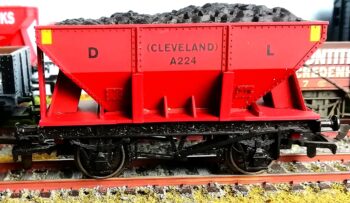
A similar design of hopper wagon to Millom Ironworks 261 once carried coal for Dorman Long, another famous name in iron and steel. Founded in 1975 when Arthur Dorman and Albert de Laude Long acquired the West Marsh Iron Works in Middlesborough, the company took over the concerns of Bell Brothers and Bolckow and Vaughan in 1929 and diversified into the construction of bridges, most notably the bowstring girder structures over the Tyne at Newcastle and Sydney Harbour. Other projects included the 1966 Severn Bridge and the Earth Receiving Station at Goonhilly Down, Cornwall, as described in The Telstar Story
In 1967 Dorman Long became part of British Steel and in 1982 the engineering part of the business, Redpath Dorman Long, was acquired by Trafalgar House who in 1990 merged it with the Cleveland Bridge and Engineering Company of Darlington.
Both Millom and Dorman Long hopper wagons are very similar to a Charles Roberts of Wakefield design of the early 1930s which was also built by the firm for British Railways after 1948 to Diagram 162. These wagons – relatively small for their maximum permitted payload – could also carry sand and limestone ( like iron ore, another mineral necessary for blast furnace iron smelting and twice as dense as coal ) and some examples were fitted with roller bearing axle boxes. Between 1949 and 1959 British Railways acquired 5 270 ironstone hopper wagons built to eight separate diagrams and ranging in capacity from 22 to 33.5 tons.

Before Nationalisation, most cement was bagged and transported in ordinary covered vans and this trend continued despite the ability of newer freight vehicles to carry cement in bulk. In 1964, for instance, Standard Wagon of Heywood, Lancashire, built 96 long wheelbase pallet vans for Associated Portland Cement Manufacturers Limited. As late as 2000, bagged cement was being carried in bogie Cargowaggons from Moorswater in Cornwall to Hope between Manchester and Sheffield.
The same firm’s short wheelbase van 177 catches the eye not only because of its yellow livery and white roof but because of its relatively short height compared to the BR Ventilated van next to it. It is in fact based on the GWR Iron Mink covered wagon and could also be used to carry explosives to quarries. Such wagons lasted into the 1950s.
The express passenger speed rated bauxite painted van has four shoe vacuum brake gear under its plywood body with plywood cupboard doors and corrugated ends with one high central vent each. Although this van conforms closely to BR Diagram 1/213- built by British Rail Faverdale, Darlington and Ashford Works and Pressed Steel from 1952 to 1961 – other Ventilated van variants included those with planked bodies, LNER pattern eight shoe brake gear, planked cupboard or sliding doors and Oleo hydraulic buffers. Corrugated van ends had been pioneered by the LMS to minimise damage caused by sliding loads and were widely adopted by British Railways during its first twenty years of existence.

On the left of the picture above is the Ministry of Transport slope-sided variant of the classic all-steel 16 ton mineral wagon. During the Second World War the Ministry of Transport had taken over Britain’s huge fleets of private owner coal and mineral wagons and many slope sided “16 ton mins” were constructed for it as part of the war effort by Charles Roberts of Wakefield, although Metropolitan Cammell also built examples.
In the early 1950s The Gloucester Railway Carriage and Wagon Company produced a steel 16 ton mineral wagon for the Ministry of Supply as well as a rivetted take on the basic format for British Railways Western Region and a corresponding all welded design for London Midland Region where the type had originated in the 1930s.
The arguably definitive variant of the 16 ton Mineral wagon, built by Derby Works under both LMS and BR ownership, lacked bottom discharge doors but did feature drop flaps above the side doors, the two ends of the wagon thus being held together by a steel bar in between. Enshrined as BR Diagram 1/108, these vehicles also lacked continuous vacuum brakes but were fitted with hand operated Morton brake gear applying one shoe to each wheel on one side only. In fact between 1950 and 1958 over 200 000 wagons were built to Diagram 1/108 by BR workshops and private builders in the biggest wagon building spree in British railway history. The 16 ton mineral wagon was also the basis for later doorless iron ore tippler wagons.

The 16 ton mineral wagons that were fitted with vacuum brakes actuating first four and then eight brake shoes – and were painted Bauxite rather than grey – were used for industry rather than individual small coal merchants, where the all-steel wagons had finally supplanted wooden bodied ex-Private Owner types by 1964. Indeed, as much wagon load traffic was lost to road transport at the end of the 1960s, many unfitted but welded 16 ton mineral wagons were rebuilt with vacuum brakes and continued to carry large amounts of coal until replaced by even larger hopper wagons in the 1970s.
By this time, too, although early pressed steel variants had come and gone, there were still a range of detail differences to be found on 16 ton mineral wagons including disc and spoked wheels, plain or ribbed brake levers, axleboxes, three link and Instanter couplings (screw couplings being reserved for vacuum fitted vehicles).

As well as wagon load traffic falling from two thirds of BR freight tonnage in 1968 to one fifth in 1976, the 1984 Miner’s Strike caused many 16 ton mineral wagons to be damaged by being stored loaded for long periods of time. After this time, too, the closure of many coalfields made large fleets of 16 ton mineral wagons redundant, most coal now being carried in merry-go-round trains of hopper wagons straight from ports to power stations.
The final use of the 16 ton mineral wagon was thus as a departmental ballast carrier, notably with rectangular holes burned into the sides half way up the bodies to prevent over-filling with spent ballast which is considerably more dense than coal.
As might be expected, the numerous and widely distributed 16 ton mineral wagon was soon represented in the 00 gauge railway boom of the 1950s with the Airfix kit being the best way to create an accurate model with the correct 9′ wheelbase. Early ready to run Wrenn, Graham Farish and Palitoy versions however had a body stretched to fit their standard 10′ wheelbase wagon chassis but recent releases seem to have rectified these issues.
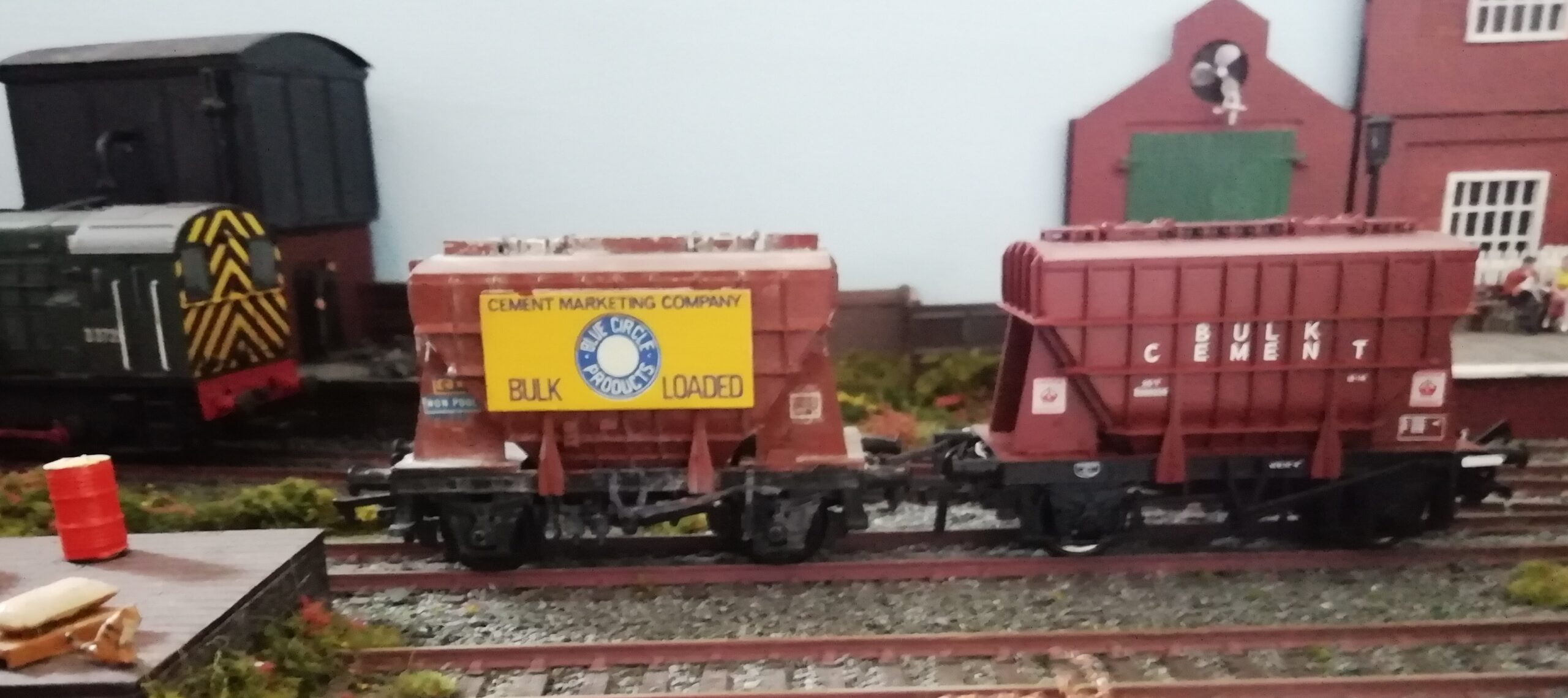
The first really successful British bulk cement wagon was the Presflo. Designed and first built in 1954 at Shildon, the Presflo – with its distinctive ribbed hopper body – was top loaded by gravity but used dry compressed air to discharge its 20 ton load into a storage silo or road vehicle. Presflos were also used to carry flour, salt, aluminia powder and sand. Unlike earlier wooden bodied wagons, Presflos had their own vacuum braking systems and pipes and were designed for work in fast moving block trains.
The prototype Presflo – B888000 – was built to BR Diagram 1/273 and Shildon Lot Number 2679 but all 1 891 production cement vehicles – outshopped by five different builders between 1955 and 1963 – conforming to Diagram 1/272

Measuring 11’9″ high and 19’11″ over buffers (when fitted with the most common 24.5″ self contained or hydraulic buffers) the production 10’6″ wheelbase all-steel vehicle mainly boasted two vacuum cylinders –located at one end of the underframe with a ladder positioned at the opposite end of the central reinforced hopper – actuating eight clasp brakes and roller bearing axle boxes for high speed running. Most versions also featured screw couplings.
A further thirty wagons were built by Metro-Cammell to Lot 3156 of 1958 and designated for ICI salt traffic, making a total build of 1 921 wagons.
In service B888003/17/22/25/38/51/84/94, B888111/8/21/28/29/48/50/55/60/62/63/64 and perhaps more of the Presflos were also allocated to salt traffic and received roof modifications including walkways. These went on to carry slate powder from Wadebridge (Delabole) and finally fly ash in the Peterborough area during the late 1980s and early 1990s.

Indeed, British Rail’s own workshops later built a longer wheelbase version of the Presflo to carry talcum-like fly-ash from power stations. This began with a Diagram 1/272 Presflo being modified to Diagram 1/281 as an experiment with a reduced 17 ton load. A small production batch of Diagram 1/278 ASH 17VBs and three Diagrams of 21 ton fly ash Presflo – 1/279, 1/ 280 and 1/ 282) followed.
The Butterley Iron Company built 100 Presflos, Shildon 180, Metropolitan-Cammell and Central Wagon 400 apiece while Gloucester RCW constructed 840 examples. As such it is fitting that the last surviving Presflo -B873368, eventually cleared to carry 22 tons of cement and now preserved at Shildon – was built in Bristol Road as part of Lot 3361. Presflos built to Diagram 1/272 began to be phased out from 1984 and all had gone by 1991.

While rectangular tanks sufficed for the bulk transport of coal tar, the more volatile products of coal tar – and crude oil – including required petroleum, creosote, ammoniacal liquor, acids and dyes, required cylindrical tank wagons of more advanced design that were introduced from the start of the 20th Century. However, these did not become commonplace until the arrival of specialised rail-connected reception facilities during the 1920s.
The main challenge of cylindrical tank wagon design was securing the tank to the frame. The Railway Clearing House produced various drawings to illustrate its recommended methods of fixing, but while these were broadly adopted they were not compulsory and any method could be used which was acceptable to HM Inspector of Railways.
For many years timber was widely used, both for the underframe and the tank mounting by either the saddle or cradle method. In the saddle method, the tank was carried on four transverse bolsters ( or saddles ) while in the cradle method the cylindrical tank was carried on two longitudinal members.

Angle iron end stanchions and wooden – or steel and wooden – horizontal beams held the tank longitudinally and the beams were stayed to the underframe by steel rods. The tank was finally secured by holding-down bands and crossed wire ropes.From the mid 1920s the wire ropes on cylindrical tank wagons were discontinued and a horizontal tie rod was introduced between the stanchion beams. Later on, various bracket mounting techniques and welding were adopted which ultimately led to the monocoque bogie-mounted 100 ton oil wagons that run on Britain’s railways in the 21st Century.
Wagon 202, above, is in the red-brown of Olympia Oil and Cake Mills, founded before the First World War by Joseph Watson (10 February 1873–13 March 1922), later the First Baron Manton.
Joseph Watson was the son of George Watson who had in turn succeeded from his father – also named Joseph – as head of soap manufacturer Joseph Watson & Sons which had grown in 1820 from a hide tanning business based near Leeds. However, it was the Repton-educated third generation Joseph – also a director of the London and North Western Railway – who expanded the medium sized concern into a rival for William Lever of Port Sunlight fame.

Despite a failed pre-War attempt by Watson and William Lever to monopolise the soap market both “Soapy Joe” and his Wirral-based rival founded the Planter’s Margarine Company Limited in Godley, Chesire, in November 1914 in response to Government anxiety at the wartime loss of Dutch supplies.
Joseph Watson supplied Planter’s from his own Olympia Oil & Cake Co. Ltd. at Selby, Yorkshire, which operated the largest linseed oil crushing and refining plant in Europe and also hardened whale oil. Indeed, a ‘village estate’ of worker’s housing was built by the Olympia Oil and Cake Co. in Barlby, East Yorkshire, soon after 1910 which had grown to 350 houses by 1938 while the only surviving village pub is the Olympia Hotel, opened in 1921 and depicting seed-crushing machinery on its sign.

Although Joseph Watson’s organisational skills helped alleviate the British shell supply crisis of the conflict against the Kaiser, it was The Olympia Oil and Cake Company’s cake by-product used to fatten livestock that almost played a very sinister role in the struggle against Hitler’s Germany.
The aim of Operation Vegetarian in the summer of 1944 was to wipe out the German beef and dairy herds and then spread the bacterium to the human population. With people then having no access to antibiotics, this would have caused many thousands of German men, women and children to suffer awful deaths.
Having said that, a recently declassified memorandum dated August 1939 revealed MI6 feared a similar anthrax attack on Britain’s livestock and water supply by Germany and that the outbreak of war might also see Nazi agents spreading lethal germs on the London Underground system and even trying to poison Prime Minister Neville Chamberlain’s milk on the doorstep of 10 Downing Street.

Dr Paul Fildes, director of the biology department at Porton Down near Salisbury in Wiltshire, had spent early 1942 searching Britain for suppliers and manufacturers of linseed-oil cattle cake to make five million small cakes.
The raw material for the cake was provided by the Olympia Oil and Cake Company in Blackburn while the contract to cut the cattle cake into small pieces went to J & E Atkinson of Bond Street, perfumers and toilet-soap manufacturers and suppliers to the Royal Family. Atkinsons calculated that they could produce 180,000 to 250,000 cakes, each 2.5cm in diameter and 10 grammes in weight, in a 44-hour week. The price was to be between 12 and 15 shillings per thousand. The London firm pledged to deliver 5,273,400 cakes by April 1943 and by the middle of July 1942 were producing 40 000 per day.
The anthrax was manufactured by the Ministry of Agriculture and Fisheries at its veterinary laboratory in Surrey. Oxford academic Dr E Schuster was set to work devising the pump to inject the bacilli into the cattle cakes and thirteen women were then recruited from various soap-making firms, sworn to secrecy and given the job of injecting the cattle cakes with anthrax spores.

The infected cattle cakes were then packed four hundred at a time in cardboard containers ready to be launched from wooden trays fitted on to the flare chutes of RAF Bomber Command’s four engined heavy bombers. Operation Vegetarian was specifically timed to begin when the lush spring grass was on the wane in Germany’s cattle country of the northern half of Oldenburg and northwest Hanover.
It was further calculated that aircraft flying to and from Berlin would cover over 60 miles of grazing land in 18 minutes at a speed of 300 mph with one box of tablets dispersed every two minutes so that a dozen aircraft would have been enough to contaminate most of Northern Germany’s countryside.

In the event, the successful Allied invasion of Normandy caused Operation Vegetarian to be abandoned and at the end of 1945, five million anthrax-infected cattle cakes were incinerated in one of Porton Down’s furnaces although the testing ground for this experiement in biological warfare -Gruinard Island, off Wester Ross – was only fully decontaminated in 1990.
The Olympia Oil and Cake Company – whose 14 ton tank wagons also sometimes carried molasses – finally merged with British Oil and Cake Mills in the early 1950s.
Rothervale fleet number 48 – modelled by Bachmann – meanwhile is of a slightly more modern design and represents what was effectively the colliery division of the United Steel Companies Limited from 1918. The Rothervale Colliery Company sprang from Fence Colliery, sunk in 1862, while United Steel’s antecedents included Steel Peech and Tozer of Rotherham, the Workington Iron and Steel Company and United Coke and Chemicals Company, which operated coke ovens at Orgreave and Brookhouse and distilled tar transported from Workington as well as supplying coke to Appleby Frodingham steelworks in Scunthorpe. Rothervale open wagons delivered gas coal to, among other places, Gloucester and despite much of its fleet being built in or near Yorkshire two orders – each for 100 vehicles – went to The Gloucester Railway Carriage and Wagon Company Limited in 1923 and 1925.

Arguably the most famous tank wagon ever to appear as a 4mm scale kit was of Esso Class B 3300, first injection moulded by Rosebud Kitmaster, then Airfix, and now sold under the Dapol banner. In comparison with the other designs discussed above, this wagon has a simple yet elegant twin-saddle attachment between cylinder and chassis although the 22′ 6″ cylinder noticeably stops short of the full length of the chassis ( 27′ 9 3/4″ over buffers ) and is far enough inside the loading gauge to permit sub-solebar length ladders to be attached amidships. Other visible refinements include roller bearing axle boxes and two brake blocks acting on each wheel. The latter were applied either by manual lever during shunting or by twin vacuum cylinders as part of a vacuum brake fitted train. Like later airbraked monocoque tank wagons, the buffers were either hydraulic or pneumatic.

The two stars are also a clue that this 15′ wheelbase Class B wagon was designed with the post 1955 Modernised British Railways in mind and intended to be run at over 45 mph without frequent inspection stops during transit. Such special treatment was made necessary by the general age and obsolescent design of Britain’s tank wagon fleets, which had not been Nationalised along with the rest of British Railway in 1948.
In 1956 the Esso Petroleum Company Limited approached British Railways to design a maximum capacity four wheeled tank wagon within the existing 35 ton gross laden weight limit and more than 800 examples of this pattern were constructed by various builders to carry both Class A and B liquids. Load discharges were to be controlled by an internal rod and plug operated by a handwheel on top of the tank barrel, some 12′ 6″ above rail level. The same wagon design was also built for operators such as TSL in the early 1950s by Powell Duffryn of Cardiff, later to absorb the remains of the Gloucester Railway Carriage and Wagon Company.

In the case of Esso’s Class B variants the loads would have included diesel fuel and kerosenes with steam coils fitted to assist the offloading of heavy fuel oils. An alternative way of heating tar ( also known as bitumen ashphalt ) from its room temperature solid state to fluid aboard post Second World War wagons was by means of flame tubes. These would be set low on the wagon ends and end in a chimney at the top, the heat being provided at the discharge location by means of a gas lance.
Indeed, one of my earliest memories of visiting the East Somerset Railway at Cranmore was walking toward the steam locomotives saved by David Shepherd past lines of what looked like petrol tankers that had been set on fire! Luckily the “SUKO” ( short for Shell UK Oil ) wagons did not explode but just wafted warm tar as they prepared for bottom discharge of their loads – possibly sourced from Californian crude oil or the tar sands of Trinidad.
Unlike petrol carrying Class A tank wagons, Class B vehicles were permitted to be coupled next to guards vans and locomotives without any intervening barrier vehicle.

849 twenty-ton Midland Railway brake vans were built between 1924 and 1927 and many lasted well into the 1960s. Some even went into civil engineer’s service into the 1970s. Although Garfield in its many epochs is essentially a shunting layout, brakes vans with a very short wheelbase are essential to forming proper trains due to the limited length of sidings. Even a Great Western Toad would limit a train to just one wagon!
GARFIELD 1960 ROAD VEHICLES

After the Second World War, one time German aircraft builder Heinkel diversified into building small cars that would use scarce petrol very ecomically. While Messerschmitt’s “bubble car” used a side hinged canopy, both Heinkel’s 1956 vintage Kabine and BMW’s Isetta were built around a single front door.
The three wheeled Heinkel Kabine was technically advanced with a steel monocoque body, four speed gear box and reverse – a feature not shared by all of its competitors. It could also be driven on a motorcycle licence at a top speed of 56 mph which, given its single cylinder design and with the escape hatch sunroof open, was probably a bit hairy!
From 1957, the nemesis of those quirky bubble cars was the economical British Motor Corporation’s Mini: designed by Alec Issigonis and offering room for four adults.
Kabine production was transferred under licence to Dundalk Engineering Company in Ireland in 1958. However, the licence was withdrawn shortly afterwards due to poor quality control. Production restarted in 1960, again under licence, under the Trojan 200 name by Trojan Cars Limited in the UK, and continued until 1966.

The Bedford OX was the short wheelbase version of what had been one of the most common British military lorries of the Second World War. In this case, the cab unit of the British Railways articulated flatbed has an extra pair of wheels on the rear axle. Lorries such as this would have taken goods and parcels to and from rural railway stations to their remote hinterlands.
ABOVE GARFIELD 1960

The English Electric Lightning stemmed from a 1947 requirement for a fighter capable of unprecedented performance. English Electric’s design was so radical at the time that the Royal Aircraft Establishment took exception to some parts of it. They went so far as to award Shorts with a contract to put together an aircraft to show English Electric just what parts of their design were wrong.
The Short SB.5, which could have its wing sweep and tailplane position varied between flights, first flew on 2 December 1952 and by early 1954, the trials had confirmed EE’s choice of low tailplane and mainplane sweep angle.
The first prototype – designated the P.1 and powered by two vertically integrated Sapphire engines – took to the air on 4 August 1954, piloted by Roland Beamont . During its third flight – on 11 August 1954- the P1 became the first British aircraft to exceeded Mach 1 in level flight.
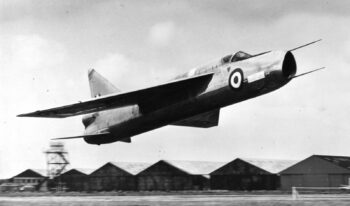
The second prototype, the P.1A (a P.1. with twin 30mm cannon and later a bulged belly fuel tank), took to the air on 18 July 1955 and was displayed at that year’s Farnborough show. The P.1s, while recognisably Lightning ancestors, had a number of differences in appearance. Most obviously they had yet to receive a radar holding nose cone and the nose intake was egg-shaped rather than round. No ventral fuel tanks were fitted to start with and the vertical tail was substantially smaller.
English Electric were by now working on a possible production variant, the P.1B. This had a ventral fuel tank, Ferranti AI-23 radar, raised cockpit and Avon engines. Armament had improved with the inclusion of a ventral pack to take either two more cannon, two retractable rocket packs or two Firestreak infra-red homing missiles.
The vertical tail was increased in size from the fourth P.1B onwards, after some slight directional stability problems had been found when flying at high speeds.
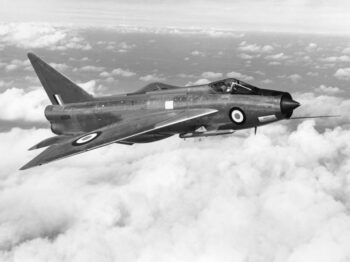
In fact, the P.1B was a very different aircraft to the P.1 and P.1A; so much so that EE had some worries that the government could cancel this ‘new’ project if EE presented it as such. Accordingly, the designation for this new variant was merely P.1B, which made it at least sound like a minor modification instead of a major advance.
In late 1956 an order for 20 of these aircraft was placed so that testing of every aspect of the new fighter could be accelerated. EE’s decision on the P.1B designation may very well have saved the project, because the 1957 Duncan Sandys Defence White Paper cancelled almost every advanced aircraft project in development, but left the P.1 alone.
While the P.1 had survived the Defence White Paper, export prospects practically disappeared. In later months, the government even went so far as to sabotage English Electric’s own efforts to sell the aircraft to Germany – after frustrating and fruitless attempts to sell the aircraft to the Luftwaffe, EE discovered a government representative was actually telling the Germans not to buy the aircraft!
On the 4 April 1957 the first P.1B flew and also exceeded Mach 1 without using reheat. In July, the world jet air speed record (then at Mach 1.72) had been broken. Flight testing was not without its mishaps; problems with the canopy release mechanism resulted in no less than three in-flight losses of the canopy. The pilots involved were lucky to survive (one canopy self-jettison occurred at supersonic speed, making the pilot, de Villiers, the fastest open-cockpit pilot in the world). Some amusement in the press was caused by these failures; Punch printed a cartoon showing the P.1 with rope wrapped around the fuselage and canopy with a caption of “Had a little trouble losing cockpit canopies, but I think we’ve mastered it.”
With performance of the aircraft better than predicted, EE designed new wings with a kinked and cambered leading edge which gave better subsonic performance and a little more available space to store fuel in. These were flown on the P.1B but EE did not want to proceed with the new wings until they were absolutely sure of their usefulness, and official indifference led to the new wings not entering production until many years later.
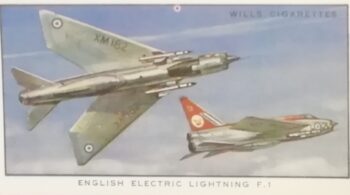
In October 1958, the RAF officially named their new aircraft Lightning and one month later, using minimum afterburner, the Lightning attained Mach 2.0.
The initial requirement did not actually specify Mach 2 performance, but EE had seen that it was possible and the Lockheed F-104 programme was also progressing towards Mach 2 . Roland Beamont later stated that the Lightning’s performance at Mach 2 was much superior to the F-104, with less noise and vibration and better controllability.
A planned Double Scorpion rocket mounted in the rear of belly tank of the P.1B was cancelled as the aircraft’s new Rolls Royce Avon engines were found to give enough extra performance to render the rockets pointless. Besides, the space lost to the rocket and its fuel would have meant even less room for jet fuel, and the Lightning was short enough of that as it was.
Late 1959 saw the RAF finally getting their hands on some Lightnings to trial. The Lightning F.1 differed very little from the P.1B except that the ventral fuel tank now had a small fin, the main vertical tail was enlarged.
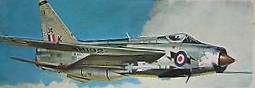
Lightning F1s entered service with 74 squadron at Coltishall in 1960, and the F.1A followed on, entering service with 56 and 111 squadrons at Wattisham. The only difference of note was that the F.1A (seen above in 111 Squadron markings) had attachment points for an in-flight refuelling probe – the Lightning’s limited fuel capacity meant that interception missions were almost limited to the area of the airfield otherwise!
Variable afterburners made their appearance in the F.2 variant, while the F.3 had some more major changes – improved AI-23B radar, more powerful Avon engines, a larger square-topped fin, cannon armament removed, Red Top (as opposed to Firestreak) missile capability and auxiliary overwing fuel tanks.
Although very much a pilot’s aeroplane, the Lightning was much more complex than the Hawker Hunter it replaced. Despite this, it was to continue in RAF service until June 1988 when finally supplanted by the air defence variant of the Panavia Tornado.