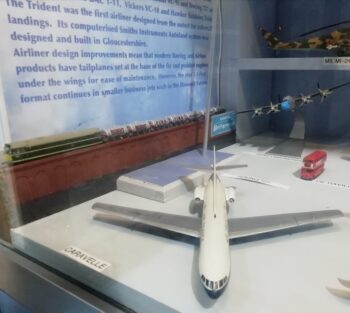
Although June 2021 did not see the anticipated easing of Covid 19 restrictions on Museum opening, I saw an opportunity to enhance the Jet Age visitor experience by filling a gap in the Trident model cabinet between the airport apron and north wall.
A section of high level railway – inspired by parts of the North London Line – would balance the low double-track embankment on the southern side of the apron and the south wall and also help hold the large scale descriptive caption flat.
Fortunately, Homebase were selling pieces of 38 x 63 x 1200 mm softwood for less than the price of a retail chain cappuccino so creating the core of a 450 mm long by 36 mm wide section of high level railway seemed easy – or so I thought! The problem was that the cabinet itself was not fully square and so the core had to be carefully sanded so that both the thin nose and flared rear section dropped into the 18 mm deep slot.

Once the top of the slot had been established relative to the shaped core, a line could be scribed into the softwood to locate 450 mm of thin rectangular section strip wood which was then glued on to the core. This wooden strip would in turn define the depth of the core, allowing the lower unpainted section to be further sanded for ease of entry into the slot. The few millimetres depth of stripwood would also cover any gap between the core and the apron edge and provide a foundation for the arched retaining wall above. The same piece of stripwood also yielded the 450 mm long back wall of the high level railway, painted Dove Grey to simulate concrete.
The 35mm high retaining wall was built from Ratio N gauge trackside kit 239, the most expensive single component of the high level railway. However, this presented two problems. Firstly, this was designed purely as a retaining wall without any thought to the top section being used as a brick parapet and secondly it was only 348mm rather than 450mm long.

Happily though, I had some parts from Ratio N Gauge Platform kit 509 to hand. Once I had cut off the moulding pips and rubbed down the top of the inside of kit 239 I was able to line it using the platform edging and use a section of platform surface as a billboard to fill the 102mm gap.
The advertisement on the billboard was cut from an old, unwanted, copy of Air Pictorial magazine and unlike the possible alternative oil company logos was more visible from a distance. Although no 1/144 scale model Bristol Britannia is currently in the cabinet, this pioneering turbo prop airliner was built in the late 1950s when Filton was part of Gloucestershire. It was also contemporaneous with most of the other airliners on display as well as the first diesel locomotives built under the 1955 Modernisation Plan of British Railways.
Once the retaining wall and billboard sections had been stuck to the dark grey side of the core with cyano acrylic adhesive, a thin layer of white PVA glue could be applied to the floor of the channel formed by the back and retaining walls. On to this was dropped a 450mm length of N gauge track – which already had rail sides painted with Humbrol 173 enamel and so allowed immediate ballasting. As predicted, the high viscosity PVA glue also filled the gaps between the retaining wall and the core. This strengthened the overall model scenery and any excess could be wiped off as it dried. Any remaining glue excursions dried clear and could be painted over green to simulate the moss and weeds that always sprout from old brickwork.
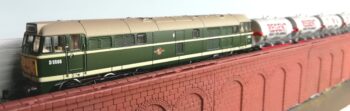
Now installed, the high level railway can showcase any N gauge rolling stock appropriate to the adjacent aircraft. As the current focus is the evolution of rear engined T-tailed airliners during the late 1950s and early 1960s, I was able to add Brush Type 2 D5596 and some of my tank wagon collection.
Descended from the first production batch of twin cabbed diesel electric locomotives with an A1A – A1A wheel arrangement, D5596 carried the Brush works number 196 and was introduced to traffic at Hornsey depot (34B) in March 1960. Renumbered 31 403 in March 1974, the locomotive wa stored unserviceable on 20 February 1995, officially withdrawn from Toton depot on 24 September 1996 and moved to scrap merchant TJ Thompson, Stockton on Tees on 28 January 2000. It was finally cut up between 19 and 29 June 2003.
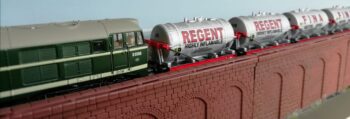
The Regent Oil Company was founded in 1947 with the merger of Texaco Petroleum Products and Trinidad Leaseholds. Prior to the war the Regent brand name had been used by Burt, Boulton & Haywood Ltd, a small distributor of high grade motor spirit who had been taken over by Trinidad Leaseholds in 1931. The company had a refinery at Regent’s Wharf, London, and sold – ‘Regent’ and ‘Regent Motor Spirit’. The Regent Oil Company expanded into branded petrol sales in Britain in the 1950s. It also shipped and refined petroleum products abroad before being taken into the full ownership of Texaco in 1967 when the now-familiar Texaco star logo began appearing on filling station forecourts. However, some Regent petrol stations still exist, including at least one in Budleigh Salterton, Devon.

Just before this rebranding however, Regent Petrol invested heavily in a wild west themed promotional campaign built around the slogan “Get out of town fast!” and using the image of “Regent Girl” – in fact a Kensington based model named Caroline Sanders (pictured above by Brian Duffy). A promotional package sent to Regent filling stations included a vinyl LP record entitled “The Lively One ’67” and ‘sensational’ new posters in various sizes, a new pump bezel, a ‘fabulous’ life-size cut-out of the Regent Girl and ‘bullet hole’ stickers and T-shirts.
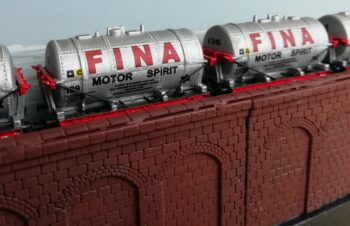
Petrofina meanwhile was founded in Antwerp, Belgium, on 25 February 1920 by Auguste Diagre, brothers Hector and Fernand Carlier and Aloys Van de Vyvere as Compagnie Financière Belge des Pétroles, but the name was changed to PetroFina to reflect its telegraphic address.
Petrofina merged with Total SA of France to form TotalFina and with Elf in 2000 to form TotalFinaElf. The company’s name has been Total SA since 2003.
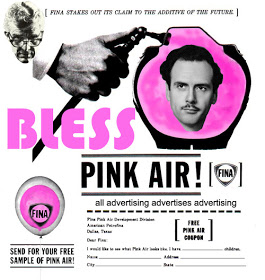
American Petrofina was founded in 1956 with service stations branded as Fina from 1959. In 1961, Fina introduced its Pink Air promotional campaign noting that while Fina gasolines were loaded with all the same ingredients that made their fuels “Exactly As Good As The Best” adding that only at Fina stations could motorists get “Pink Air” for their tyres to keep them from deteriorating. In its “Pink Air” ads, Fina (then undergoing a major expansion of its marketing territory which encompassed the Mid-Continent region from Texas to Minnesota) noted that Pink Air was arriving at new Fina stations as fast as they could be opened and set a goal of having Pink Air in all of its stations by May 1966 – five years later.
In 1966, when “Pink Air” finally arrived at every Fina station, Fina replaced that campaign with a new one regarding an ingredient in its gasoline called “Pflash.” At a time when other US oil companies were promoting their gasoline products with campaigns such as Esso’s “Put A Tiger in Your Tank!”, Shell’s “Platformate” additive that they claimed to improve gas mileage, Texaco’s invitation to “Trust Your Car to the Man Who Wears The Star” and Mobil’s”Detergent gasoline”; “”PFLASH”, was promoted as an ingredient in Fina gasoline that would improve driving pleasure by “turning red lights green,” “smoothing out rough roads,” “improving the food at roadside restaurants” and “making you feel less sorry you ever got a driver’s license.” Fina stations even offered free “Pflash” bumper stickers to motorists who pulled in for gasoline purchases.
Fina were heavily involved with NASCAR sponsorship in the USA while in Europe Fina were BMW’s primary oil & lubricants partner from 1988 to 1998, featuring on all of BMW Motorsport’s works team racing cars
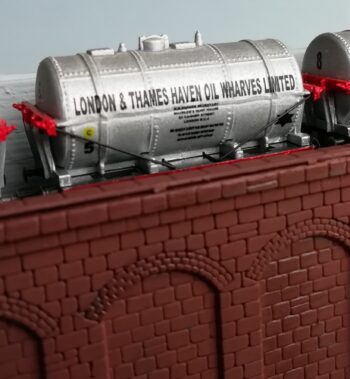
The London and Thames Haven Oil Wharves Company was founded at 101 Leadenhall Street, London on 24 May 1898, the wharves themselves being at the end of a branch line from Thames Haven Junction, located between East Tilbury and Stamford Le Hope.
In London & Thames Haven Oil Wharves Ltd v Attwooll [1966] 43TC491 the company’s jetty was damaged by an oil tanker. The company received payment from the tanker owner and from its own insurers, which exceeded the cost of repairing the jetty. The insurance was for physical damage only but it was agreed with the insurers that the recovery from the tanker owner should be taken to include a sum for the loss of use of the jetty whilst undergoing repair. The compensation for the loss of use of the jetty was to make up a hole in the profits and was taxable. Lord Diplock first of all set out the general rule governing compensation cases: the compensation is to be treated for income tax purposes in the same way as the sum of money would have been treated if it had been received instead of the compensation
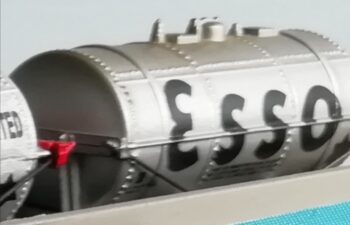
The Standard Oil Company was founded in Ohio, USA, by John D. Rockefeller in 1870. As well as refining and transporting its kerosene heating and lamp oil in larger amounts than rival companies to achieve economies of scale, Standard Oil made better use of all the products that crude oil could yield. While other companies were dumping “waste” gasoline in rivers, Standard Oil used it to power machinery and were thus in a strong position to embrace the first automobiles. Rockefeller’s firm also produced the first synthetic alternative to beeswax.
In 1891, the Shukov cracking process became the World’s first commercial method for breaking down the heavier hydrocarbons in crude petroleum, increasing the percentage of lighter products compared to simple distillation.
So successful was Standard Oil that Rockefeller disengaged from the business in 1896 to concentrate on philanthropy while in 1911 the break up of Standard Oil into 34 smaller companies made him the richest man in the World and even a today his name is a byword for wealth. Emerging from these 34 companies were such household names as Exxon, Mobil, Chevron, Amoco – and Esso : the red word in the blue oval being a phonetic derivative of Standard Oil.
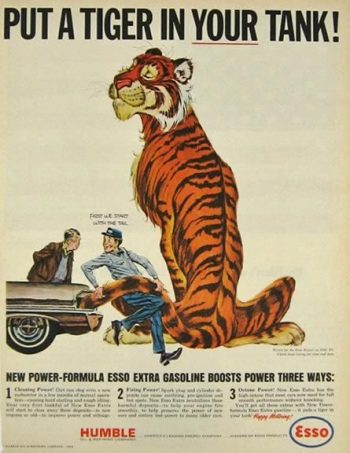
In the 1920s, Esso fuel was delivered to kerbside pumps in Britain by Foden steam lorry and the first UK Esso filling station opened in 1934. At the end of World War II, Italian dictator Benito Mussolini was strung up by his feet from an Esso petrol station in Milan. Later, in the UK, two and a half million Esso bumper and petrol cap stickers urged motorists to “put a tiger in your tank”. The slogan created in 1959 by Emery Smith, a young Chicago copywriter who had been briefed to produce a newspaper ad to boost sales of Esso Extra. However, the tiger wasn’t Smith’s invention. The big cat had first appeared as a mascot for Esso in Norway around the turn of the 20th century. But it wasn’t until the end of the Second World War – and the resumption of petrol advertising – that the tiger made his US debut. He was a very different character back then. Cute, amiable and in cartoon form, he closely resembled Tigger in Winnie-the-Pooh and was intended to represent a new post-war optimism after years of shortages. He also gave an identifiable face to Esso in a market where brand differentiation has never been easy. It was in 1964 that the character really hit his stride with a campaign developed by McCann Erickson. As Esso sales soared and the advertising became the talk of adland, Time magazine declared 1964 to be “The Year of the Tiger” along Madison Avenue.