
The story of the Metropolitan Vickers engined Saunders Roe SRA1 jet flying boat is recounted in Aeroplanes Without Runways Part One on this website, but the Cowes, Isle of Wight, based firm’s final two major projects – the SR 53 mixed powerplant fighter and the SRN1 hovercraft – were also tales of technical possibility undermined by official myopia and ignorance.
SR53 FIGHTER

The story of this delta winged mixed powerplant aircraft really began with the first flight of the Messerschmitt Me 163 B-1 Komet in August 1941. The World’s first – and so far only – operational rocket interceptor built on German experience with rocket planes dating back to 1928. But rather than air breathing gunpowder, the Me 163 Komet was built around the Walter HWK 109-509C-1 liquid fuel rocket motor.

Because a rocket does not ingest and compress air like a gas turbine but carries its own oxidant, its performance actually improves with – rather than suffers from – extreme altitude. The penalty for this however is that a rocket aeroplane has to carry the weight of its own oxidant as well as fuel, limiting its range and/or performance.
While Werner von Braun’s V2 ballistic missile was fuelled by alcohol, water and liquid oxygen pumped together and burned in a combustion chamber, the Komet used a pair of hypergolic chemicals – ones that spontaneously ignite when mixed. Of these, the fighter – designed by Dr Alexander Lippisch – needed 3 parts of T-Stoff oxidiser to 1 part of C-Stoff fuel.
T-Stoff was 80% high test peroxide and 20% water with some stabilisers such as phosphoric acid. With added permanganate catalyst Z-Stoff, T-Stoff rapidly decomposed into steam and oxygen and was thus used on the launch catapults for V1 cruise missiles as well as driving the propellant pumps on the V2.
C-Stoff was a mixture of methanol, hydrazine and water but both clear liquids were highly toxic and corrosive. As a result, one tanker truck would fuel the Komet with C-Stoff and be driven well away before another – often an Opel Blitz – would approach with T-Stoff oxidant.

The Messerschmitt Me 163 B-1 Komet entered service in the summer of 1944 and could reach 30 000′ in 2.6 minutes at a speed of 596 mph. In comparison, neither the Avro Lancaster, Handley Page Halifax (pictured above) Boeing B-17 Flying Fortress or Consolidated Liberator could exceed 300 mph and the North American P-51D had a top speed of 440 mph.
However, the Komet only carried enough fuel for 8 minutes of powered flight, after which the tail-less swept wing aeroplane glided back to base and landed on a skid, its main wheeled undercarriage having been jettisoned at take off to improve streamlining and save weight. The shock of such a heavy skid landing often caused the residual fuel in its tanks to explode and more of the 470 Komets built were lost in such accidents rather than in combat. Indeed, describing his one post War Komet test flight, Captain Eric “Winkle” Brown RN likened the rocket fighter to being in charge of a runaway train!
Once on the ground, the aircraft had to be retrieved by a Scheuch-Schlepper, a converted agricultural vehicle towing a special retrieval trailer with a pair of short tracks supporting twin trailing lifting arms

After the War, the Allies were able to examine the Me 163 and its engine as well as other German projects. These were not just academic technical enquiries however. As the Cold War divided Europe again, Britain would need to defend itself against the threat posed by high speed nuclear armed Russian jet bombers.
The result was two British rocket assisted take off motors, the 5 000 lb thrust de Havilland Sprite and the 2 000 lb thrust Armstrong Siddeley Snarler.
The Sprite used high test peroxide as a monopropellant with a silver catalyst while the Snarler, like the V2 engine, used methyl alcohol, water and liquid oxygen.
The Snarler was first flown on 20 November 1950 in the Hawker P1072, essentially the prototype Armstrong Whitworth Sea Hawk, VP401, with the rocket in the tail. Although the P1072 achieved a very impressive climb rate of 5 000 feet per minute, fuel capacity for the Nene turbojet was decreased by the presence of rocket fuel and oxidiser tanks. After six more flights the P1072 was grounded after an explosion, by which time reheat had become the favoured method of boosting jet aircraft speed and altitude.

However, 2 February 1952 saw the Ministry of Supply issue Specification F124T for a cheap, simple rocket fighter for point defence. After launch from a ramp, this would, like the Komet, land on a skid and require a recovery vehicle to bring it back to a preparation and refuelling point.
In late 1951 however, Maurice Joseph Brennan, assistant chief designer and later replacement for Sir Arthur Gouge at Saunders Roe, had written a paper on rocket powered aircraft.
And by the time that the company was allowed to see a copy of Specification F124T in April 1952, Brennan considered possible a rocket fighter which could reach an altitude of 100 000 feet: more than 19 miles and considerably higher than the subsequent SAM-2 missile or the Lockheed SR-71 Blackbird spyplane. And also at an altitude where a jet engine would struggle to breathe but a liquid fuelled rocket would be in its element.
Brennan also favoured high test peroxide (HTP) oxidant and kerosene fuel rather than the practical alternative of nitric acid and liquid oxygen. Although HTP was very expensive in the early 1950s (but would be cheaply mass produced later on), the liquid oxygen in a fighter aircraft would need constant topping up while the mechanical parts would need to be warmed to prevent freezing.
Fire on an oxygen rich aircraft would also be violent and difficult to extinguish: one reason for the eventual cancellation of the rival Avro 720 rocket fighter. This was due to combine an Armstrong Siddeley Viper gas turbine with a methanol/liquid oxygen Screamer rocket from the same company but was terminated before a mock up could be completed.

By April 1952, the Ministry of Supply had also modified Specification F124T to include a conventional nosewheel undercarriage and a jet engine to help the fighter return to base and land: an advantage that the Soviet Buran spaceplane would later have over the American Space Shuttle which returned to Earth as a glider.
However, there was disagreement about how powerful the gas turbine should be before, on 30 October 1952, Saunders Roe received the Ministry of Supply’s Instruction to Proceed to build three prototype mixed powerplant fighters.
What became the Saunders Roe SR 53 had an Armstrong Siddeley Viper gas turbine mounted above a de Havilland Spectre rocket. The 2 700 lb thrust Viper, which went on to power the Hunting Percival Jet Provost and Hawker Siddeley Dominie trainers, was supplied with air through shoulder mounted intakes on the SR 53. The 8 000 lb thrust Spectre, although needing its own supply of oxidant, could share tanks of kerosene fuel with the Viper turbojet. However using both engines together at maximum power would consume fuel very rapidly although the Spectre could be throttled between 10 and 100% thrust.
Crucially too, the SR 53 could not take off on Viper power alone and would only be an effective interceptor within a highly capable ground control environment. It carried no guns or air interception radar of its own and armament would be a de Havilland Blue Jay – later known as Firestreak – air to air heat seeking missile on each wingtip.
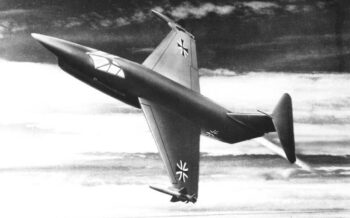
However, as early as 1954, Saunders Roe were planning a phase two mixed powerplant fighter with room for Ferranti air interception radar above a chin intake to permit collision course attacks.
By the time that an Instruction To Proceed for what became the SR 177 arrived at Cowes in September 1955, the delta winged fighter was to place a Spectre rocket above a de Havilland (later Bristol Siddeley) Gyron Junior turbojet of 10 000 lb thrust. The Gyron Junior would later power the Mark 1 Blackburn Buccaneer which also featured blown flaps to reduce landing speed.
More importantly, Saunders Roe received a grant of 1.5 million dollars towards development of the P177 from the United States which, despite having been first to break the sound barrier in a rocket aeroplane in 1947, had no comparable mixed powerplant programme.
In September 1956, orders were placed for 27 examples of the SR177 for the Royal Air Force, Royal Navy and as aircraft for further research.
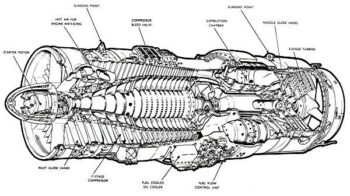
During the same month, de Havilland bought a 33. 3% share of Saunders Roe and in early 1957 the newly re established Luftwaffe showed interest in an interceptor which could climb to Russian bomber altitude within West German airspace. The German specifications however would have substituted a Rolls Royce Avon (pictured above) of greater thrust than the Bristol Siddeley Gyron Junior although interest was also shown in an Avon only SR 177 with greater fuel capacity for low and medium level missions. The Kriegsmarine also considered ordering SR 177s in their hundreds, possibly with the involvement of aerospace companies across Western Europe in component building and airframe assembly.
In fact the SR 177 could have been further developed to include short field operation, flight refuelling, wingtip ferry tanks and underwing stores pylons and have been used for reconnaissance and ground attack missions as well as high level bomber interception.
Saunders Roe itself even suggested that the more basic SR 53 – purely rocket powered to offer a range of 90 miles – could be mounted on the back of an Avro Vulcan as a parasite fighter. Assuming that a dorsal position launch could be successful, it is not clear where the parasite fighter would land after battling MiGs. But launching a rocket aeroplane from a four engined jet already flying at 60 000 feet could have considerably raised the World Altitude Record if not put a British pilot into space.

Sadly, in April 1957, the infamous Duncan Sandys Defence White Paper cancelled all future manned fighter aircraft with the exception of the well advanced English Electric Lightning. By August 1957, even the Royal Navy SR 177 was cancelled. German interest was then redirected towards the American Lockheed Starfighter jet and even a Japanese offer to buy the existing SR 53 s and the SR 177s then under construction at Cowes fell through.
Britain never did adopt the “trip-wire” missile based national defence strategy put forward by Duncan Sandys but did have to fight colonial and brush fire wars with jet aircraft, either in its own interests or as part of NATO and the United Nations.
As such, Britain had to spend its foreign currency on American aircraft such as the McDonnell Douglas Phantom II or be obliged to collaborate with other European partners on the Jaguar, Tornado and Typhoon.
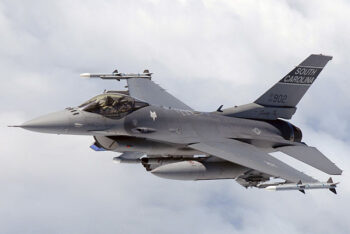
One American aeroplane that Britain did not buy, but many nations around the world did, was the General Dynamics F-16 Fighting Falcon. Like the SR 177, this is a single seat delta wing fighter which began life as an agile interceptor fighter but has since developed as an attack and reconnaissance platform.
First flown in 1974, the F-16 is 49′ 5″ long, with a 32′ 8″ wingspan and can be fitted with either a General Electric or Pratt & Whitney engine with in excess of 17 000 lb of dry thrust and 29 000 lb with reheat. This allows it to reach 50 000′ and a maximum speed in excess of Mach 2.
The equivalent figures for the SR 177 were 50′ 6″ long, wingspan over missiles 30′ 3 1/4″, de Havilland Spectre rocket of 10 000 lb thrust plus 10 000 lb thrust Bristol Siddeley Gyron Junior gas turbine. Speed was estimated at Mach 2.35 and service ceiling 67 000′.

Although the first SR 53 prototype, XD145, was structurally complete by the end of 1954, fitting out the systems was made difficult by the small compact nature of the aircraft – a similar situation to the later Folland Gnat jet trainer.
More seriously, de Havilland was slow to supply a working Spectre engine because of fuel proportioning and bag fuel tank issues and the blast from it on an SR 53 test rig damaged both the control surfaces and jet efflux pipe.
XD145 arrived at the Aircraft and Armament Experimental Establishment at Boscombe Down on 28 June 1956 for nearly a year of engine and other ground trials. By this time both the third SR 53 prototype and the rival Avro 720 had been cancelled.
16 May 1957 however saw new Saunders Roe test pilot Squadron Leader John Booth DFC engage both powerplants of XD145 and take to the Wiltshire skies. As predicted, the SR 53 displayed an impressive rate of climb and, not long after in the test programme, a speed of Mach 1.33.

XD145 flew at the 1957 SBAC Farnborough Air Show while the newly delivered second prototype XD151 was displayed on the ground. This flew for the first time on 8 December 1957, taking over the test programme while XD145, which suffered a Spectre motor flashback in October 1957, was modified with the same larger fuel tanks. In all, XD145 made 31 test flights while XD151 logged eleven.
As 1958 progressed, the mixed powerplant concept justified its supporters with more efficient HTP handling methods being developed and the discovery that the small white interceptor could be held at readiness for days at a time.

On 15 June 1958 however, XD151 failed to leave the Boscombe Down runway on take off, John Booth only deploying the landing parachute just before the fatal collision with a concrete lamp pole. After the explosion, the remains of the aircraft showed it to be in good mechanical condition but that the Spectre had been throttled back, making take off impossible on just the Viper jet, and the wheel brakes not touched.
The true reason for the crash was not ascertained but XD145, which had not flown after October 1957, was permanently grounded. However, XD145 had spent early 1958 ground testing newer Spectre engines before being moved in 1959 to the Rocket Propulsion Research Establishment at Westcott. After being retired to the RAF museum store at Henlow, the sole surviving SR 53 arrived at RAF Brize Norton in November 1978 for restoration work and has been a long time resident of RAF Cosford.

However, the SR 53 programme was not entirely in vain. The purchase of a third of Saunders Roe by de Havilland in September 1956 gave the Hatfield based firm a greater stake in the rocket vehicle expertise of Maurice Brennan and led to the Black Knight launch vehicle being built and tested on the Isle of Wight.
Black Knight was commissioned in 1955 to study the behaviour of high speed vehicles re entering the Earth’s atmosphere: originally to help design the warhead carrier for Blue Streak nuclear deterrent. Power came from a four chamber Gamma 201 motor developed at the Rocket Propulsion Establishment at Westcott, Buckinghamshire and once again HTP provided the oxidant for RP-1 Kerosene fuel.
Britain’s first indigenous expendable rocket booster lifted off from Woomera, South Australia, on 7 September 1958, the first of 22 successful launches. Among these, lasting into 1965, BK01 and BK02 were used to test Black Knight itself while BK11 supported the European Launcher Development Organisation.
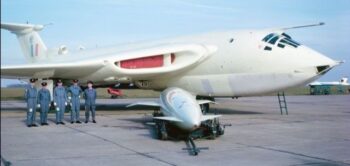
From 1960, Black Knight missions used the more powerful and efficient Gamma 301 rocket motor developed from the Bristol Siddeley Stentor unit from the Blue Steel stand off missile, assembled by the Gloster Aircraft Company.
A second stage was also added. Powered by a solid fuel Cuckoo motor, this was designed to fire on the way down rather than the way up, to increase the vehicle’s velocity just before re-entry.
Black Knight rockets eventually travelled to an altitude of 500 miles, about twice the height of the later American Space Shuttle, and were powerful enough to attained Earth orbit.
In fact, Saunders Roe helped to build the lower portions of the three stage Black Arrow launch vehicle which, in October 1971, lofted Britain’s Prospero satellite into orbit. The United Kingdom then became the only nation in the world to give up its satellite launching capability. And by this time Saunders Roe had been taken over by Westland of Yeovil.
SRN 1 HOVERCRAFT

Just as the door of mixed powerplant interception was being closed by Duncan Sandys at Cowes, Saunders Roe was presented with a new opportunity by the Ministry of Supply.
Since 1953, Christopher Cockerell had been experimenting with the idea of a vehicle that could move easily from smooth land to water on a cushion of air. On 31 August 1957, Saunders Roe picked up a design study declined by Short Brothers and Hartland and Cockerell joined Maurice Brennan and Saro’s Chief Aerodynamicist Richard Staunton-Jones in developing a man carrying air cushioned vehicle.
Although the hovercraft had, and still has, immense military potential, its existence was declassified in September 1958 and was financed by the National Research and Development Corporation. This public body had been founded in 1949 to finance new ideas deemed to be in the public interest. But as Cockerell’s vision was to be the largest project that the NRDC had ever undertaken, it was handled through a subsidiary – Hovercraft Development Limited – founded in 1959.

The first full scale hovercraft, SRN1, was completed at Cowes in May that year before engine tests and a public demonstration on 11 June with new Saro test pilot Lieutenant Commander Peter Lamb DSC AFC at the controls.
Looking rather like a cotton bobbin, SRN1 was built around an Alvis Leonides piston engine which blew air downwards to create lift and along ducts either side of the cockpit to propel and steer the air cushion vehicle. Although never “flying” more than a few feet off the ground, SRN1 was still technically an aeroplane and carried the Saunders Roe experimental registration G-12-4 just under the word Hovercraft. After four years of paving the way for larger and more useful hovercraft, SRN1 became part of the Science Museum collection.
“Sheepy” then took Saunders Roe Nautical Number 1 across the Solent on 22 June and the English Channel from Dover to Calais on 25 July, the 50th anniversary of Louis Bleriot flying in the opposite direction.
But in their moment of technical triumph, Saunders Roe disappeared inside Westland aircraft. Alliott Verdon Roe had died the year before, Sir Arthur Gouge resigned as Chief Executive in September and Maurice Brennan also left.

At the same time, the helicopter interests of Fairey and Bristol also gravitated towards Yeovil while inside the Columbine hangar at Cowes, SRN2 was being developed. By 1970, the British Hovercraft Corporation was 90 % owned by Westland and 10% by the British Government.
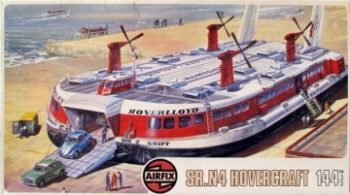
Although they never became as ubiquitous as Sir Christopher Cockerell perhaps would have liked, hovercraft captured the imagination of the world in the 1960s. They mounted expeditions up tropical rivers, ferried passengers to and from the Isle of Wight and most impressively the giant SRN4s took passengers and cars across the English Channel – as celebrated in an Airfix kit and the James Bond film “Diamonds are Forever”.
Before the NRDC rationalised hovercraft development into the British Hovercraft Corporation in 1966, interested companies included Denny Brothers of Dumbarton, Vickers Armstrong, Folland aircraft and Britten Norman.

John Britten and Desmond Norman both trained with de Havilland and began work in their Ventnor, Isle of Wight, factory in 1953 making crop spraying equipment for Tiger Moth biplanes. Their lightweight Cushioncraft CC1 – pictured above – was the second operational hovercraft, but they are better known today for the BN-2 Islander twin propeller monoplane, which first flew in 1965.
Britten and Norman made a detailed analysis of the aviation market and decided there was a demand for a twin-engined utility aircraft with the minimum of complex systems that could operate from short, rough airstrips and also be used for high-density commuter flights.
The Trislander – with a third engine mounted on the tail and greater range and payload – followed in 1970 and in 1975 won the Queen’s Award for Industry for technical innovation. The Islander also evolved into the military Defender and is available as a turboprop as well as with the original Lycoming piston engines. A number of components for the Islander were also supplied by what was left of Saunders Roe at Cowes from 1964. This division of Westland also made engine nacelles for, among other aircraft, the Handley Page Jetstream.

Britten Norman itself said :
“The ubiquitous Islander is the best-selling commercial aircraft produced in Western Europe. Adaptable, versatile and durable, it has an unsurpassed record of solving transportation problems simply and economically in some of the world’s harshest environments.
Ten seats, twin engines and a design driven by the requirement for ease of operation provide exceptional levels of utilisation. Constant refinement ensures that the Islander continues to excel in modern-day roles including environmental protection, transportation, air ambulance, fisheries protection, photo surveying, policing and parachuting to name but a few.”

G-XAXA, as represented by Ron Firth’s 1/72 scale model, is a BN-2A-26 Islander with 300 bhp Lycoming piston engines in the markings of Blue Islands. Carrying Britten-Norman serial number 530, the 1976 vintage machine was first registered as G-BDWG before joining the Canadian register as C-GYUG. It returned to the UK, again as G-BDWG, to join Euroair Transport on 15 August 1977 and retained the registration until 27 July 1995 when it became G-LOTO of the Scottish Parachute Club (Islander) Ltd.
The identity G-XAXA was assumed on 22 August 2000 with Guernsey based LeCoq’s Airlink, renamed Rockhopper on 29 August 2003 and Blue Islands on 14 February 2006. Blue Islands retired their Islanders in 2011 but the registration G-XAXA was retained when c/n 230 joined Pixair Survey SAS on 29 February 2012. Since 22 January 2013 however, the Islander has been French registered as F-HSUR.

Like the Islander, the Handley Page Jetstream was the product of market research to identify an affordable niche product: in this case a regional and commuter airliner for America.
In the 1960s, Handley Page wished to remain independent of both the Hawker Siddeley group of companies and the British Aircraft Corporation but lacked the money needed to develop a large new airliner that would keep it in the market.
The solution was a 12-18 seat high speed twin turboprop, which gathered orders even before the drawings were complete. Unlike the Islander, the Jetstream was also pressurised to allow it to fly above bad weather but the circular fuselage cross section was so small that the main spar of the low straight wing presented a trip hazard in the cabin floor.
Although final assembly was at Handley Page’s Radlett works, engine nacelles were built at Cowes and complete wing sections fabricated by Scottish Aviation at Prestwick and tailplanes by Northwest Industries of Canada.
More problematic after the maiden flight on 18 August 1967 however were the French Turbomeca Astazou engines which at 840 bhp apiece seemed underpowered and surprisingly temperamental for such a well proven design.
As a result the testing programme relocated to the Turbomeca factory in the south of France while the fifth Jetstream was fitted with a Garratt TPE 330 powerplant more familiar to North American operators.
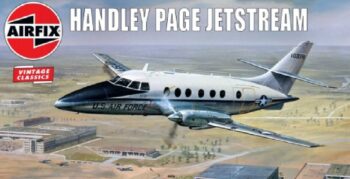
This also made the Jetstream acceptable to the US Air Force which ordered eleven examples as the C-10A, fitted with a cargo door and accommodation for 12 passengers or six stretcher cases. However, this order was cancelled in 1969 due to late delivery and the Jetstream never flew in USAF markings: to the undoubted embarrassment of Airfix, who still have not revised their box art and decal sheet!
By the time that the first production Jetstream 1 flew on 6 December 1968, and as 36 examples were delivered over the next year, Handley Page launched the Jetstream 2 with a more powerful 965 bhp Astazou XVI engine. However, late delivery and further engine issues meant that only three of the improved Jetstreams were delivered before Handley Page went bankrupt. The production line closed in 1970 with development costs standing at £13 million rather than the projected £ 3 million.
However, Scottish Aviation was interested enough in the design to set up a subsidiary named Jetstream Aircraft. In February 1972, 26 Jetstreams were ordered by the Royal Air Force as the Jetstream T.1 multi engined trainer. Of these, 14 eventually became Jetstream T2 observer trainers for the Royal Navy. Following these orders, the Jetstream, now a British Aerospace product, found buyers in the regional airline and corporate market.

The Royal Air Force retired its Jetstreams in 2003 with the Royal Navy following suit in 2011. Most of the former were painted in red and white training livery but this particular model by Ron Firth, who also built the model of G-XAXA, anticipated the trend of modern RAF aircraft being painted in commemorative Second World War schemes. The serial number L1105 is from a Bristol Blenheim and the code FK belonged to 219 Squadron which flew Blenheims from RAF Catterick from October 1939 to October 1940.

During World War II, Saunders-Roe opened a factory at Fryars in Llanfaes, Anglesey, converting and maintaining Catalina flying boats. In the late 1940s and 1950s this Beaumaris factory began making bus bodies under the names Saunders, SEAS (Saunders Engineering & Shipbuilding) and SARO.
SARO bodied 250 RT double deckers for London Transport between 1948 and 1950 (RT 1152–1401), which were almost indistinguishable from the standard Weymann/Park Royal products; and some double-deck buses for Liverpool Corporation. 620 prefabricated Rivalloy (the brand name comes from rivetted (aluminium) alloy) single deck buses components for local assembly were sold to Autobuses Modernos SA, Cuba which later became Omnibus Metropolitanos, S.A. Another large customer was Auckland Regional Transport in New Zealand who took the Rivalloy body on 90 Daimler Freeline chassis.
In 1948 the only double deck bodies to be exported were 20 ordered by South African operator Durban Motor Transport which were mounted on AEC Regent Mark III chassis.
The factory later passed to Cammell Laird who mainly used it for producing refuse-collection vehicles.

The Leyland Tiger Cub was a lightweight underfloor-engined bus chassis manufactured by Leyland between 1952 and 1970. Most were built as 44-45 seat buses with a smaller number as coaches. Modified from the older Leyland Royal Tiger, the Cub was popular because of its lighter weight, less expensive price and revised, more modern specification.
The newly designed lightweight high straight frame of the Leyland Tiger Cub had a vertical radiator set just behind the front axle and it was powered by a Leyland O350H 91 bhp 5.76 litre diesel engine with a four speed gearbox.
The prototypes – and many later examples – were bodied by Saunders-Roe of Anglesey (SARO) as 44 seaters. Their second prototype in the livery of Ribble Motor Services was shown at the 1952 Commercial Motor Show.
Large numbers of SARO bodies were specified by the British Electric Traction group on Leyland Tiger Cub chassis. Operators included Trent, East Midland, Ribble, Yorkshire Traction and the Northern General Group. An integral version of the body design powered by a Gardner 5HLW engine was bought by Maidstone & District.

The Ulster Transport Authority ran both rail and bus services from their headquarters in Belfast in Northern Ireland from 1948 to 1966 when they ceased operation. Amongst their varied transport fleet were a number of the single deck front opening Leyland Tiger Cubs with SARO bodies, decorated in the UTA colour scheme of two tone green and cream, sporting the UTA badge on the sides.
The destination blind on this 1/76 scale Oxford Diecast model of PZ 4874 shows it going as the 108 to Aldergrove, one of Northern Ireland’s most famous aerodromes.
The wheels are an interesting shade of lime green with bright red and silver inserts with the remainder of the exterior trim finished in silver. The interior seating is moulded in dark green, with contrasting tan carpet and cream dashboard.
By the 1970s, Saunders Roe expertise was united with that of the Gloster Aircraft Company to create Gloster Saro road tanker lorries and fire appliances.