
The years after 1945 were a time of reconstruction. New houses, schools, roads and bridges were needed to replace infrastructure destroyed by wartime bombing and building. Later, during the 1950s, motorways and shopping centres would further transform British life into a more materialist and individualist culture. All this required cement distributed in bulk – rather than in bags – over long distances by rail.
This diorama contrasts the solutions to the challenge of moving bulk cement with the older accoutrements of the age of coal fired steam.

The first really successful British bulk cement wagon was the Presflo. Designed and first built in 1954 at Shildon, the Presflo – with its distinctive ribbed hopper body – was top loaded by gravity but used dry compressed air to discharge its 20 ton load into a storage silo or road vehicle. Presflos were also used to carry flour, salt, aluminia powder and sand. Unlike earlier wooden bodied wagons, Presflos had their own vacuum braking systems and pipes and were designed for work in fast moving block trains.
The prototype Presflo – B888000 – was built to BR Diagram 1/273 and Shildon Lot Number 2679 but all 1 891 production cement vehicles – outshopped by five different builders between 1955 and 1963 – conforming to Diagram 1/272

Measuring 11’9″ high and 19’11″ over buffers (when fitted with the most common 24.5″ self contained or hydraulic buffers) the production 10’6″ wheelbase all-steel vehicle mainly boasted two vacuum cylinders –located at one end of the underframe with a ladder positioned at the opposite end of the central reinforced hopper – actuating eight clasp brakes and roller bearing axle boxes for high speed running. Most versions also featured screw couplings.
A further thirty wagons were built by Metro-Cammell to Lot 3156 of 1958 and designated for ICI salt traffic, making a total build of 1 921 wagons.
In service B888003/17/22/25/38/51/84/94, B888111/8/21/28/29/48/50/55/60/62/63/64 and perhaps more of the Presflos were also allocated to salt traffic and received roof modifications including walkways. These went on to carry slate powder from Wadebridge (Delabole) and finally fly ash in the Peterborough area during the late 1980s and early 1990s.

Indeed, British Rail’s own workshops later built a longer wheelbase version of the Presflo to carry talcum-like fly-ash from power stations. This began with a Diagram 1/272 Presflo being modified to Diagram 1/281 as an experiment with a reduced 17 ton load. A small production batch of Diagram 1/278 ASH 17VBs and three Diagrams of 21 ton fly ash Presflo – 1/279, 1/ 280 and 1/ 282) followed.
The Butterley Iron Company built 100 Presflos, Shildon 180, Metropolitan-Cammell and Central Wagon 400 apiece while Gloucester RCW constructed 840 examples. As such it is fitting that the last surviving Presflo -B873368, eventually cleared to carry 22 tons of cement and now preserved at Shildon – was built in Bristol Road as part of Lot 3361. Presflos built to Diagram 1/272 began to be phased out from 1984 and all had gone by 1991.

The Prestwin was first built by the Metropolitan Cammell Carriage and Wagon Company in 1960. Based on a Continental design, the “twin tub” format was inherently stronger than the Presflo and also lacked any corners in which runny solids could stick. The Prestwin also featured a 2’ diameter aeration base plate so that the contents would discharge like a liquid.
The 11’11″ tall Prestwin could carry a 515.5 cubic feet load and was better adapted to carrying finer grained runny solids such as lime, hydrate of aluminium, soda ash, fertilizers and chalk. Many of the 12’ wheelbase Prestwins ended their days carrying sand. An example of this was B873748 built by Central Wagon Co Ltd of Wigan in 1962 as part of their Lot 3469, although the contemporary Airfix ( now Dapol) kit of a Prestwin ( above) depicts B873371. Like the Presflos, Prestwins each had two vacuum cylinders actuating two brake blocks per wheel.

1961 however saw Gloucester Railway Carriage and Wagon Company produce its first Cemflo wagon. These had entire floors which could be aerated for discharge, and to achieve a low tare to weight ratio the Cemflo bodies were made of unpainted aluminium. This also required the Cemflos to have two different suspension settings for running full or loaded.
In all, 285 Cemflo wagons were built. The original batch of 190 light alloy vehicles, numbered LA 001 to LA 190.
These wagons were fitted with eyebolt and rubber auxiliary suspension,and originally incorporated 8-plate laminated springs. These were very stiff and, in combination with the naturally stiff tank body, produced a torsionally stiff vehicle which was prone to derailment when running empty. The suspension was then modified twice, in consultation with the British Railways Board. First to incorporate softer 9-plate springs and later 10-plate Duplex springs. The tyre profiles were also to the British Railways’ Number 9 standard.
A further batch of 94 Cemflos, numbered LA 200 to LA 293, was built by Metropolitan-Cammell Ltd. between 1963 and 1965. These wagons are fitted with a double-link suspension of the International Union of Railways (U.I.C.) type. The suspension was designed by Metropolitan Cammell and incorporated laminated springs. The tyres had Continental type profiles. This new design was again approved by the British Railways Board.

The Cemflo wagons were best known for use on cement traffic from Cliffe in Kent to Uddingston in Glasgow which saw them hauled from Kent to York by pairs of Class 33s. They were also seen on flows from Holborough Cement Works in Kent to Widnes in Lancashire.
However by 1969 – and after the 1967 Thirsk disaster – they had been moved north and served Eastgate in Durham, Hope in the Peak District and Oxwellmains works near Dunbar amongst others.
Of the models displayed in this presentation, the shiny LA21 coupled next to the locomotive is based on an Accurascale product and represents the earliest iteration of the design while the weathered wagons are scratch built from pairs of old, inaccurate Hornby Cemflos and represent Cemflos modified to save weight and improve tare/load suspension.
More technical background to the development of cement wagons can be found at
Gloucester RCW and Cement Wagons
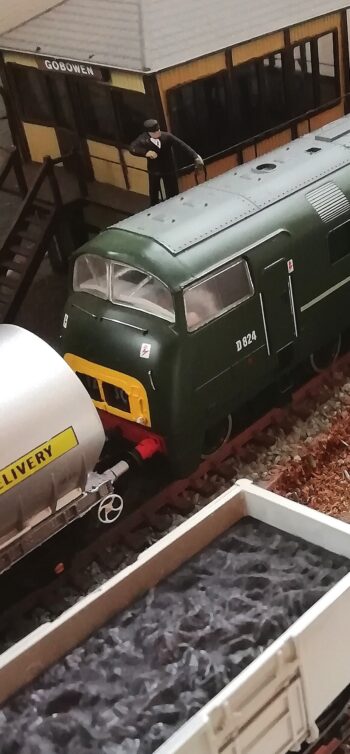
The classic Airfix Signal kit was based on the still-extant Midland Railway box at Oakham in Rutland although the original box and header card artwork showed a more inherently Great Western paint scheme of chocolate and cream.
When the ex Airfix mould was used to produce kit C006, Dapol added nameplate decals for Gobowen. This was firmly on Great Western territory between Shrewsbury and Chester but as Western Region took over former Midland lines on its territory from 1957 many signalboxes – such as the one at Mangotsfield in Gloucestershire – would have lost their original carmine woodwork.
It was these ex Midland boxes in particular – many of which were once found in Gloucester City – that inspired my diorama model although it soon became apparent how non-standard the Midland signalboxes were.
Discounting locations such as Gloucester’s Barton Street Junction – with the box on a gantry over the tracks – Midland installations could be one rather than two storey and be longer or shorter than C006 depending on how many point and signal levers were needed.

If I were assembling another Dapol signal box kit I might also paint the first floor outer deck – component six in stage two – brown before using it to hold the parts of stage one together. otherwise adding the brown elements on top of the cream undercoat just required a patient, steady hand whether done on the sprued parts or completed model.
Although Dapol kit C006 is supplied with clear plastic glazing panels, the Midland signalbox is still – again, like the Airfield Control Tower – supplied without the guard rail on the outside platform which would have been essential for its safe operation – not least when the signalman stood on the corner to issue or accept a single line token, as depicted above. As such I thought that it would not detract from the purpose of the diorama to add a guard rail made from thin, stiff florist-type wire which can be easily bent at 90 degrees over a table edge. These sections can then be glued together and painted black, although working on the principle of quitting while I was ahead I only used four upright members on the front of the box.
As with paint schemes, window glazing and other customised parts, studying historic photographs would be the best way of identifying the most authentic guard rail arrangements for a specific signalbox.

Having just given up the single line token is Western Region “Warship” diesel hydraulic locomotive D824 “Highflyer”.
As the narrow British loading gauge – even on the former Broad Gauge lines of Western Region – precluded the direct evaluation of German built V200s, Swindon Works had to redesign the original Krauss-Maffei V200 concept for their D800 series with licence built components at the same time as learning monocoque construction techniques. The D800 series would use thin metal plate strategically stiffened to bear loads. The side walls and roof of the locomotive would carry deadweight, buffing and drawing loads as well as the floor above the bogies. This meant that drawing office staff at the Wiltshire facility had to translate imported plans from German to English and metric to imperial as well as creating a new 2 200 bhp locomotive and the first unit was hand built from a pair of cross-membered steel tubes on the floor of the Erecting Shop. Given these challenges it is to the credit of all concerned that D800 “Sir Brian Robertson” was outshopped from Swindon in June 1958 and ready for traffic that August when the first blueprints only arrived in the spring of 1956.

“Sir Brian Robertson” was the only non-Naval name in the D800-D870 range – which continued the Warship theme from D604 – honouring the British Transport Commission chairman of the time who lived at Far Oakridge near Stroud in Gloucestershire. As might be expected, WR’s new bulbous fronted diesel had a strong family likeness to its Teutonic forbears and was powered by two Maybach MD650 engines ( of 1 056 bhp at 1 400 rpm and licence built by Bristol Siddeley ) allied to four speed Mekydro K10411 transmissions.
Like their D600 diesels, North British Locomotive built D833 – D865 with German designed MAN engines and Voith transmissions. These 33 locomotives had been ordered in July 1959 but construction only began in 1960 when NBL staff had been trained in stressed skin monocoque construction and sets of plans had been dispatched from Swindon. However, these locomotives – identifiable by square rather than circular rooftop exhaust ports – were often seen as less reliable than the Swindon built D800 series by the operating departments of Western Region and were usually to be found on freight rather than passenger duties as a result.

Toward the end of their careers, the NBL built Warships could also sometimes be distinguished by two small round holes cut under the route indicator panels to ventilate the cab and reduce fumes from the Voith transmissions. Although retaining their original numbers to the end of their lives ( but losing the D prefix after 1968 ), the Swindon built D800 -D832 and D866-D871 became Class 42 under British Rail’s Total Operations Processing System (TOPS) and the North British built D833-D865 likewise became Class 43: both Class identities being transferred to streamlined single-cab prototype and production High Speed Train locomotives during the latter part of the 1970s. The joker in the warship pack was D830 “Majestic” – Swindon built with Mekydro transmission allied to a pair of all-British Davey Paxman 12YJXL Ventura powerplants as an alternative to Maybachs.

In the early 1950s The Gloucester Railway Carriage and Wagon Company produced a steel 16 ton mineral wagon for the Ministry of Supply as well as a rivetted take on the basic format for British Railways Western Region and a corresponding all welded design for London Midland Region where the type had originated in the 1930s.
The arguably definitive variant of the 16 ton Mineral wagon, built by Derby Works under both LMS and BR ownership, lacked bottom discharge doors but did feature drop flaps above the side doors, the two ends of the wagon thus being held together by a steel bar in between. Enshrined as BR Diagram 1/108, these vehicles also lacked continuous vacuum brakes but were fitted with hand operated Morton brake gear applying one shoe to each wheel on one side only. In fact between 1950 and 1958 over 200 000 wagons were built to Diagram 1/108 by BR workshops and private builders in the biggest wagon building spree in British railway history. The 16 ton mineral wagon was also the basis for later doorless iron ore tippler wagons.

The 16 ton mineral wagons that were fitted with vacuum brakes actuating first four and then eight brake shoes – and were painted Bauxite rather than grey – were used for industry rather than individual small coal merchants, where the all-steel wagons had finally supplanted wooden bodied ex-Private Owner types by 1964. Indeed, as much wagon load traffic was lost to road transport at the end of the 1960s, many unfitted but welded 16 ton mineral wagons were rebuilt with vacuum brakes and continued to carry large amounts of coal until replaced by even larger hopper wagons in the 1970s.
By this time, too, although early pressed steel variants had come and gone, there were still a range of detail differences to be found on 16 ton mineral wagons including disc and spoked wheels, plain or ribbed brake levers, axleboxes, three link and Instanter couplings ( screw couplings being reserved for vacuum fitted vehicles ).

As well as wagon load traffic falling from two thirds of BR freight tonnage in 1968 to one fifth in 1976, the 1984 Miner’s Strike caused many 16 ton mineral wagons to be damaged by being stored loaded for long periods of time. After this time, too, the closure of many coalfields made large fleets of 16 ton mineral wagons redundant, most coal now being carried in merry-go-round trains of hopper wagons straight from ports to power stations.
The final use of the 16 ton mineral wagon was thus as a departmental ballast carrier, notably with rectangular holes burned into the sides half way up the bodies to prevent over-filling with spent ballast which is considerably more dense than coal.
As might be expected, the numerous and widely distributed 16 ton mineral wagon was soon represented in the 00 gauge railway boom of the 1950s with the Airfix kit being the best way to create an accurate model with the correct 9′ wheelbase. Early ready to run Wrenn, Graham Farish and Palitoy versions however had a body stretched to fit their standard 10′ wheelbase wagon chassis but recent releases seem to have rectified these issues.

Introduced in 1952, the 141 diesel mechanical 0-6-0s numbered D2200 – D2340 and later known as Class 04 were among the first diesel locomotives mass produced for British Railways. However, although ordered from the Drewry Car Company, sub-contraction saw them actually assembled by other manufacturers. D2277, the subject of the 1959 vintage Airfix (now Dapol) kit had a service life of less than a decade due to the amount of wagon load freight being lost to road haulage. Despite this, a diesel shunter had the advantage over an equivalent steam tank engine that, like a bus or lorry, it could be instantly started and switched off. No early morning fire raising or disposal with dropping the fire and raking out clinker at the end of a working day. A well maintained diesel engine would also create less noise and pollution than a steam locomotive, offer greater thermal efficiency and a cleaner, more comfortable working environment.
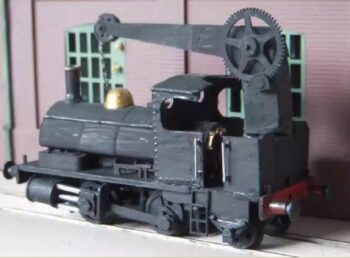
In the days before forklift trucks and lorries with HIAB lifting gear however, crane fitted tank locomotives were an ideal way of lifting heavy objects around factories, workshops and shipyards, which would almost certainly have had their own railway systems.
To modify the standard Airfix (now Dapol) kit, the frames of the crane Pug were stretched to accommodate an 0-4-2ST wheel arrangement allowing the crane jib to stand over the carrying axle, allowing the weight of the boiler to counteract any load being swung from one side to the rear and over to the opposite side of the locomotive. Notice too that although the jib can slew through more than 300 degrees it is fixed in the vertical axis and can only lift objects by raising its hook through shortening the chain.