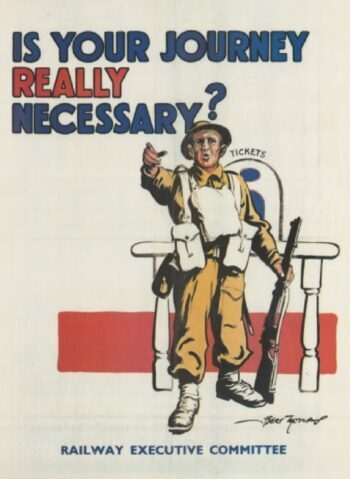
In 1942, the railways of Britain were once again under government control and carrying huge amounts of freight in support of the war effort. In particular, coal, iron ore and chemicals were often transported in private owner wagons while tanks, other fighting vehicles and even fireless engines for munition works travelled on larger railway company rolling stock.
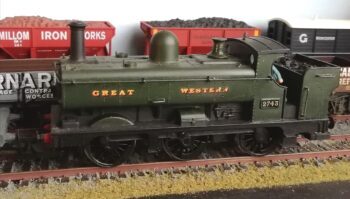
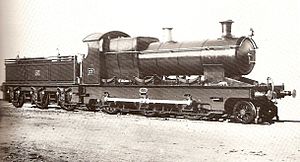
No locomotives were deliberately scrapped on Britain’s railways during World War Two, which led to the survival of many older types. Among these was GWR half cab 0-6-0PT 2743, built as Swindon Works number 1705 in 1899. First allocated to Cardiff, it was only withdrawn by British Railways at Worcester in 1950. Although never as glamorous as the Star, Castle and King four cylinder 4-6-0s, six coupled pannier tank locomotives were icons of GWR design and represented a quarter of the company’s motive power. The last examples did not leave Swindon Works until 1956 and some examples later served with London Transport.

During the conflict Swindon works built landing craft, parts for midget submarines, Stanier designed 2-8-0s for the Middle East – and diesel railcars.
The first railcar with Park Royal bodywork on an AEC chassis entered service in December 1933. Three more improved versions, 2 to 4, followed in 1934 while GWR railcars 5-18 (the last of these pictured above) were bodied by the Gloucester Railway Carriage and Wagon Company from 1935 to 1937.
Following the success of Gloucester RCW bodied railcar 18, designed to haul trailing vehicles, the GWR Chairman told the company’s annual meeting in February 1938 that 20 more diesel railcars were being ordered. With almost a million miles run by the first 18 examples, he said that:
“Whilst the original intention was to use them to provide additional services where the traffic was insufficient to justify the working of a train, our experience is that owing to the increasing cost of operating steam locomotives considerable economy can be effected by replacing them with diesel cars on certain sections”.
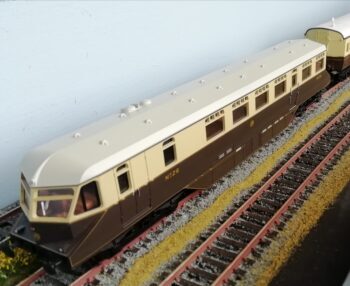
With both AEC and Gloucester RCW becoming increasingly involved in war work, Railcars 19-38 were constructed in-house at Swindon from July 1940 to February 1942.
AEC supplied transmissions and pairs of direct injection engines rated at 105 bhp while this final batch of railcars had clasp instead of drum brakes, more angular utilitarian bodies and 48 seats in 2+2 formation. Weights for railcars 19-33 were 35.65 tons and costs £ 6 240 apiece.
The performance of Gloucester RCW built car 18 had proved so influential that all but 19 and 20 of the Swindon built batch were permanently geared for a maximum speed of 40 mph and sufficient tractive effort to haul a trailing load.

Railcars 19 and 20 had special dual-range gearboxes which gave the options of 60mph fast running or a higher tractive effort at low speed. Of the Swindon built GWR railcars, 19 and 20 were built in July and June 1940 with number 20 being allocated to Ebbw Junction in the same month. Railcar 19 joined it there in December 1940.
Railcars 21-27 meanwhile were built at Swindon between July and November 1940 before being stored at Cherry Orchard near Cardiff. They entered service between May 1941 and March 1942 with Number 26 – the subject of Hornby model R2524A – being the last released to traffic. Built to GWR diagram A1 and Carriage Lot 1635, Number 26 was allocated to Cheltenham in 1942, Leamington Spa in 1947 and was withdrawn from Worcester in October 1962. During its last years it plied between Gloucester, Newent and Ledbury in a very tatty state – rails and ballast being visible through holes in the linoleum flooring!
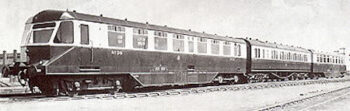
Although most GWR railcars were built with a cab at each end, the final four had one cab each and ran as either twin car trains or three car sets with an ordinary carriage marshalled between them. These trains were precursors of the diesel multiple units built in the 1950s for British Railways.
As new Modernisation Plan DMUs began to flood onto British Railways, many of the ex GWR railcars became concentrated in the Worcester, Severn Valley and Tenbury Wells areas by 1961.
All ex GWR railcars were retired in 1962 but three survive in preservation: AEC/Park Royal built 4 at Swindon and Swindon built numbers 20 and 22 on the Kent & East Sussex Railway and at Didcot respectively.

Even before diesel railcars, the Great Western Railway had pioneered auto trains with a small steam tank engine either pushing or pulling an auto trailer. Designed to avoid running the locomotive round the trailer at a terminus, the passenger vehicle featured a cab at one end for the driver while the fireman stayed on the locomotive footplate. Auto trailers could also be used as trailers to boost the capacity of railcars, although the railcars had to run round their auto trailers at the end of each journey.
When running autocoach first, the driver could warn of the train’s approach using a large mechanical gong, prominently mounted high on the cab end of the autocoach, which was operated by stamping on a pedal on the floor of the cab.
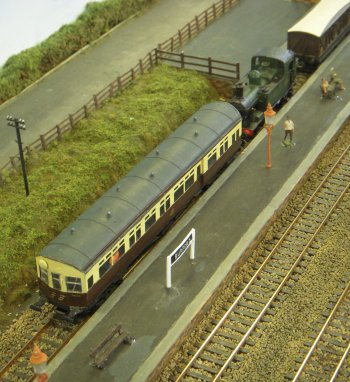
Internally, the passenger section of the coach was divided into two open saloons – originally for ‘smoking’ and ‘non-smoking’ – with a lobby in the middle separating the two. There was usually a small guard’s and luggage compartment at the ‘loco’ (non-driving) end of the coach. The seating layout was similar to the lower deck of a modern-day bus, with a mixture of transverse seating and inwards-facing bench seats.
Passengers accessed the auto coach via the lobby and the vehicle was equipped with retractable steps, which could be extended if the train stopped at rural halts with either low or non-existent platforms and which folded in tight against the coach underframe to keep them clear of lineside obstructions when the train was moving. These steps were controlled by the guard using levers in the lobby.

However, it will be noted that the Mainline model of auto trailer 187 is in post 1937 condition. Up till this date they had windows on the non-driving ends similar in size and shape to those at the driving ends.
In 1935 it was decided to paint these windows black as locomotive crews complained about being distracted by reflections. The non driving end windows were also likely to be smashed during locomotive coaling whilst the auto coach was still attached at this end, despite a thin white horizontal stripe being painted over them as a warning during the early 1930s.
As a result, in 1937, it was decided to plate the luggage end windows over and consequently the correct GWR livery for these modified vehicles would include the “shirtbutton” logo – rather than the traditional crest as used. However, auto trailer 167 has run in preservation on both the Dean Forest and Llangollen Railways where the older markings could have been applied.
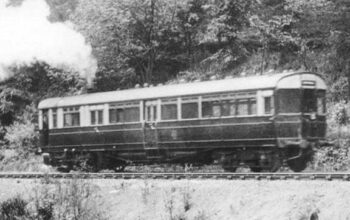
Some auto trailers were converted from steam railcars (steam rail motors being phased out from 1921) and even the new wooden framed steel panelled builds – the first of which left Swindon in 1928 and the last in 1954 – were not identical.
In the Grouping of 1922 / 3 the Great Western Railway also absorbed many smaller rural railways and inherited a number of wooden trailer type coaches. These were invariably modified and used after the takeover
Specifically, auto coach 212 was originally steam railmotor 93 of 1908, while auto coach 216 was originally steam railmotor 64 of April 1906, converted in December 1935 and condemned in September 1957.
1933 vintage auto trailer 190, preserved at Didcot, is the basis for 187, the ex-Airfix 00 gauge ready to run model. However, this has been criticised for being an amalgamation of two separate diagrams as A28 specifies 7′ wheelbase bogies, recessed glazing and flush driver’s doors but Diagram A30 has 9′ wheelbase bogies, flush glazing and recessed driver’s doors.
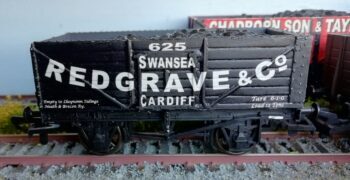
Gloucester RCW Official Photograph 3474 of January 1908 shows Redgrave 626, a seven plank 12 ton capacity wagon measuring 15’6″ x 7’4″ x 4′ with white wall tyres, a tare weight of 6-7-2 and wooden solebars with G-Plates inside the brake gear V-hanger and also under the second E in REDGRAVE. The italic legend on the left of the bodyside reads ” Empty to Llwynonn Sidings Neath & Brecon Railway.”
Arthur Redgrave was born in London in 1862 but by 1881 his family were living in Norfolk with Arthur employed as a contractors clerk. By 1901 he was in business at 88 Belgrave Terrace, Swansea, as a colliery agent and by 1903 he was trading as Redgrave & Co. Although Arthur Redgrave’s business had started in Swansea it soon spread to Cardiff. Its business address in the Welsh capital in 1909 was 84 The Exchange in Mount Stuart Square while the Swansea operation was based at Burrows Chambers. Coal was delivered as far away as the Midlands and possibly even Southampton.
Among the many Welsh mines represented, Llwynonn was one of the most productive sources of steam and manufacturing coal on the Neath & Brecon Railway at Crynant, near Neath.
In October 1903 one hundred new 10 ton wagons were ordered from the Gloucester Railway Carriage & Wagon Company Limited and paid for over seven years. All subsequent orders from Gloucester were for second hand hired wagons featuring the concave word REDGRAVE sandwiched between the words SWANSEA and CARDIFF. Only the wagons ordered as new in 1903 carried the earlier convex name above the word SWANSEA.
In July 1906 sixty 10 ton wagons were hired for a period of one year and in December 1906 a further fifty wagons were hired for two years. In January 1908 fifty five 12 ton wagons were hired for a three year period, including wagons 625 and 626. Indeed, although leased by Gloucester it is possible that it was not actually built in Bristol Road, one very alien feature to GRCW design being two bulky wooden side door stops instead of the single door stop represented on the model. This was also a feature of the light grey Charles Roberts of Wakefield wagons ordered by Redgrave from 1910.
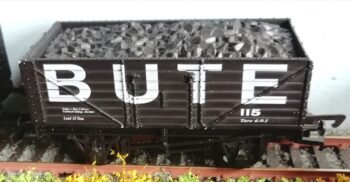
Note how on this Dapol / Antics model (reference ANT 008) note how the 12 ton load and 6-9-1 tare data are placed in opposition to to normal practice. Data on the left reads “Empty to Bute Collieries, Cwmbach Sidings, Aberdare”. 15’6″ length, 7’4″ width, 4′ depth.
According to Gloucester RCW Official Photograph 3381 of June 1907, solebar G-plates should be present under the U and T in Bute and also just to the right of the lower end of the right hand diagonal side brace. The prototype wagon was also outshopped with white wall tyres.
The Second Marquess of Bute (1793-1848) helped make Cardiff the rival of coal-exporting Newcastle in the middle of the Nineteenth Century. At the height of their busiest eras, Bute East and West Docks saw a coal wagon discharging into a ship’s hold every thirty seconds. The end door – faithfully modelled here with its commode style handles – was thus an essential design feature as laden trains from the mines up the valleys would “Cwmbach” time and again! In fact in 1900 the Great Western Railway introduced its own class of inside-framed 2-6-0s to haul heavy coal trains. They were known as “Aberdares”!
The ancestral home of the Roman Catholic Lords of Bute was Dumfries House near the village of Cumnock in the Scottish borders. This Palladian residence was designed by John, Robert and James Adams in the 1750s and contained arguably the World’s largest collection of Thomas Chippendale furniture. Until 1999 the Crichton-Stuart family also owned the island of Great Cumbrae in the Firth of Clyde and still own Mount Stuart House on the Isle of Bute itself.
Dumfries House was saved for the nation in 2012 after Prince Charles finished paying off a £ 45 million loan taken out in 2007.
The Seventh Marquis of Bute (1958 – 2021) also has strong connections with transport through his motor racing career. Driving under the name of Johnny Dumfries, he graduated from mechanic to become British Formula 3 Champion in 1984. The qualified painter and decorator then spent the 1986 Formula 1 season as second driver to Ayrton Senna at Lotus and also won the Le Mans 24 hour race in 1988 for Jaguar.
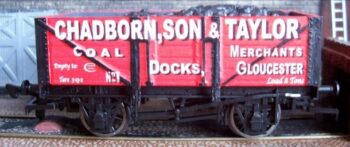
Gloucester RCW Official Photograph 2582 of September 1902 shows an 8 ton load 5-13-2 tare five plank wagon measuring 14’5″ x 6’11” x 3’1″‘ with internal diagonal bracing, white wall tyres and wooden solebars with G-Plates inside the brake gear V-hanger and just to the left of it as well as under the load data under the first E in GLOUCESTER. Unlike the model, it also had one tipping end door.
Founded by John Chadborn, the firm of Chadborn, Son & Taylor were originally stevedores who organised dockers at Sharpness and also introduced floating steam winches to unload sailing ships. John Chadborn was born around 1828/9 in Newnham, Gloucestershire and could well be the same John Chadborn that was recorded as a coal merchant in Gloucester Docks in 1868. In 1881 he was living at Barton House, Gloucester and registered as a timber merchant. John Chadborn went into partnership with his son Harry (born 1871/2) and Jim Taylor before dying in 1892. Although listed in the Kelly’s Directories of 1906 and 1935 as “steam winch proprietors” they still purchased coal wagons from The Gloucester Railway Carriage and Wagon Company, the firm that had also built their two storey wooden offices!
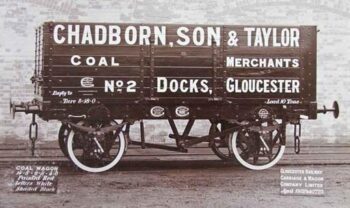
Wagon number 2, outshopped from Bristol Road in April 1903, was an end tipping seven plank 10 ton wagon acquired on seven years deferred purchase and carrying Gloucester RCW owner’s number 39801. A third wagon – a second hand 8 tonner – was acquired on similar terms in November 1916 although by 1927 the coal merchant’s side of Chadborn, Son & Taylor had been sold to W.L. Buchanan.
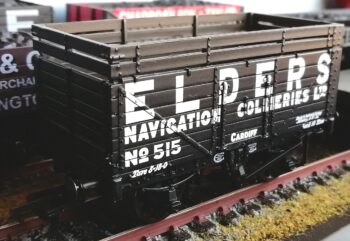
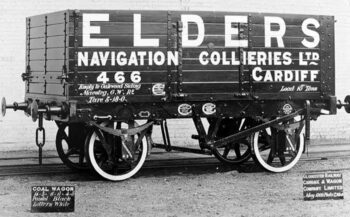
The data panel on Bachmann model 37-182 reads “Empty to Oakwood Siding Maesteg G.W. Ry.” while the May 1900 vintage Gloucester Railway Carriage and Wagon Company official photograph 2164 shows a black painted seven plank 10 ton wagon (5-18-0 tare) with side and end doors but no coke boards. Plain white lettering was similar but with larger “Cardiff” in place of Empty instructions which appear under a smaller fleet number – 466 – and beneath the identical tare weight. A third G plate also appears just to the right of this data group in addition to the two on the solebar. The length was 14′ 5″, width 6′ 11″ and depth 4′ 0″.
Elders was a colliery owner intent on supplying its own ships on a regular line service to the Canary Islands and the British colonies on the west coast of Africa, bringing mostly palm oil – for the soapmaking and food trade – and fruit back to the British isles, with general cargo in the opposite direction.
The Elder Dempster Steam Navigation Company was established in 1852 and following the acquisition of the competing Palm Line and other smaller concerns, eventually owned a fleet of 105 ships. The company fell on hard times in the 1920s and eventually folded up. From the ruins a new company was formed in 1932, which traded for many years until the advent of containerisation of cargoes which changed the face of the industry forever: including the disappearance of many of the great names of shipping companies which had become household words throughout the World.
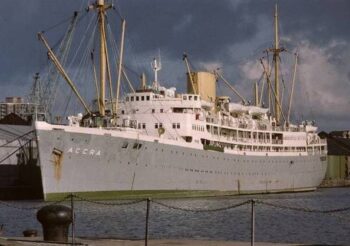
Despite this, the 1970 edition of the Observer’s Book of Ships still lists Elder Dempster Lines Ltd as trading out of the Port of Liverpool and its yellow funnelled ships as bearing African place names. It also reveals trade routes for the company as being from the USA, Canada and India to West Africa.
The Elder Dempster company eventually became part of the Ocean Transport and Trading group, into which had been merged many familiar names in the industry, including Wm Cory & Sons, one of the biggest in the coal shipping, trading, bunkering and transporting business. Cory Bros. (a different Cory) were also the sales agents for Elders Navigation Collieries, and that Elders coal was sold on the open market in Southampton is an indication that the steamship company did not use all of it.
Elders Navigation Collieries Limited were the owners of the Oakwood Colliery, a short distance south of Maesteg on the Great Western Railway branch from Tondu to Maesteg and the Llynfi Valley. Oakwood was purchased by the company circa 1900, and then passed on to the Celtic Oakwood Collieries Company shortly before it was worked out roughly 25 years later. it is impossible to prove that the wagons owned by and lettered “CELTIC” were acquired at the same time, but Celtic wagons were certainly around in the late 1920s. At around the same time the company also owned another colliery, Garth Merthyr, near Garth on the Port Talbot Railway, which was a convenient location as this railway was owned by the same interests as the docks in Port Talbot. This also ended up in the ownership of Celtic Collieries Limited.

That the Elders company decided to retire from the colliery business in the 1920s is concurrent with the more general introduction of liquid fuel: in 1925 they had a known contract for the purchase of fuel oil which was an indication of the change in fuels which indirectly was responsible for the decline in both the production and sale of the high quality steam coal for which South Wales was famous.
The Elders company purchased new wagons from both Hurst Nelson and the Gloucester Railway Carriage and Wagon Company and also purchased Yorkshire coal from Bullcroft Main. Welsh steam coal and anthracite was also sometimes sent to such east coast ports as Hull and Elder Dempster ships also called at Liverpool and Southampton
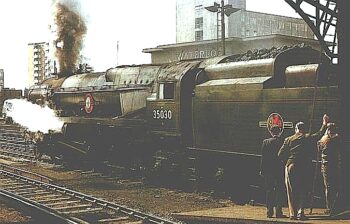
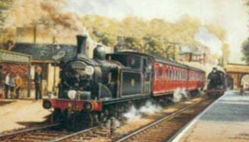
Elder Dempster Line and its flag – with a golden crown superimposed on the Cross of St George – became so famous that both were immortalised by Bulleid “Merchant Navy” Pacific 35030 seen here about to leave Waterloo for Bournemouth in September 1964.
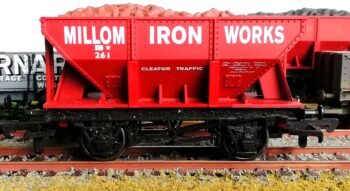
24 ton hopper wagon 261 took ore to Millom Ironworks before its closure in 1968.The most southerly town in the old county of Cumberland, Millom began life as the small hamlet of Holborn Hill and the 1841 census gave the population of 356. By 1855 however, Millom had a population of over 10 000 due to the expansion of iron, shipping,brick, tile and rail industries in the area. A licence to search for minerals was then granted by the Earl of Lonsdale and iron ore was discovered in 1856. By 1864 local mines had produced one million tons or ore, the first Millom iron smelting furnace opened in 1866 and the town boomed until the second half of the Twentieth Century.
Thousands of tons of coke arrived by rail at Barrow in Furness and Millom ironworks each day, travelling from West Auckland via Barnard Castle, Stainmoor summit, Kirkby Stephen East, Tebay, Oxenholme, Hindcaster Junction and Arnside. During the 1950s too, a train full of Durham miners would follow the same route for convalescence near Ulverston.
The additional wagon legend “Cleator Traffic” refers to another source of iron ore further north in Cumberland which sparked some local controversy in 1878.

Millom, Barrow in Furness, Ulverston and Arnside are south of Braystones along the coastal railway
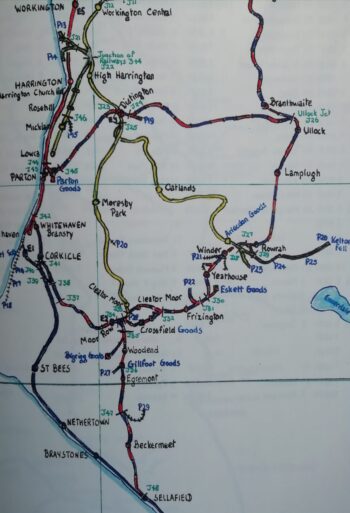
The Whitehaven, Cleator and Egremont Railway had built an extension in 1869 from Egremont to join the existing Furness Railway line at Sellafield in order to obtain an outlet to the south for the Cleator district iron traffic. The W. C. & E., although a small company, had prospered and its shareholders had come to regard dividends of 10% as commonplace.
However, in 1878, the W. C. & E. found their considerable north-bound mineral traffic threatened by the Cleator and Workington Railway, authorised on 27 June 1876. Furthermore the local traders were pressing for a reduction in the carrying rates. Just about the same time the London & North Western Railway made overtures to the W.C. & E Company. The L. N. W. had their stake in West Cumberland in shape of the line from Whitehaven to Workington, Cockermouth and Maryport, as well as their working of the Cockermouth, Keswick and Penrith Railway, and it is possible that Euston was concerned about the damage which the Cleator & Workington line might do to their traffic.
For much the same reason, the W. C. & E. accepted Euston’s offer and was leased to the L. N. W. R. in 1878. However, the Furness Company protested vigourously to the L. &. N. W. and also threatened to build their own line into the Cleator District by way of Seascale and Gosforth to Egremont. As a result the W. C. & E. R. became the joint property of the Furness and L. &. N. W. companies in 1879 and the shareholders were guaranteed 10% perpetuity.
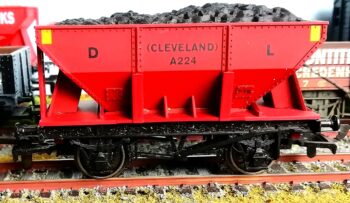
A similar design of hopper wagon to Millom Ironworks 261 once carried coal for Dorman Long, another famous name in iron and steel. Founded in 1975 when Arthur Dorman and Albert de Laude Long acquired the West Marsh Iron Works in Middlesborough, the company took over the concerns of Bell Brothers and Bolckow and Vaughan in 1929 and diversified into the construction of bridges, most notably the bowstring girder structures over the Tyne at Newcastle and Sydney Harbour. Other projects included the 1966 Severn Bridge and the Earth Receiving Station at Goonhilly Down, Cornwall, as described in The Telstar Story
In 1967 Dorman Long became part of British Steel and in 1982 the engineering part of the business, Redpath Dorman Long, was acquired by Trafalgar House who in 1990 merged it with the Cleveland Bridge and Engineering Company of Darlington.
Both Millom and Dorman Long hopper wagons are very similar to a Charles Roberts of Wakefield design of the early 1930s which was also built by the firm for British Railways after 1948 to Diagram 162. These wagons – relatively small for their maximum permitted payload – could also carry sand and limestone ( like iron ore, another mineral necessary for blast furnace iron smelting and twice as dense as coal ) and some examples were fitted with roller bearing axle boxes. Between 1949 and 1959 British Railways acquired 5 270 ironstone hopper wagons built to eight separate diagrams and ranging in capacity from 22 to 33.5 tons.
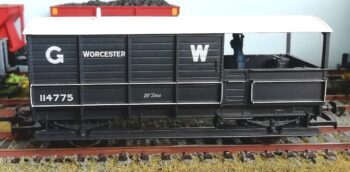
Until 1968, a brake van was necessary for every freight train, whether unfitted, partially fitted or fully fitted with continuous brakes. This meant that each railway company had to own large numbers of these non revenue earning vehicles, which still tended to be in short supply as they tended to accumulate at certain points. The GWR overcame this to an extent by allocating brake vans to specific trains.
The design of the 20 ton Great Western “Toad” brake van crystallised from 1902 under Chief Mechanical Engineer George Jackson Churchwarden and remained virtually unaltered until the last batch were built by British Railways in 1949. Compared with the short wheelbase 10 ton brake vans of some other railways, the Toad offered a much smoother ride. One design flaw however was that the horizontal brake wheel was on the open verandah rather than inside the covered cabin, making for unpleasant working conditions in bad weather. For this reason, the Toad was superceded by the British Railways LNER inspired standard brake van although its length and open verandah made the GWR design ideal for brake van rides behind the small steam locomotives of early British preserved railways.
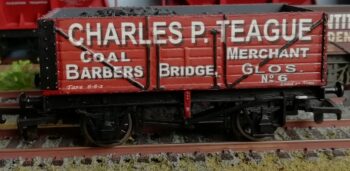
Gloucester RCW Official Photograph 3266 of October 1906 shows Charles P. Teague wagon 6 as a 10 ton seven plank wagon measuring 14’5″ x 7′ x 4′ with internal diagonal bracing, white wall tyres and wooden solebars with G-Plates inside the brake gear V-hanger and to the right of it under the G in GLOS. Like the model it also had two side doors. However there were no stop springs beneath them, no end door and a tare weight of six tons exactly.
William Teague ( 1786 – 1867) was born in Redmarley, Gloucestershire, but spent most of his life in Tibberton as a builder and carpenter. By 1851 he employed six men at his workshops at New Hall. His second wife Hannah bore him seven children, the oldest of which was Charles Teague (1818 – 1914)
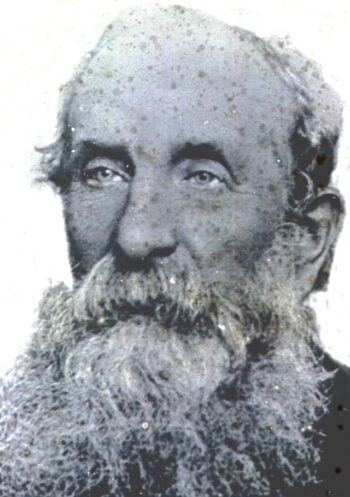
Charles Teague was a carpenter, wheelwright and builder and employed ten men and four boys at his inherited New Hall premises in 1861. By the 1880s his workforce had grown to 18 men and 3 boys and his workmanship was noted for its quality. Charles Teague was also known as a man of exceptional integrity, held many offices in the Methodist Church and posessed a fine singing voice. His funeral was attended by about 200 people but although he was buried before the First World War broke out his Sunday memorial service was disturbed by a military gathering.
Charles Teague also married twice, his second marriage producing Charles Palmer Teague ( 1876 – 1971 ) Charles Palmer Teague continued his father’s business and in addition to being a carpenter, wheelwright, farm waggon maker and builder was a part time farmer, the village undertaker and a coal dealer – keeping wagons built by the Gloucester Railway Carriage & Wagon Company at his yard at nearby Barber’s Bridge station from 1906. Wagon 6 was purchased for £ 66.00 and the original seven year repair contract with GRCW was renewed in October 1913. This was followed by Wagon 7 in October 1907 – just one inch narrower than its predecessor – which was also bought for cash and to which similar repair arrangements applied. Charles Palmer Teague remained listed in local trade directories until 1931 although he did sign his wagons up to both RCH schemes in 1926 and 1933.
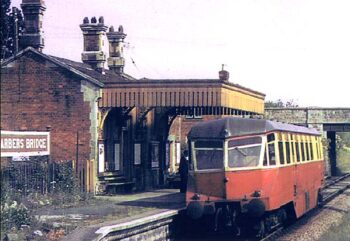
Barber’s Bridge, the first station west of Gloucester on the GWR line via Newent and Dymock to Ledbury, opened in 1885. However, Barber’s Bridge was to lose its passing loop, Down platform and signalbox as early as 1898 although its goods yard, west of the station, continued to handle coal, livestock, fruit, eggs and milk for many decades to come. Other traffics included fertiliser, elm wood for coffins, and pitch, a by product of the oil that was brought up the Severn in barges. This was brought to Barber’s Bridge by lorry and as much as 1500 tons a year was taken by rail to Cardiff and Northern England.
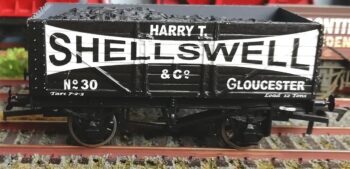
Harry Talbot Shellswell was born in 1894 or 1895 and was by 1919 trading in coal as Harry T. Shellswell at 19 Bloomfield Road, Gloucester. By 1927 Llanthony Wharf had been added to the address and “& Co” to the business title. Apart from three wagons purchased new in 1924 and two second hand in 1927, the only other references to Shellswell’s wagon fleet comes in the records of H.G. Lewis which show that Shellswell had three wagons on lease from him. Similarly, the only record of Shellswell’s trading so far known refers to occasional wagon loads from Highley Colliery near Kidderminster in Worcestershire.
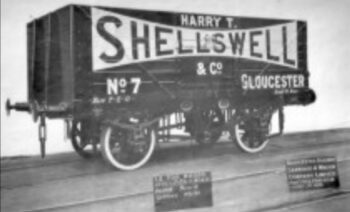
Even more intriguingly, Gloucester RCW Official Photograph 4518 of September 1924 of Order 5181 depicts Shellswell fleet number 7 as a 12 ton 7 plank wagon with cupboard rather than downward hinging side doors and therefore no stop spring. As was the custom for new wagons, the tyre walls of the 16′ 1 1/4″ x 7′ 7 1/4″ x 4′ 4 1/4″ bodied vehicle were painted white and the tare weight lettered as 7-2-0. The wooden solebars carried a G-plate to the right of the brake V-hanger and an oval owners plate to the left with the GWR registration plate just under the word Tare. The three wagons in Order 5181 were numbered 7, 25 and 50 and were sold to Harry T. Shellswell for £168 10/- apiece.
This Robbie’s Rolling Stock model thus in some ways more closely resembles Shellswell fleet number 32 photographed by the Gloucester Railway Carriage and Wagon Company in January 1927. Although another 7 plank open coal wagon, it could only carry 10 tons and had a tare of 6-4-3 with downward hinging side doors with stop springs on each side, white wall tyres and owners plate to the right of the brake V hanger on the solebar. To the left of the V hanger was the G plate, LMS rebuild plate and Midland Railway registration plate, while just below the Tare weight was the painted legend ” Glev/1/27″.
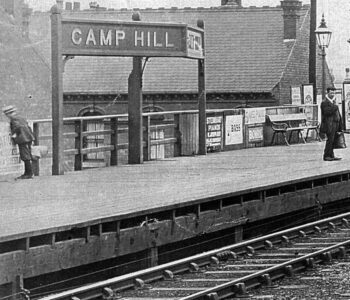
However, this refurbished wagon, first constructed in 1894, had “Gloucester” embossed axleboxes and had first gone to J.C. Gillisbrand of Camp Hill, Birmingham before being hired out by what was then still the Gloucester Wagon Company to J. Meates & Co of Ledbury in 1900. The wagon stayed with Meates as their fleet number 24 until 1927 when Gloucester RCW sold it on to Shellswell. At the same time Shellswell also bought another ex Meates wagon, number 23, which became 16 in the Shellswell fleet.
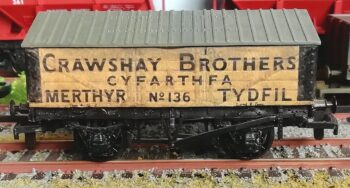
Gloucester Wagon Company Ltd ( not yet Gloucester RCW, note!) photograph 1288 of April 1880 shows Crawshay Brothers lime fleet 136 with a tarpaulin cover on top of an all wooden roof – for both weather protection and to allow lime expansion. It also shows white wall tyres as new, wooden solebars and the original rectangular Gloucester plates inside the brake gear V-hanger and to its left. Other idiosyncratic features are larger than usual wooden brake blocks and double chain couplings while the body appears to have no external diagonal side bracing.
The markings on this Peco model however are accurate and the light yellow colour likely. While Peco still produce an N gauge model of this wagon (NR-P112) a more recent 00 gauge product is Crawshay 134 as depicted in Dapol reference B630.
The Crawshay family appeared in several lines of business related to coal and mineral extraction in South Wales and the Forest of Dean. Their wagons carried the produce of their mines and quarries to customers across Britain. Among these was 1120, a seven plank 10 ton coal wagon built by Gloucester RCW in 1899.
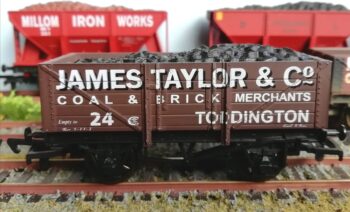
Real life five plank 8 ton wagon 9 was in fact very similar in markings to the Dapol model of fleet number 24 – sold to raise money for the Gloucestershire Warwickshire Steam Railway. The only major difference is the word BECKFORD (near to Tewkesbury) rather than TODDINGTON. Otherwise white wall tyres were fitted as new, there were two G-Plates on the solebar ( one inside the brake gear V hanger and the other to the left of it ) and diagonal side bracing and long side knees are not featured in the official September 1900 Gloucester RCW photograph. Dimensions were 14’5″ x 6′ 11″ x 3’1″.
James Taylor & Co gained high wagon utilisation by dealing in both coal and bricks and the family first appeared in the 1851 census when 40 year old William Taylor was listed as a brick burner at Dumbleton, east of Beckford and one of his sons, 15 year old James, was listed as a brick maker. Both of them were born in Hedenham, Norfolk.
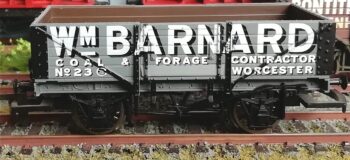
The Gloucester RCW official photograph of October 1896 matches the livery of this Hornby model – even down to the number 23 repeated on the top plank of the wagon ends – but above a wooden solebar with a single central wooden door spring rather than two metal ones and G-plates on either side of it. As new the tyre walls were also white with the word “GLOUCESTER” cast diagonally into the axleboxes. Note too the unusual business definition of coal AND forage contractor – presumably the 15’6″ x 6’11” x 3′ 1″ wagon could have carried hay just as easily as 10 tons of solid fuel for a boiler. Tare weight was 5-18-1.
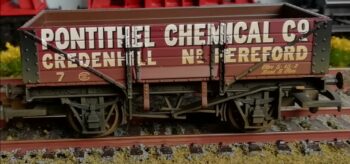
This Hornby model of Pontithel fleet number 7 was sold individually as R6072 and from 2003 as part of weathered wagon set R6219 along with Mark Williams 9 and larger Gowerton based Berthlwyd Colliery 385 .
As Pontithel fleet 7 was sold as weathered I will not complain about the lack of white wall tyres! However, an early wagon enthusiast seems to have made off with the solebar G-Plates which should be mounted either side of the brake gear V-hanger. A weathered wagon however does makes a nice contrast to the shiny new vehicles of various working fleets.
Dimensions on the five plank 8 ton wagon, photographed new at Bristol Road in September 1897 were 14′ 5″ x 7′ x 3′ 1″ with a 5-15-2 tare. The Gloucester RCW photograph board also specifies purple brown paint with white letters shaded brown.
Pont Ithel House, is located on the Brecon to Hereford road, ½ mile south-west of Aberllynfi. It is also just east of the railway line between Three Cocks Junction and Talgarth. From the mid to late 19th century, a small chemical works to the rear of the premises produced naphthalene from the distillation of coal-tar. In 1881, Pont Ithel House was occupied by Arthur Jacob, the 24-year-old manager of the chemical works, and his brother Leonard, both from Monmouthshire.

Production at the works ceased in the 1920s, as it did at Credenhill, just west of Hereford, where the Pontithel Chemical Company used timber to produce charcoal, wood naphtha, wood tar and other products derived from wood. Half a mile north west of Credenhill Station, a siding running parallel with the line on the south side was provided to serve the Pontithiel Chemical Company in 1873. However, it is not impossible that wagon 7 was not sold on to another owner who couldn’t or just didn’t clean and repaint it.

Until the 1880s most liquid chemicals – such as the oily tar processed by distillers such as William Butler and Company – would have been carried in tins, casks, jars or carboys aboard open or covered railway wagons but by then the British chemical industry had grown to such proportions that dedicated wagons were needed. Privately owned tank wagons also flourished because British railway companies were exempted from providing rolling stock for cargo that might cause contamination under the “common carrier” obligations written into their various Acts of Parliament.
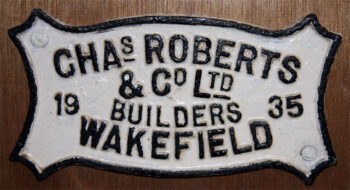
Butlers fleet number 64 would have travelled widely to collect raw materials recovered from gas works and charcoal and coke plants and from the South-West and West Midlands and the design is one closely associated with Charles Roberts of Wakefield. Built by the West Yorkshire firm until 1946, it comprises a riveted rectangular tank located directly on a wooden frame ( accurately represented in the Dapol model B738 I am pleased to say!) between simple heavy duty baulk ends held together with longitudinal tie rods. Later variants also featured steel bands over the tanks which located into brackets on the solebars.
The rectangular shape of Butlers fleet number 64 was dictated by metal sheet initially being only available in flat plates which were bolted together to form boxes. However, square joints proved to be a point of weakness, not least because liquid loads have a tendency to slosh into corners and impose a high shock load. Indeed, highly inflammable liquid fumes could exceed their flash points in a rectangular tank wagon and ignite in the same way that a diesel engine burns fuel! Similarly, the large liquid surface area inherent in a rectangular tank allows fuel to slosh from side to side, making the wagon unstable without the addition of internal baffles which add to the cost of both initial building and maintenance.
For this reason, rectangular tank wagons fell out of favour after 1927 by which time rolling plate technology had advanced enough for cylindrical tank barrels to be bolted or riveted together. In a full horizontal cylinder the fuel has a relatively small surface and so has little lateral movement. Despite this, some rectangular wagons were built after the Second World War and were still in service in the 1960s.
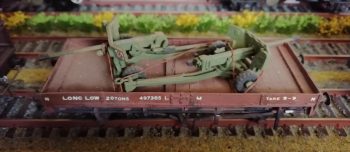
“Long Low” was the name given by the London Midland and Scottish Railway to their 22 ton plate wagons built on a 15′ wheelbase. Although the earliest examples had two plank wooden bodies, steel construction was standard by the late 1940s and examples of this type lasted into the early 1970s. British Railways developments of these wagons – designed to carry steel plate – even had roller bearing axleboxes, hydraulic buffers and vacuum brakes. Their drop sides also allowed road vehicles to be driven or rolled on to them from a loading dock.
497305, pictured above, is loaded with a pair of six pounder anti tank guns, in British army service from 1942 to 1960. However, they were also licence built in South Africa, Canada and the USA – as the 57mm M1 – and served with a number of foreign armies into the 1970s.
Although work on a replacement for the earlier 2 pounder anti tank gun began in 1938, defeat at Dunkirk and the possibility of invasion in 1940 delayed production and deployment of the Ordnance 6 pounder until 1942, when it most often towed by the tracked Universal, or Bren gun, Carrier. Although nominally replaced by a brand new 17 pounder anti tank gun in 1943, the 6 pounder still proved a nimble and effective weapon
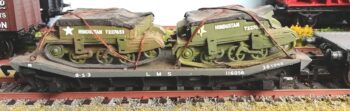
Machine wagons – known in many railway circles as “Lowmacs” and originally as Loriots or Hydras on the Great Western – were built by all the Big Four British railway companies and ranged in capacity from 12 to 35 tons.
The Universal Carrier was made famous to a post War generation by the 1/76 scale Airfix kit but could already claim to be the most produced armoured fighting vehicle in history with 113 000 built in Britain and abroad from 1934 to 1960. The engine was placed along the centre line of the vehicle ahead of a final drive to the tracks, leaving room on either side for passengers or supplies.In earlier versions, the commander’s position next to the driver jutted forward allowing him to fire a Bren light machine gun through a slit in the armour – giving rise to the popular but incorrect nomenclature of Bren Gun Carrier. Indeed, a number of varying versions appeared before the standard “Universal” format was agreed in 1940.Prior to 1940, the Carden Loyd tankette-derived tracked carriers were built by Aveling and Porter, Bedford, Ford, Morris, Sentinel Wagon Works and Thorneycroft with true Universal Carriers appearing from Aveling-Barford, Ford, Sentinel and Wolseley Motors.
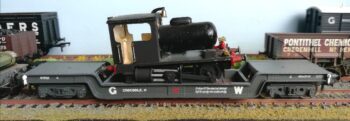
Crocodile’ was the GWR telegraphic code for what were originally described as Boiler Trucks, but later referred to as Trollies. These were all well wagons designed to carry large loads within the loading gauge and included 4-wheel and bogie versions. Several hundred of these low-slung vehicles were constructed throughout the GWR’s history for the transportation of many awkward loads from locomotive boilers to naval buoys.
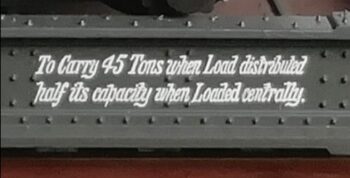
This Crocodile H bears the legend
In this case the central load is a Fireless o-4-0 locomotive built from the Airfix (later Dapol) Pug kit with the boiler replaced by a cylindrical reservoir, additional filling pipes, cab roof bell and wooden toolbox. Most distinctive of a fireless locomotive too are the cylinders grouped under the cab.
Unlike a conventional steam railway engine, the fireless supplies its cylinders with steam from a water filled reservoir which is in turn pressurised by a separate stationary boiler. As there is no fire inside the locomotive itself, it is able to work safely in such places as match factories, paper mills and jute, mustard and munitions works. Fireless engines were also popular prime movers in gas works, and power stations where supplies of high pressure steam were plentiful.
One of the most remarkable Great Western Railway Trollies however is Crocodile F 41934, now preserved at Didcot Railway Centre.
This 52ft wagon capable of carrying 25 tons was one of 12 similar vehicles within Swindon Lot 594 built to diagram C12 in 1908. 41934 saw active service during World War II with not only the British Expeditionary Force and the US 5th Army in France, but also the Wehrmacht, having been left behind at Dunkirk in 1941 and then reclaimed after D-Day returning to its duties with the GWR in 1945.
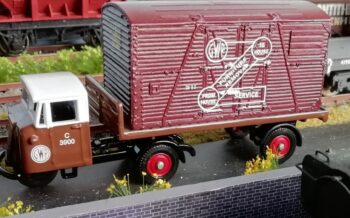
In the late 1920’s the railway companies were looking for a suitable vehicle to use on their town parcels delivery traffic, which was predominately horse drawn.
The London and North Eastern Railway approached Napier’s, the quality car and aero-engine makers for an answer to the problem. They came up with some ideas, but didn’t wish to develop the concept and sold the project to Scammell Lorries. Their designer, O. D. North, refined and further developed the concept of the three wheel tractor unit which automatically coupled and un-coupled trailers, and in 1934 announced the introduction of the Mechanical Horse.
This was a very simple and sturdy vehicle which was constructed on a steel channel frame and fitted with a wooden cab, the early versions having canvas doors. The Mechanical Horse came in two sizes, capable of carrying loads of three tons and six tons. These were powered by Scammell’s own side valve petrol engine of 1125cc (3-ton) and 2043cc (6-ton), the engine being offset to the left of the cab. The vehicles were very manoeuvrable (with a 16 foot trailer they could turn through 360O in 19 feet), have a road speed of about 20 mph, and do between 10 and 20 mpg. In addition to the railway companies, they were also used by quite a number of private companies and the armed forces, who used them in stores and on aircraft carriers. The 6-ton coupling was also fitted to popular makes of light trucks such as Bedfords. In this case, a GWR Mechanical Horse is coupled to a flatbed trailer carrying a road-rail shipping container used for moving household goods.
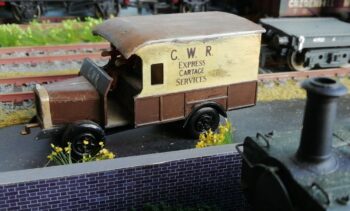
The 1924 vintage Thorneycroft A1 30 cwt van was the smaller sibling of the two ton A2 and together were the first of the Basingstoke company’s vehicles to be offered with the engine and gearbox as one unit. However, pneumatic tyres and front brakes were offered on the A1 as optional extras. A longer wheelbase version of the A1 chassis became the basis for many small buses and a forward control version was also available.