
1/72 scale Douglas Thor Intermediate Range Ballistic Missile, kindly built by Dave West for display at Jet Age Museum.
20 RAF Squadrons ( 77, 82, 97,98, 102, 104, 106, 107, 113, 130, 142, 144, 150, 218, 220, 223, 226, 240, 254 and 269 ) operated a total of 60 of these nuclear armed Intermediate Range Ballistic Missiles (IRBMs) from bases in eastern England between 1958 and 1963.
These missiles were liquid fuelled and were withdrawn because the resulting long reaction time made them vulnerable to pre emptive strikes.
The Thor was the first Intermediate Range Ballistic Missile (IRBM) deployed by the U.S. armed forces. Although its military career was relatively short, its descendants were still in use as space launch vehicles during the early 21st Century.
Development began in 1954 with USAF studies regarding a 1500 mile range single stage ballistic missile to complement the long-range ICBM. Soviet ballistic missile progress resulted in a decision in 1955 to develop an IRBM, to be named Thor, as quickly as possible.
Using existing components (the Rocketdyne S-3D liquid-fuel rocket motor from the Army’s SM-78/PGM-19 Jupiter IRBM, and the inertial guidance unit and Mk.2 re-entry vehicle from the SM-65D/CGM-16D Atlas), and requiring the missile to be air-transportable by Douglas C-124 Globemaster transport aircraft, the basic design and overall dimensions of the Thor were quickly determined. Go-ahead for development was given in September 1955, and in December 1955, Douglas was selected as prime contractor for the SM-75 Thor IRBM.
Because of the many existing components development was extremely quick, and production of test missiles began as soon as the drawings were completed in August 1956. Testing of the XSM-75 missile began in December 1956, but the first launch attempts all failed – sometimes in spectacular explosions. The first successful flight finally occurred in September 1957. Unlike the later production missiles, the first XSM-75s had small stabilizing fins at the base of the rocket.
After the Soviet Sputnik launch in October 1957, the IRBM program was again accelerated, and Thor was ordered into full production in November 1957. In the next month, the first flight with a fully operational guidance system succeeded.
All operational SM-75 missiles were stationed in Great Britain beginning in September 1958. Deployment was completed in June 1960 with 60 missiles at five bases including RAF Hemswell in Lincolnshire and Melton Mowbray in Leicestershire.
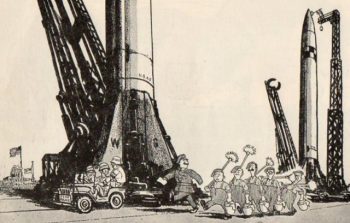
By then, the Royal Air Force had taken over the operation of the Thor bases and missiles and one unarmed Thor from each base was sent with its crew to Vandenburg Air Force Base in California for a combat training launch on the Pacific range there.
The SM-75 was powered by a single Rocketdyne S-3D (designated LR79-NA by the USAF) fuelled by kerosene and liquid oxygen. The complete main propulsion system was designated as MB-3. Two small Rocketdyne LR101 vernier engines were used for fine-tuning thrust and directional control. The Thor could carry a 1.45 megaton W-49 thermonuclear warhead and the all-inertial guidance unit achieved an accuracy of somewhere between 1000 ft and 2 miles Circular Error Probability. To protect them from conventional attacks and the weather, the missiles were stored horizontally in soft shelters at the base. After the launch order, the missile would be raised into the vertical, for fuelling and launch. Thors could be moved on and off base on special trailers hauled by Leyland Hippo cab units.

This resulted in an overall reaction time of about 10 minutes – better than the US Army Atlas IRBM ( 15 minutes when stored in a “coffin” silo ) and much better than the Soviet R7 ICBM ( 24 hours ) – although still more than twice as long as the four minute warning that NATO radar was expected to offer of an incoming Soviet first missile strike.
During 1962, the Thor was used in a series of exo-atmospheric nuclear tests (called “Starfish”, “Bluegill”, and “Kingfish”), including the explosion of a 1.4 megaton device ( equivalent to 1 400 000 tons of TNT ) at an altitude of 280 miles.
Also in 1962, the USAF already started to plan the retirement of the SM-75 IRBM. The intended replacements were the GAM-87/AGM-48 Skybolt ALBM (Air-Launched Ballistic Missile), which was later cancelled, and the Navy’s UGM-27 Polaris SLBM (Submarine-Launched Ballistic Missile). The first Thor was removed from base in November 1962, and by September 1963, all Thors had been deactivated and moved back to the USA. Production of Thor IRBMs totaled about 225, with a peak deployment level of 60 missiles.
In June 1963, shortly before its retirement in the UK, all Thor missiles were redesignated in the PGM-17 series: XSM-75 Thors becoming XPGM-17A, SM-75 items becoming PGM17A and unarmed training missiles changing from USM-75 to PTM-17A
The final chapter in the military career of the Thor was its use as an anti-satellite weapon. In February 1962 the USAF had started Program 437 to provide for a nuclear ASAT (anti-satellite) capability. Unarmed tests of Thors as ASAT missiles began in February 1964, and by September 1964 the ASAT Thor was declared operational. From that time until the retirement in December 1972, the ADC (Air Defense Command) always had two Thor ASAT launchers on 24h alert. The designation of the Thor in the ASAT role was apparently still PGM-17A, although a redesignation to PIM-17A would have been appropriate.
After retirement as an IRBM, disarmed PGM-17As, as well as new-built Thors, were used by the USAF as space launch vehicles under the basic designation of SLV-2.
The Thor was developed by McDonnell Douglas (now Boeing) into the very successful Delta family of space launchers.