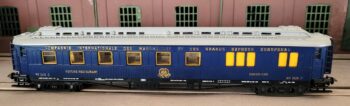
I also liked the CIWL blue livery, made famous in the 1920s by Les Trains Bleu racing to the French Riviera and the Paris to Istanbul Orient Express.
However, it was only later on that I realised the significance of the number. In its accurate brown timber livery, 2419D was the carriage in which was signed the Armistice of 11 November 1918 which effectively ended the First World War.
Then, at the Hucclecote Model Railway Exhibition of 2023, Mr Tim Blake of Brockworth presented me with a photographic album of 2419D, containing views from both 1918 and 1940, when it was the venue of the Surrender of France to Nazi Germany.
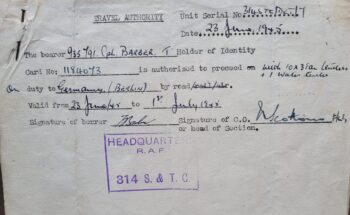
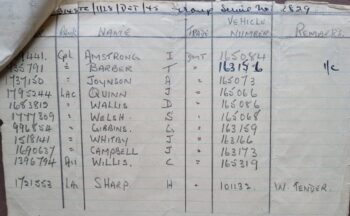
This album had been acquired by Mr Blake’s father in law, then Corporal T. Barber, who had been a lorry driver with the Royal Air Force in Berlin at the end of the Second World War. On official business in the Soviet occupied zone of the German capital, he disobeyed orders to stay in his vehicle and found the album in a ruined building.
Here is his authorisation:
But to start at the beginning, the vehicle that became known as the Compiègne Wagon was built in May 1914 in the Saint-Denis works of the General Construction Company as CIWL dining car No. 2419D.
The varnished teak carriage with a steel frame reinforced with tie rods was one among 22 roughly identical restaurant cars of the 2403–2424D series.
2419D was used in the First World War by the Compagnie Internationale des Wagons-Lits until 1916 when it was stored in Clichy in the northern part of Paris.
In October 1918, 2419D was commandeered by the French Army and converted into the office and mobile headquarters of Ferdinand Foch, the Supreme Allied Commander, who had been promoted to the rank of Marshal on 7 August 1918. He began using his new train from 28 October 1918, by which time 2419D had been equipped with a telephone, telegraph and a large table installed in the middle of one end.
By this time, the Imperial German government had signalled to the Allies their willingness to start peace negotiations. This was prompted both by military successes on the Western Front with British, French and American forces pushing the German lines back during September and by Austria-Hungary and Bulgaria suing for peace.
In fact, as early as 27 September 1918, American President Woodrow Wilson had delivered a speech inside the New York Metropolitan Opera House stressing the importance of finding a compromised peace without discrimination toward the defeated. The US president mentioned the planned ‘League of Nations’, an international organisation of peace which should not be dominated by inner alliances. Wilson proclaimed that ‘after the final triumph of justice and fair dealing’ there would be no more secret diplomacy.
On 8 November 1918, Foch and representatives from the Allied Powers met five representatives from what was about to be the German Republic to discuss the terms of armistice in the then-called “Wagon of Compiègne”.

Kaiser Wilhelm II would abdicate and flee to the Netherlands on 9 November 1918.
To avoid embarrassing the Germans, Marshal Foch sought an out-of-the-way location near Paris for the discussions. For this reason, the Rethondes Clearing in the Compiègne Forest was chosen, being both obscure but endowed with good railway connections. In fact the former open air artillery dump had two parallel tracks 100 metres apart.
One of these hosted the train of Marshal Foch, including Wagon Lit 2419D, while the other – composed of the Chemin du Fer Nord’s fixed wheelbase Imperial carriages of Napoleon III and stocked with 1870 vintage wine – brought the German delegates, led by civil servant Matthias Erzburger.
The German delegation had been given safe passage from Spa in German occupied Belgium to a French military outpost on 7 November 1918 before taking their places on Napoleon III’s green satin seats.
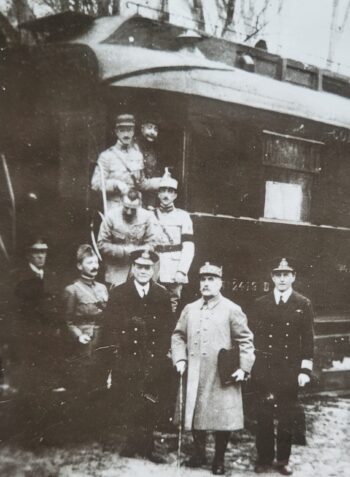
The armistice signed in the carriage on 11 November finally ended the First World War. The other Central Powers had already reached agreements with the Allied Powers to end hostilities.
Despite plans to exhibit the carriage around the World, 2419D was later returned to the Compagnie Internationale des Wagons-Lits and briefly resumed service as a dining car ( which might justify the blue livery) before becoming part of the French Presidential train.
On 1 October 1919, it was donated to the Army Museum (Paris). The 2419D was on display in the Musée’s Cour des Invalides from 27 April 1921 to 8 April 1927.
At the request of the Mayor of Compiègne, and with the support of the American Arthur Henry Fleming, 2419D was restored at the workshops of Saint-Denis. This took half a year, and 2419D returned to Compiègne in late October 1927. Arthur Henry Fleming paid for the carriage’s restoration after observing its poor condition at the Cour des Invalides.
2419D was housed in a specially created museum building as part of the “Glade of the Armistice” historic monument, with the Dining Car a few metres from the exact site of the signing ceremony.
The official opening of the carriage shelter, the Clairiere del’Armistice, took place on 11 November 1927 to commemorate the ninth anniversary of the Armistice agreement, and the fifth year of the memorial.
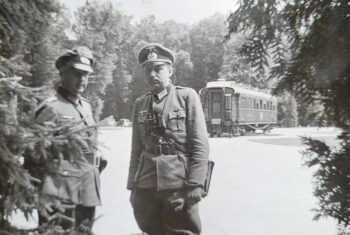
On 22 June 1940 however, a victorious Adolf Hitler ordered that 2419D be dragged out of its shelter and moved to exactly the same location as 11 November 1918 for the signing of the second “armistice at Compiègne”, on 22 June 1940 in which France would capitulate to him.
One section of wall in the museum at Compiègne was opened up to allow 2419D to be removed and placed on the rails again. Once the armistice was signed, the museum was blown up and the site of the signing was flattened.
Subsequently 2419D was taken to Berlin and displayed from 5 July, first next to the Brandenburg gates, later on the ‘Museum island’. Accompanying 2419D were pieces of a large stone tablet which bore the inscription (in French):
Here on the Eleventh of November 1918 Succumbed the Criminal Pride of the German Reich. Vanquished by the Free Peoples Which it Tried to Enslave..
In 1944 the Wagon Lit was sent to Ohrdruf in Thuringia, central Germany. Then it moved to Ruhla and later Gotha Crawinkel, near a huge tunnel system. There the carriage body was burned in March 1945 by the SS in the face of the advancing U.S. Army. Only its chassis remained, and was used to transport goods in East Germany right up until 1974, when it was definitively dismantled.
The SS buried the remains of the body to prevent them from falling into Allied hands. Some of these remnants were later exhumed and moved back to the restored Compiègne site for display.
Today people who come to the Crawinkel commune can visit the exact site – marked with a small sign – where the famous carriage burned out.
In 1950, the Compagnie International des Wagons-Lits donated a similar dining car of the same vintage -2439D – to the Glade of the Armistice Museum. This car had also been part of Foch’s private train during the 1918 signing.
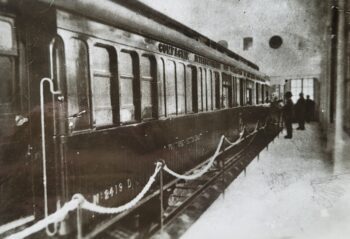
The opening ceremony took place on 11 November 1950 and the car was renumbered 2419D. It is parked beside the display of the original car’s remains: a few fragments of bronze decoration and two access ramps.