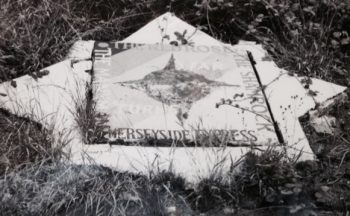
Having been privileged to write up The Railway World of Arthur Kyle in 2013, the man himself contacted me again in 2019 and was kind enough to share another story: that of the metal and concrete Star Turns sign which was added to the bank at West Allerton – the next station to Mossley Hill, Liverpool – to mark the Festival of Britain in 1951.
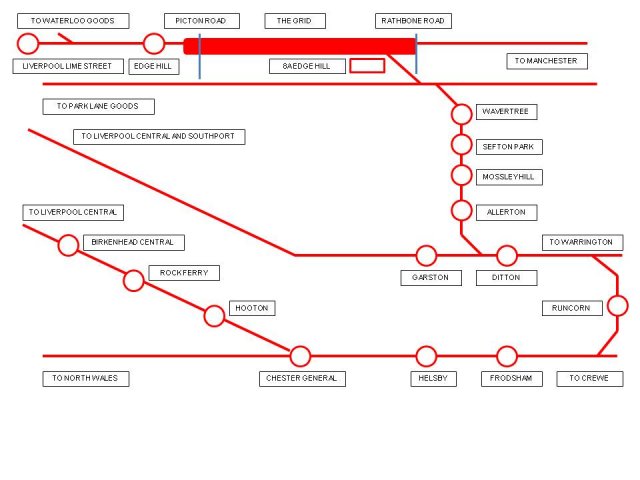
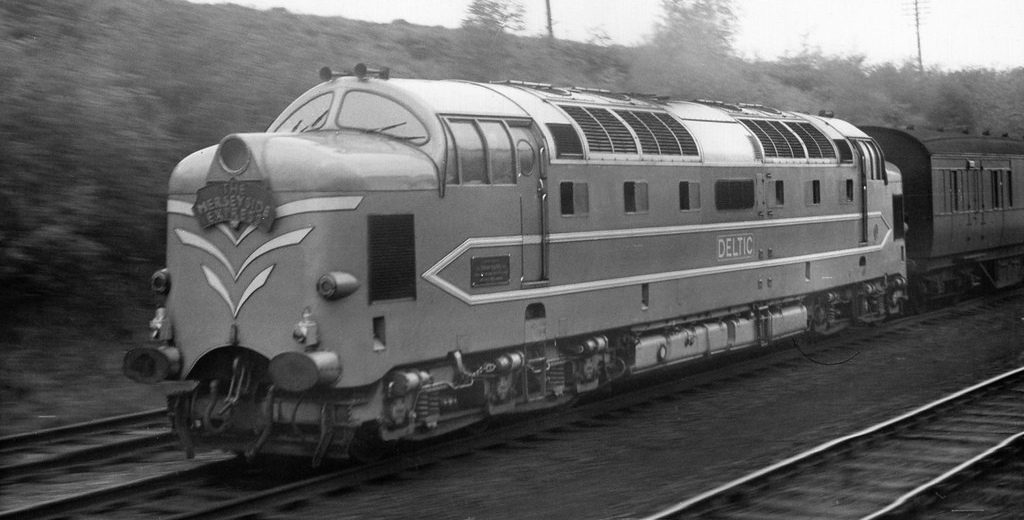
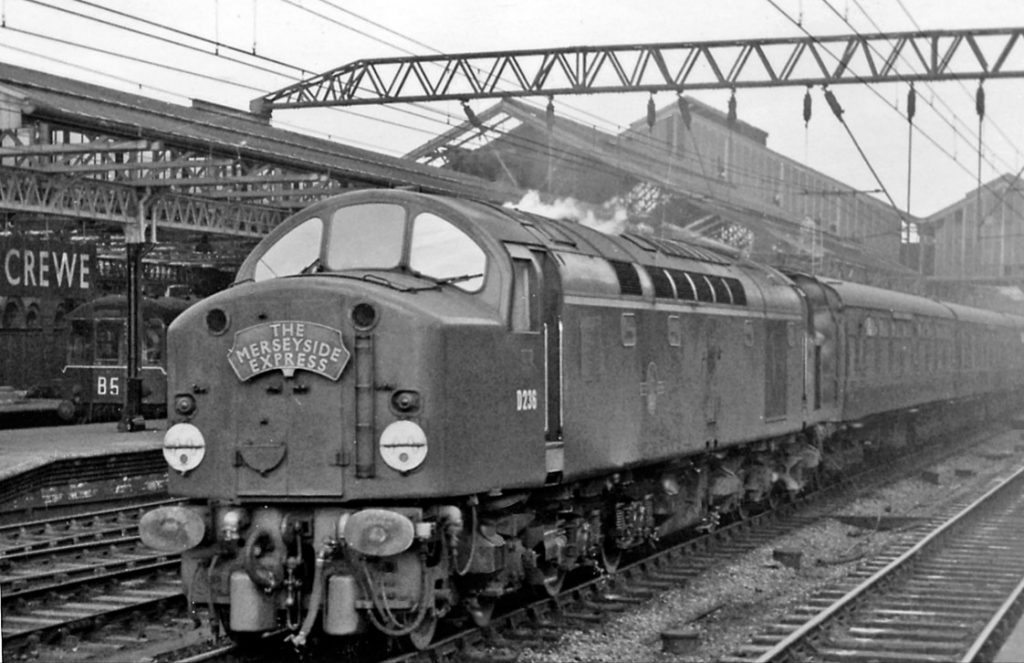
The Star Turns hauled by locomotives and crews from 8A Edge Hill depot were The Manxman, The Shamrock, The Merseyside Express and, introduced in 1951 to mark the Festival of Britain, The Red Rose. Arthur Kyle’s friend Dennis Flood, later to become the Chief Traction Inspector of British Railways Western Region , recalls taking the picture at the top of this article himself in the 1960s.
The sign was rediscovered in the early 1980s. Now though, it is missing. Does anyone know what happened to this substantial object? The ‘star’ sign edges were made of concrete but the square sign laid within it,showing the named expresses painted on it,was made from heavy duty hollow metal (a heavier version of an inverted bin lid.!)
In the 1954 edition of his book Titled Trains of Great Britain, Cecil J. Allen noted:

In earlier London & North Western Days a single express from Euston at 5.30 pm was sufficient to carry the evening traffic from London to Liverpool and Manchester, and to various other parts of Lancashire as well. But as the extent of the traffic and the luxury of the accommodation grew, and especially as more and more passengers demanded to be fed en route, the 5.30 pm by degrees split into various independent trains. First of all the Manchester passengers were given a separate 6.00 pm express and the 5.30 pm became a train for Liverpool and Fleetwood. Then, in 1905,an express at 5.55 pm Down [away from Euston] was allocated exclusively to Liverpool making a non stop run to Edge Hill. later a stop would be added at Mossley Hill, a more convenient alighting point for many residents in the southern suburbs of Liverpool.
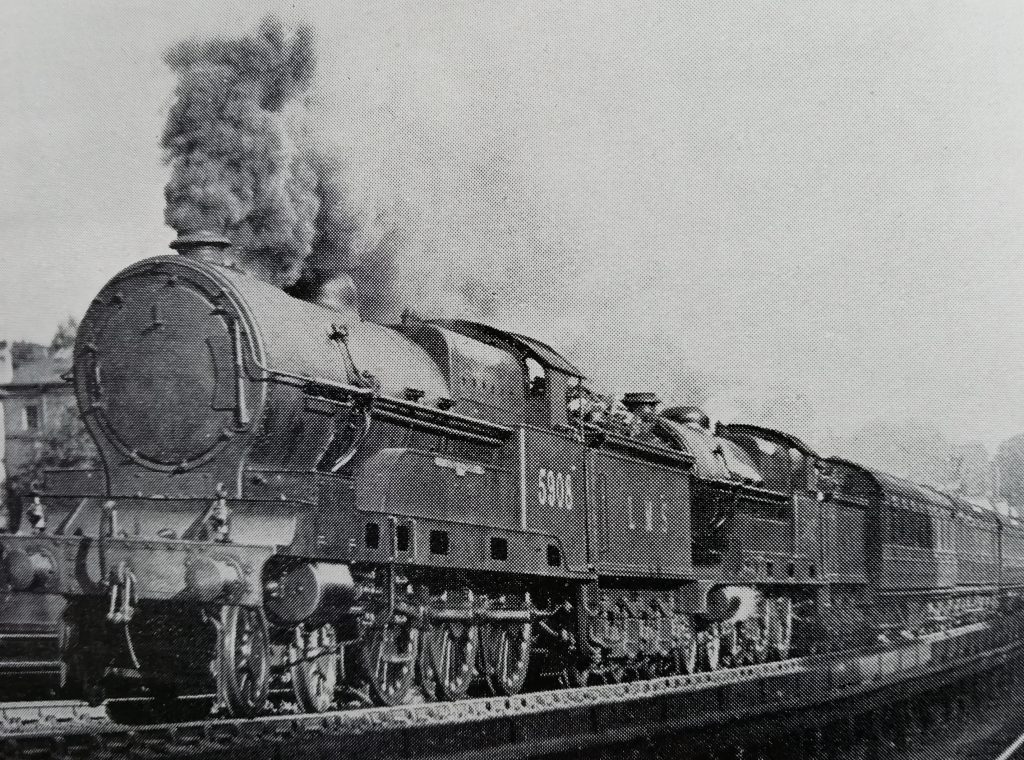
The name “London-Merseyside Express” was conferred on this train in 1927, soon to be abbreviated to the simpler “Merseyside Express”. In 1932, when the 6.05 pm down “Lancastrian” [pictured above] was accelerated to make a 3 1/4 hour run to Manchester, the two trains changed places, and the 5.55 pm “Merseyside” start was altered to 6.05 pm. The latter train was booked to run the 189.7 miles to Mossley Hill in 200 minutes, at 56.9 mph, and so continued to the outbreak of war. Then, after calling at Edge Hill, Lime Street was reached at 9.40 pm.
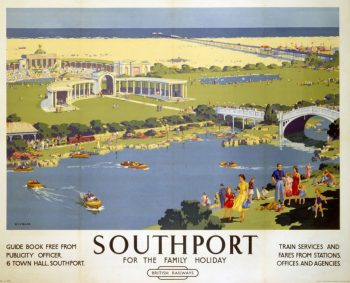
The Edge Hill stop was to detach the two rear Southport coaches, which were worked round through Walton to Bootle, on the Electric Liverpool -Southport line and reached Southport, after making certain intermediate stops, at 10.30 pm.
In the Up direction, the “Merseyside Express”, which for some years left Liverpool Lime Street at 10.00 am and was due into Euston at 1.30 pm, was also accelerated to start 10 minutes later, and to make the journey to London in 3 hours 20 minutes. In this direction the Southport coaches, leaving Chapel Street station at 8.50 am, were worked through into Lime Street and attached to the front of the London express there.
This arrangement enabled the “Merseyside” to dispense with the Edge Hill stop and to call only at Mossley Hill, from which the run of 189.7 miles to Euston was booked non stop in 189 minutes at just over a mile a minute – to be precise at 60.2 mph. Often between Crewe and Stafford the Up “Merseyside”, running on the fast road, would overtake the “Pines Express” from Manchester to Bournemouth on the slow road. And at times a lively race would develop, especially over the falling gradients south of Whitmore. This is a reminder that the Down “Merseyside” has often had a similar race with the 6.06 pm from Euston to Northampton, which runs non stop to King’s Langley. But the latter now has a minute’s start and generally shows the heavier train a clean pair of heels.
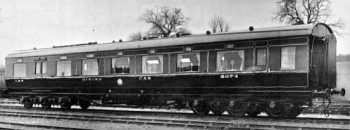
Latterly the “Merseyside” became a very heavy train for its fast schedule. it was seldom less than 14 or 15 coaches and, if the latter, weighed about 490 tone empty and 525 tons with passengers and luggage. Two complete sets of dining cars were provided – a kitchen car flanked by two open First Class cars, and a twelve wheeled Third and Kitchen with an Open Third, five vehicles in all. The First Class accommodation included one of the lounge brake cars, furnished with armchairs, that were originally built for the “Royal Scot”.
During the Second World War, the 5.30 pm departure from Euston of much earlier history was resumed. For some time the Liverpool and Manchester trains were worked as one combined formation again but eventually, except on Saturdays, this became too heavy for a single engine load and the Manchester train was run separately. With stops at Crewe and Mossley Hill, the 5.30 pm Down reached Liverpool Lime Street at 9.46 pm. Coming Up, the start was at 10.00 am and and with stops at Mossley Hill, Crewe and Watford, London was reached at 2.22pm – a slowing down by one hour of the peacetime schedule.
On 7 October 1946, the Euston departure was altered to 5.45 pm and the journey time was cut to three hours 55 minutes. In September 1949, the historic 6.05 pm (working time 6.07 pm) departure was reverted to, following instead of the preceding the “Lancastrian”. An Edge Hill stop was introduced to detach the Southport coaches, and Lime Street now is reached at 9.50 pm. The Up express, starting at 10.10 am, has come down to a public timing of 3 hours 40 minutes (3 hours 37 minutes working time)
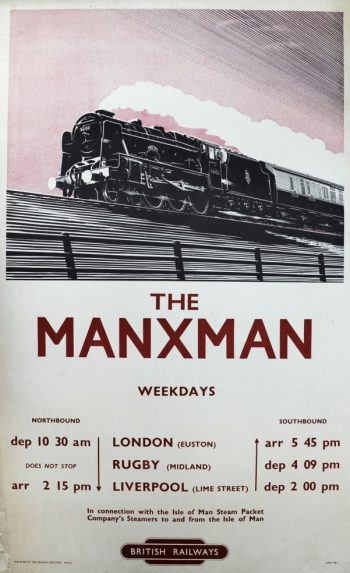
The morning express from Euston to Liverpool, at 10.40 am, also, in earlier years, used to run combined with a Manchester train and started at 10.30 am, but latterly became a separate departure at 10.40 am. In the summer it carried the name of “Manxman” by reason of connecting at Liverpool with the Isle of Man boats. Through sections were run to Southport, like that of the evening train and also – an oddity for a train travelling north westward out of London – to Swansea. The latter coaches, attached in rear, were taken off at Stafford and worked to Shrewsbury, whence they made the lengthy cross country journey by way of the Central Wales spas to reach Swansea Victoria at 6.35 pm. The Manxman, calling only at Stafford and missing Crewe, was due in Liverpool Lime Street at 2.18 pm
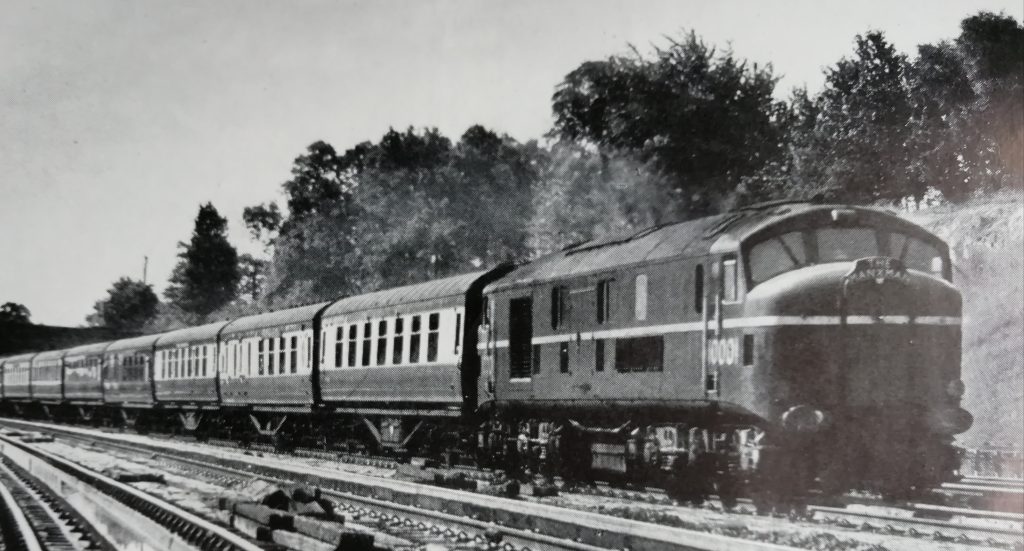
The up “Manxman” was the express leaving Lime Street at 2.10pm calling at Mossley Hill and Crewe, and then making a very fast run over the 156 miles from Crewe to Euston in 152 minutes, and so reaching London at 5.30 pm. During the War period, the 2.00 pm from Liverpool did not reach London until 6.15 pm, but now this popular express, which calls at Rugby only, has been speeded up to a run of 3 hours 45 minutes, reaching Euston at 5.45 pm. The morning train from Euston, now 10.30 am , has had all the intermediate stops cut out, and takes the same 3 3/4 hours for a non stop journey of 193.7 miles but runs during the summer service only.
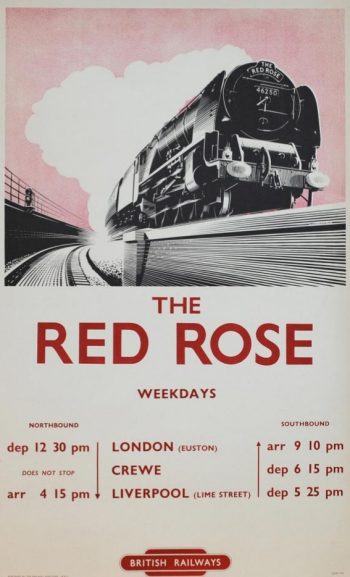
The Festival of Britain in 1951 was made the occasion of naming a third train on the Euston-Liverpool service, and equipping it with new standard stock throughout. This was the 12.15 pm from Euston to Liverpool and the 5.25 pm back. In years gone by the Up express had a distinguished record, as for some years it was one of the fastest trains on the LMSR. It was timed over the 152.7 miles from Crewe to Willesden Junction in 142 minutes (64.5 mph) and from 1932 onwards and when later the Willesden stop was taken out, the timing became 148 minutes for the 158.1 miles from Crewe to Euston (64.1 mph).
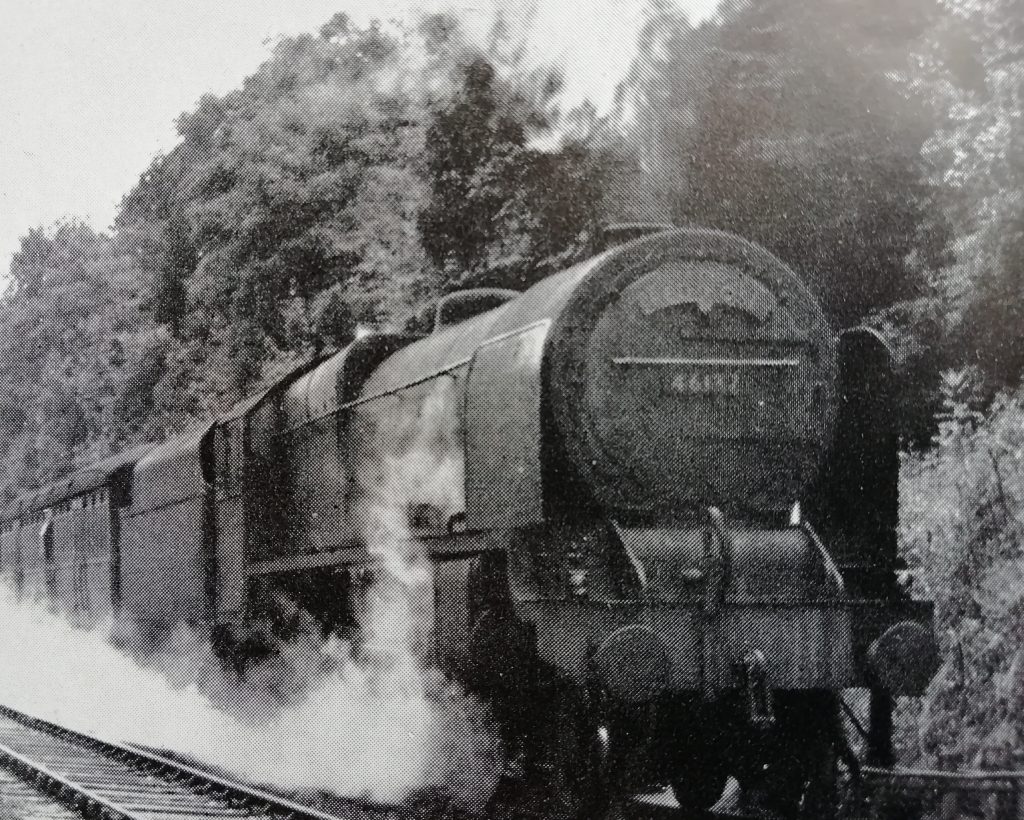
Up to the outbreak of War, this express was running from Liverpool to Euston in 31/4 hours – the fastest regular time on record.
The new name given to this train was “Red Rose”, Lancashire counterpart of the Yorkshire “White Rose” between Leeds and King’s Cross. At the time it was reaching Euston at 9.10 pm but in September 1952, the arrival was advanced to 9.00 pm with a 165 minute run from Crewe, bringing the overall time down to 3 hours 35 minutes. The Red Rose at first was the 12.15 from Euston to Liverpool, but with some timetable rearrangement in 1951, the departure was altered to 12.30 pm and the train was made non stop over the 193 3/4 miles from Euston to Liverpool Lime Street in 3 hours 45 minutes, as with the “Manxman”.
At the back of the book, Cecil J. Allen added:
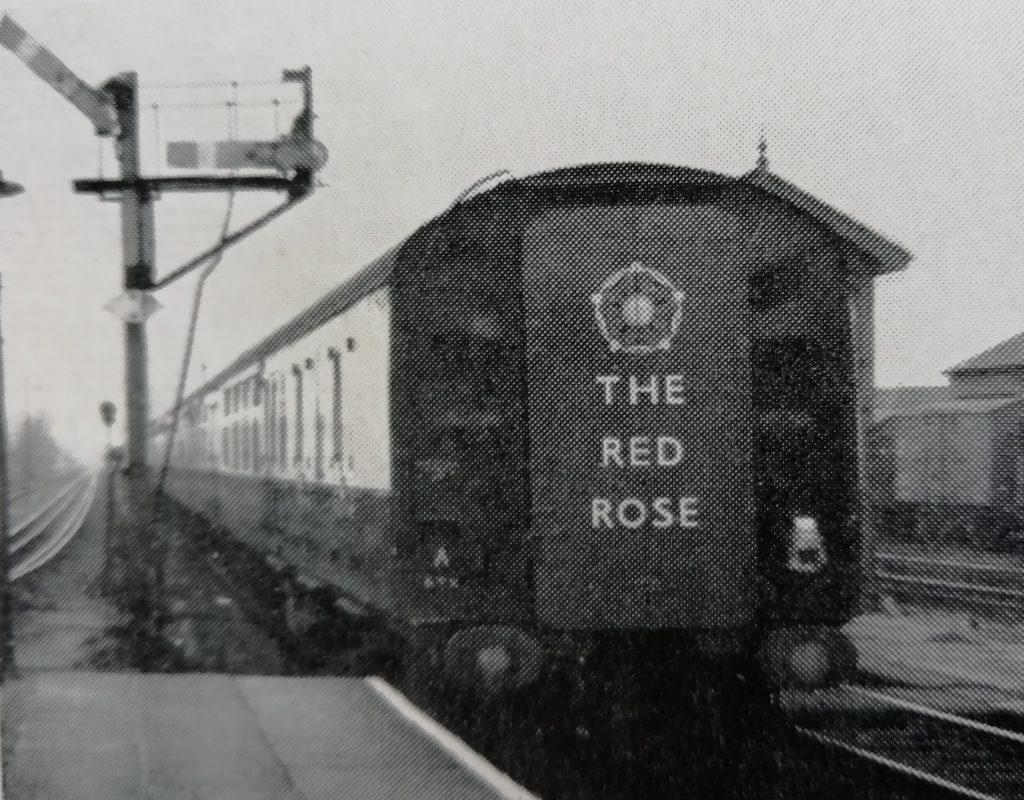
The Down “Merseyside Express” now leaves Euston at 6.10 pm, but the 9.50 pm arrival at Liverpool Lime Street is maintained. In the Up direction (10.10 am from Lime Street) there has been a 5 minute acceleration to Euston, reached at 1.45pm. In the summer of 1953 the Down “Manxman” (10.30 am from Euston, which now runs during the summer months only) had its non stop run to Liverpool accelerated to 3 hours 35 minutes, with an arrival at 2.05 pm. The Up “Manxman”, at 2.10 pm from Liverpool, also has been speeded up to a journey time of 3 hours 35 minutes, including the Rugby stop and is booked from Rugby to Euston, 82.6 miles, in 84 minutes. The latter train runs throughout the year, but carries a name in summer only.
Also in 1953 the “Red Rose” was accelerated in both directions. Yet another non stop train between Euston and Liverpool, the Down “Red Rose” (12.30pm from Euston) makes the journey in 3 1/2 hours. But the fastest on the service is the Up “Red Rose”, leaving Liverpool at 5.25 pm, which by three successive accelerations has been brought down, in the 1954 to 1955 winter timetable, to 5 hours 25 minutes including a run over the 158.1 miles from Crewe to Euston in 155 minutes. Before the War the overall time of this time was 3 1/4 hours but the present formation, usually of 13 or 14 coaches of standard stock, is heavier than in pre War days.
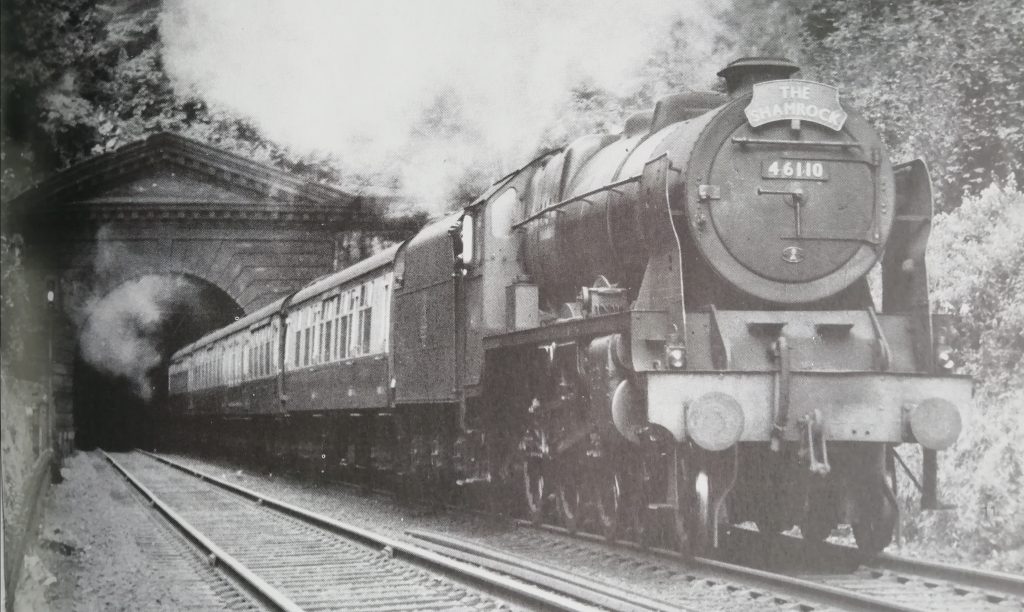
To the fine post-War service between Euston and Liverpool yet another non-stop train – the fourth daily in the Down direction in summer and one of three in the winter – was added in the summer of 1954.
The start time of the 4.30 pm from Euston was altered to 4.55pm, and all intermediate stops were cut out. With an arrival at Liverpool Lime Street at 8.22 pm in 3 hours 27 minutes from London, it has now become the fastest Down train on the service. As this express provides the connection with the night steamers from Liverpool to Dublin and Belfast, it has received the name “Shamrock” (pictured above) which is carried in the Up direction by the 8.10 am from Liverpool, due in Euston at 12 Noon.
All four of these named trains ceased operation in 1966.