
The role of airborne forces is to rapidly take control of an area using an element of surprise and then hold on for heavier reinforcements.
In the Glider Assault diorama built for Jet Age Museum in 2020, a Waco CG-4A Hadrian has already landed and delivered 15 soldiers together – not spread out as they would have been had they dropped individually by parachute. These soldiers would have been relatively lightly armed and carried rations, ammunition and other supplies for less than four days.
A typical function of the glider troops was to disrupt the advance of the enemy by destroying railroads, bridges and other communications.
Arriving to relieve the airborne forces were three rocket firing Sherman Calliope tanks accompanied by their support vehicles and an M2 Long Tom artillery piece towed by an M5 high speed tractor.
in 2023 however, the success of similar boxed dioramas on an “Order of Battle” theme persuaded me to upgrade the Glider Assault with more and different Allied vehicles from the North West Europe campaign of 1944 to 1945.

On 24 February 1941 United States Army Air Force Classified Technical Instruction 198 was issued under the instruction of Major General Henry “Hap” Arnold – later associated with Sir Frank Whittle’s jet engine being evaluated in America – to initiate the study and development of two, eight and fifteen seat gliders and their associated equipment.
Of the four firms that agreed to participate in the study, only the Waco Aircraft Company was able to deliver the experimental glider prototypes that satisfied the requirements of Materiel Command, the eight-seat Waco CG-3 (modified to become a production nine-seat glider) and the fifteen-seat Waco CG-4 – later known in Britain as the Hadrian and pictured above.
The CG-4A went on to become the most widely used U.S. glider of World War Two and the 7 December 1941 attack on Pearl Harbor prompted the USA to set the number of glider pilots needed at 1 000 to fly 500 eight-seat gliders and 500 fifteen-seat gliders. The number of pilots required was increased to 6 000 by June 1942.

The first examples of the CG-4A began to enter service with the US Army Air Corps during 1942, with production reaching its peak in 1942-43. CG-4As were used in the invasion of Sicily, Chindit actions in Burma, the invasion of Normandy and southern France, at Arnhem, and during the Rhine crossings. They were also used by the RAF, but only operationally at Sicily.
Hadrians were also used to supply remote bases in China and Burma. Although nearly 14,000 were built, less than a dozen remain in the world today
Built from a fabric covered tubular metal fuselage and wooden framed wings and piloted by a crew of two, the CG-4A Hadrian could carry 15 combat equipped troops or a Jeep and artillery piece.
More that 14,000 CG-4A’s were built by twenty companies including two on Long Island, Dade Brothers of Mineola and General Aircraft in Queens. Also assembled by the Ford Motor and Cessna Aircraft Companies as well as furniture, piano and coffin makers across America, the Hadrian last went to war at Luzon in The Philippines on 23 June 1945.
However, combat glider operations were only deleted from the US Army’s capabilities on 1 January 1953 to be replaced by helicopter troop insertion.
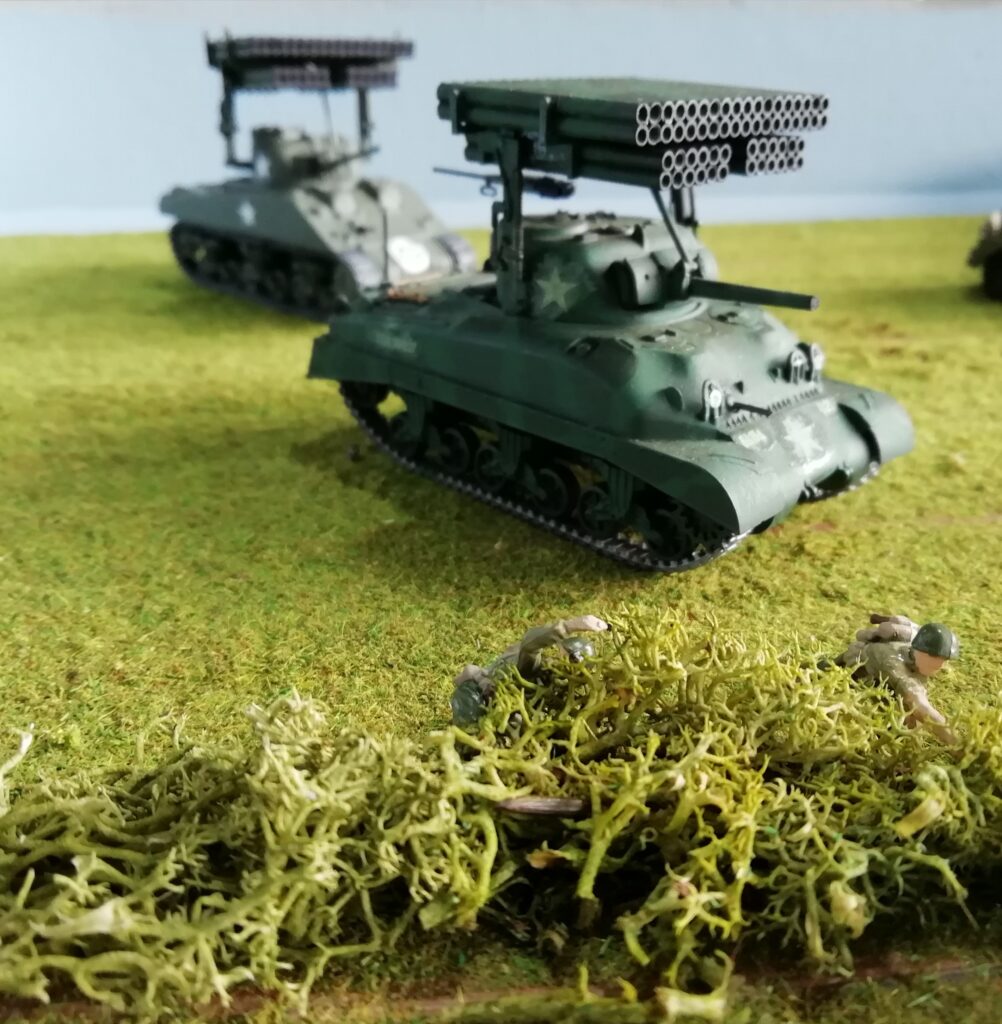
Perhaps the ultimate development of the solid fuel rocketry epoch was the 1943 vintage Sherman T34 Calliope tank, each fitted with projectors for M8 4 1/2″ unguided missiles.
These models are from the Airfix kit (first moulded by Esci) which incorrectly identifies its outcome as being from the US Army’s 752nd Tank Battalion which served in Italy as opposed to the 753rd which did in fact invade Germany.
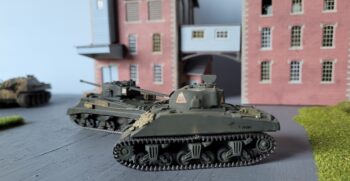
Also now on the Glider Assault diorama for comparison is a standard gun Sherman: the best known of all American tanks of World War II.
Like its Soviet opposite number the T-34, the strength of the M4 Sherman was the sheer numbers in which it was produced for American, British and other Allied armies. As such, it continued to serve around the World for many decades after 1945.
Although armed with a dual purpose 75mm gun in the turret rather than in the hull, the fast and reliable Sherman was relatively lightly armoured with a high profile and a vulnerable fuel tank – hence the popular German nickname “Tommy Cookers”.
The Sherman was designed on 1941 to be an improvement on the earlier Lee and Grant fighting vehicles and was also the result of careful study of contemporary tank warfare.
When the Sherman entered production in 1942 the British army was dangerously short of tanks following the desert campaigns and the few tanks available had neither adequate armour nor armament to deal with their German opponents, including the first Panthers. For the 1944 invasion of Europe, many Shermans were made amphibious by fitting a collapsible canvas hull and water propeller- these Duplex Drive tanks being able to arrive on the Normandy beaches ahead of the landing craft.
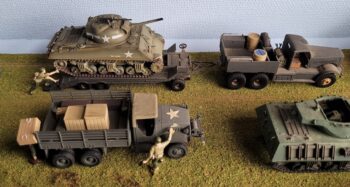
I took the opportunity to mount my gun Sherman on an M9 Rogers lowloader trailer hauled by an M20 980 Diamond T prime mover: collectively known as an M19 Transporter/Recovery 45 tons.
Although the gun Sherman weighed only 30 tons, ever increasing armour meant that tanks were becoming heavier and more than ever needed lorry transport to avoid the undue wear on tracks, engines and transmissions of long road journeys.
The task of developing a suitable Transporter/Recovery vehicle was undertaken by the US Ordnance Corps for the British government thus leaving existing heavy vehicle production uninterrupted.
Introduced in 1941, the M19 saw service in Egypt and Italy and in North West Europe served with both British and American forces. They were only replaced in British army service in the mid 1950s.
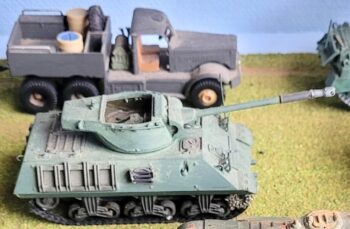
In the US Army doctrine of the 1940s, defeating massed enemy armoured counter attack was the job of the Tank Destroyer Force. Tank destroyers would be moved rapidly to the scene of such a counter attack but then ambush the enemy tanks.
This led to a requirement for fast, well-armed vehicles. Though equipped with turrets (unlike most self-propelled anti-tank guns of the day), the typical American tank destroyer design was more heavily gunned, but more lightly armored, and thus more maneuverable, than a contemporary tank.
The idea was to use speed and agility to bring a powerful self-propelled anti-tank gun into action against enemy tanks.
The M36 Tank Destroyer (later known unofficially as the Jackson) combined the 90mm M3 gun in a new turret with the hull of the existing M10 tank destroyer but with sloping armour. The M10 itself used the chassis and drive train of the M4 Sherman.
The M36 entered Europpean service in October 1944 and would later fight in the Korean and be widely exported to the Allies of America. It was well liked for its ability to destroy heavy German tanks such as the Panther at a distance of over four kilometres.
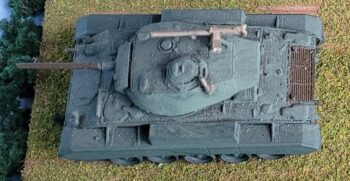
Next to the M36 is the M24 Chaffee – named after American tank pioneer General Adana R. Chaffee and was first produced in April 1944 by Cadillac. The M36 was developed from the M3 Stuart light tank but with a 75mm gun to replace the earlier 37mm weapon.
A total of 4 070 were produced by June 1945 and the M24 Chaffee saw action during the crossing of the Rhine and the final advance into Germany as well as the Pacific campaign against Japan and in the Korean War against Soviet built T34/85 tanks. The M24 Chaffee had a range of 100 miles, top speed of 34 mph and had storage for 48 shells.
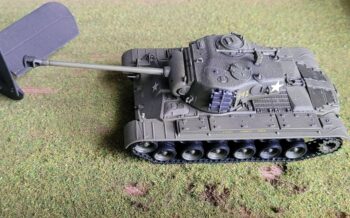
Completing the line up of American tanks on my Glider Assault diorama was the M26 Pershing. Like the M24 Chaffee this was named after a 20th Century American general – in this case John G. Pershing who led the American Expeditionary Force in the First World War.
The M26 itself was a heavy/medium tank intended to replace the M4 Sherman but which only arrived in Europe in January 1945 after the huge losses of American armour during the Battle of the Bulge in the Ardennes in December 1944.
Believed by a number of historians to be a better tank than the Panther and Tiger I but still inferior to the Tiger II, the M26 was withdrawn by the US Army in 1951 with the introduction of the M46 Patton. However, M26 Pershings played important roles in the capture of the Ludendorff Bridge at Remagen, further crossings of the Rhine and the liberation of Czechoslovakia.
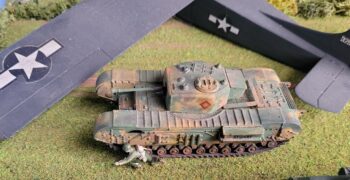
Among the British tanks on my Glider Assault diorama, the first Vauxhall designed A22 Churchill tanks began appearing in June 1941 with The Gloucester Railway Carriage and Wagon Company producing 764 of the 5 640 eventually built.
In accordance with British Infantry Tank doctrine of the 1930s and based on the expected needs of static warfare, an envisaged 38 ton Type A20 – was required to cross shell-cratered ground, demolishing obstacles and attacking fixed enemy defences with a long trench-spanning wheelbase and armour heavy enough to withstand artillery attack.
However, by the time that the first A20 prototypes were completed by Harland and Wolff in June 1940, it was clear that a new design – known as the A22 or Infantry Tank Mark IV – would have to incorporate the experience of the Nazi Blitzkreig and be in production within a year to replace tanks left behind at Dunkirk.
The Mark III Churchill – first rolled out in March 1942 – proved decisive in the Second Battle of El Alamein that October, mainly thanks to a new turret design carrying a 57mm calibre 6 pounder gun which later even knocked out a German Tiger tank!
The crew comprised five members, commander, gunner, loader/radio operator, driver and co-driver/hull gunner. The operational range was 56 miles and the tank had a speed of 15 mph. Armaments for the 1-VI variants comprised a 102mm hull front, 89mm hull side, 51mm hull rear, 89mm turret front and 76 mm turret side and rear. In addition, the Mk III was fitted with a QF (quick firing) 6 pounder gun.

The first examples of the A34 Comet tank were issued to the 11th Armoured Division of the British army in December 1944. In March 1945 they moved forward to the Weser Bridgehead on the Rhine and ended the war on the Baltic coast at Lubeck. Other Comet operators included the Second Fife and Forfar Yeomanry and the First Batallion Royal Tank Regiment.
After the war, the Comet became the standard British tank and was used in Palestine, the Suez Crisis and in Berlin before being replaced by the Centurion in 1957.
The Comet was developed from the earlier Cromwell tank and was powered by the same Rolls-Royce Meteor engine. However, its lower profile partly-cast turret was equipped with the same 17 pounder high velocity gun as the Sherman Firefly. This gun was effective against late-war German tanks, including the Panther and Tiger.
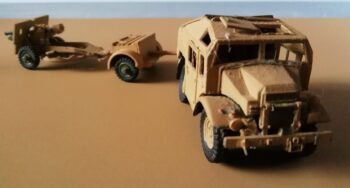
The idea of a gun to replace the 18 pounder and 4. 5″ howitzer and fulfil the dual role of gun and howitzer first arose in 1918 and was revived in 1928. A pilot model was made in September 1930 and production began in 1935.
The 3.45″ calibre gun-howitzer was already in production by mid 1940 and could fire high explosive, armour piercing or smoke shells to a range of 13 400 yards, depending on the separate propellant cartridges used with each shell type.
The barrel could be depressed 5 degrees below horizontal or raised 40 degrees above it. Inbuilt traverse was 8 degrees, which could be boosted to 360 degrees when using the wheel like firing platform. Quick traverse made the 25 Pounder a useful anti tank weapon until the introduction of the more specialised 6 pounder.
The 25 Pounder and its ammunition carrying limber were towed by the four wheel drive all terrain Morris Commercial C8 Field Artillery Tractor, or Quad, which accommodated the crew. The 70 bhp unarmoured Morris Quad was also built on Ford and Chevrolet chassis and some examples had a 2′ X 5′ canvas roof sections. Built from 1939 to 1945, the last examples only left the British army in 1959.
The idea of a gun to replace the 18 pounder and 4. 5″ howitzer and fulfil the dual role of gun and howitzer first arose in 1918 and was revived in 1928. A pilot model was made in September 1930 and production began in 1935.
The 3.45″ calibre gun-howitzer was already in production by mid 1940 and could fire high explosive, armour piercing or smoke shells to a range of 13 400 yards, depending on the separate propellant cartridges used with each shell type.
The barrel could be depressed 5 degrees below horizontal or raised 40 degrees above it. Inbuilt traverse was 8 degrees, which could be boosted to 360 degrees when using the wheel like firing platform. Quick traverse made the 25 Pounder a useful anti tank weapon until the introduction of the more specialised 6 pounder.
The 25 Pounder and its ammunition carrying limber were towed by the four wheel drive all terrain Morris Commercial C8 Field Artillery Tractor, or Quad, which accommodated the crew. The 70 bhp unarmoured Morris Quad was also built on Ford and Chevrolet chassis and some examples had a 2′ X 5′ canvas roof sections. Built from 1939 to 1945, the last examples only left the British army in 1959.
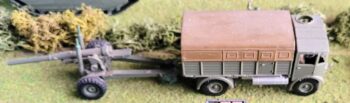
The 5.5 inch gun was designed by the Armaments Research and Development Establishment in 1938 to replace the outdated 6″ howitzer which then equipped the Medium Regiment of the Royal Artillery. Ordered in large numbers just before war broke out in 1939, it first went into service in North Africa in 1941 and remained the standard howitzer of the British army into the 1950s.
The accurate and efficient 5.5″ gun required a crew of ten and could fire two 82lb explosive shells up to 18 200 yards (1 760 yards= 1mile) every minute.
The four wheel drive AEC Matador lorry featured a Park Royal body with enough room for the crew, their equipment, gun tools and a limited supply of ammunition. The Matador was also used by the RAF as a fuel tanker and by many civilian organisations after 1945.
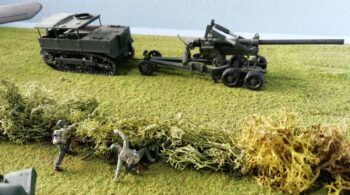
The 13 ton M5 high speed tractor was built by International Harvester and introduced in 1942 as the prime mover for 105 and 155mm canon mounted on two axle carriages. With chassis and running gear based on the M3 Stuart medium tank, power came from a Continental R6572 petrol engine yielding a road speed of 35 mph and 20 mph on a 3% incline.
During the interwar period, the US Army sought to build a powerful artillery piece, drawing on the lessons of the First World War.
In 1920, following the recommendations of the Westervelt Board, the first plans of a 155 mm long range gun were drawn up.
In 1939, the first prototypes appeared under the name T3 8 inch howitzer. This was mounted on eight wheels, and finally became known as the M1.
Used in the various theatres of operations of the Second World War, it is deployed during the Battle of Normandy, where it offered high firepower at long distance. It was thus nicknamed “Long Tom”.
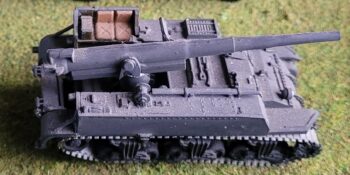
Moving on from towed to self propelled artillery, the idea for the M12 Motor Gun Carriage was first proposed in 1941.
The M12 was built on the chassis of the M3 Grant tank with the engine moved forward to the centre of the vehicle to allow room for the gun mount. Most vehicles used later M4 Sherman-style bogies with trailing return rollers.
The armored compartment at the front was occupied by the driver and commander. The gun crew were located in an open-topped area at the back of the vehicle. It mounted a 155 mm gun M1917, M1917A1 or M1918 M1, depending upon availability, a weapon derived from the nearly identical French 155 mm GPF gun of World War I vintage.
The main armament had a traverse of 14° and elevation limits of +30° to -5°. Limited storage space meant that only 10 155 mm projectiles and propellant charges could be carried on the vehicle.
An earth spade (similar to a bulldozer blade) at the rear was employed to absorb recoil. This layout (large gun mounted in an open mount at the rear, with a spade) was the pattern adopted for many years by other pieces of heavy self-propelled artillery.
In the Allied assault on the Siegfried Line the M12 earned its nickname “Doorknocker” thanks to the 155mm cannon’s ability to fire armour piercing rounds through seven feet of concrete at ranges up to 2 000 yards (1,830 metres)
In 1945, the M12 was complemented in Europe by the M40 Gun Motor Carriage, designed on a late-war M4A3 Sherman chassis with the 155mm gun M1.
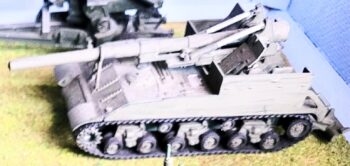
The M40 Gun Motor Carriage was derived from the earlier M12 developed at the Rock Island Arsenal. Both vehicles featured a 155mm bore gun on a highly mobile chassis. Design work on the M40 began in January 1944 with the anticipation of its use in opening of a Second Front in Europe. Carrying a Long Tom gun on a widened M4A3 HVSS chassis, the M40 first saw action in the bombardment of Cologne in early 1945. Its speed and mobility allowed it to keep up with advancing troops.

Bringing up the rear with food, ammunition and personnel is one of the US Army’s M3A1 half track personnel carriers.
The M3 Half Track was partly developed from the French Citroen-Kegresse half track, three examples of which were purchased by the Americans in the interwar period. Weighing in at 10 tons, the M3 could carry a crew of three plus up to ten infantry.
The M3 was a highly successful design which was deployed not only by the US Army but also the armies of Great Britain and the Soviet Union. Over 40,000 examples of the various types of M3 were produced, with the vehicle serving well beyond the end of the war in Europe. Israel was a prolific user of the type in the post-war period, and some of its vehicles were still in frontline used in the early 1980s.
Developed by the White Motor Company of Cleveland from their pre War four wheeled scout car, the half track offered a similar cross country performance to fully tracked vehicles but with a steering system that was simpler and could be assembled from commercially available parts. As a result the M3A1 could offer a mix of armour and mobility superior to conventional wheeled army trucks and was ultimately used as a weapons carrier, signals and command truck and battlefield ambulance by both the US Army and infantry units of the British Guard’s Divisions. In service the 45 mph M3A1 – powered by a 127 bhp White 6 cylinder engine – often towed a trailer although this could be substituted for a 6 pounder anti tank gun.
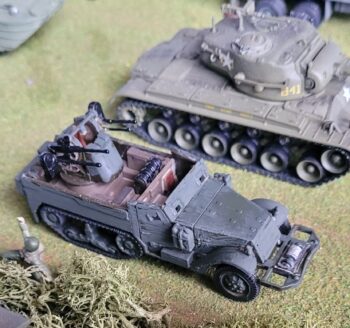
Other guns could be mounted directly on the White half- track including twin and quadruple 0.5 inch anti aircraft machine guns, 75mm guns and 105mm howitzers. Pictured here is the M16 Multiple Gun Motor Carriage with its four 0.5 inch Browning guns, together capable of firing up to 2 400 rounds per minute.
However, most M3A1s carried just one 0.5 inch machine gun flexibly mounted beside the driver’s compartment.
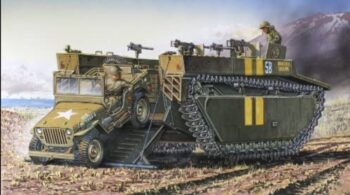
Also able to keep up with advancing armour – and swim across rivers – is the LVT-4 Buffalo.
This was a development of the LVT-1 designed for the US Marine Corps in 1940 which in turn was based on the Alligator, designed by Donald Roebling in 1935 as a civilian rescue vehicle able to reach swampy areas inaccessible to both boats and cars.
In 1937 an improved, faster version of the Alligator appeared in an article in “Life” magazine which caught the eye of USMC planners developing the amphibious warfare doctrines of Lt Col Earl Hancock “Pete” Ellis. As a result, Donald Roebling was approached to design a more seaworthy machine ultimately known as the Landing Vehicle Tracked (LVT).
The first 200 LVTs were built in Dunedin, Florida by Food Machinery Corporation (FMC) who had made some parts for the Alligators as well as insecticide spray pumps and other farm equipment. Eventually FMC also made LVTs at Lakeland, Florida as well as Riverside and San Jose in California, but although the Riverside plant was erected by Roebling Construction the very patriotic Donald Roebling waived any other royalties for the use of his invention by the Allies. However, FMC later evolved into United Defence, now a part of BAe Systems Land and Armaments.
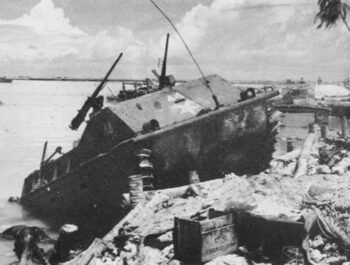
The original LVT could carry 18 men or 4 500 lb of cargo ashore at 12 mph but its tracks and suspension proved unreliable on hard ground. Fitted with new torsilastic suspension however, the LVT2 with a power train taken from the Stuart light tank proved its worth at the battle of Tarawa in June 1942, delivering combat troops to beaches made inaccessible to boats by coral reefs.
Nevertheless, only 35 of 125 LVTs fielded were serviceable at the end of the struggle and the need for armour and fire support in an opposed landing became apparent. As a result the USMC added engines and turrets from Stuart light tanks to create the fire support (LVT(A)-1) with a 37mm gun and Howitzer Motor Carriage (LVT(A)-4) amphibious fighting vehicles. The latter’s 75mm gun proved highly effective against Japanese fortifications although machine guns were later added to suppress infantry attacks to the open topped vehicle.
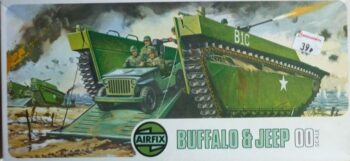
Both “Amtanks” were used inland from the beaches in the Marianas campaigns although of the 18 621 LVTs were built during World War II the more lightly armoured LVT-4, as depicted in the diorama model, was the most prolific with 8 351 units delivered.
This version had the engine relocated to the front of the vehicle, allowing the rear to contain an open well – capable of holding up to 30 men or a light vehicle – behind a ramp for ease of exit.
Over 1 000 LVTs took part in the battle for Okinawa, by which time the LVT-4 had been used by British, US and Canadian forces to cross such rivers as the Schelt, Rhine and Po in Europe. The LVT-4s supplied to the British army were known as Buffalos and used by the 79th Armoured Division were armed with a forward facing 20mm Polsten Cannon and 0.30 calibre Browning machine guns on either side.
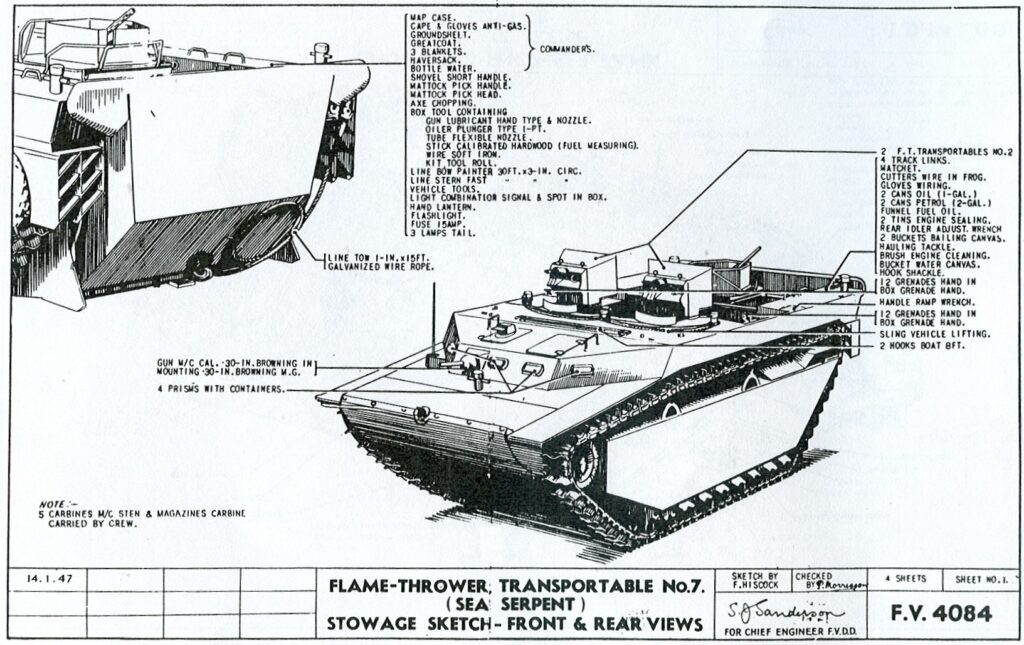
Indeed, had Japan not surrendered in September 1945, the 79th Armoured Division’s design of flame throwing “Sea Serpent” LVT would have been deployed in amphibious assaults on the home islands although the American built LVT-3 “Bushmaster” with rear ramp and engines in side sponsons was used in the Okinawa landings.
US supplied LVTs finally saw action with the French army in Indo China and during the 1956 Suez Crisis.
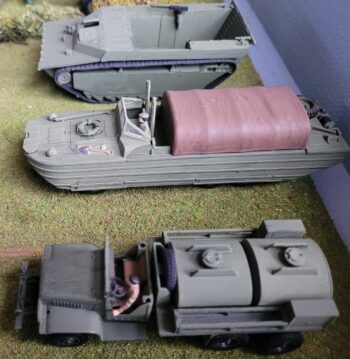
Also designed as an amphibious transport was the DUKW, based the successful General Motors 2 1/2 ton 6×6 truck seen next to it above. Fully loaded the DUKW could carry 25 troops and equipment or 12 loaded litters or 5 000 lb of cargo.
It was first used by the British army in the 1943 invasion of Sicily when 230 examples were allocated to the Royal Army Service Corps companies of the 8th Army to put urgent stores and anti tank guns ashore. Later DUKWs ferried cargo across the Straits of Messina and took part in the landings at Anzio and Salerno.
After D Day in June 1944, DUKWs took supplies from ships anchored within the Mulberry Harbour at Arromanches to dumps inland.
The 31 feet long DUKW had a 93 bhp engine and could reach 50 mph on land and 6 knots in the water.
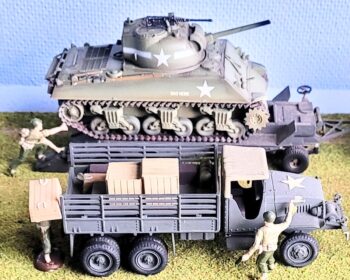
The General Motors Corporation CCKW ‘Jimmy’ was an off road capable 21/2 ton 6×6 truck built for the US Army from 1941 to 1945. The original “Deuce and a Half”, it formed the backbone of the famed Red Ball Express that kept Allied armies supplied as they pushed eastward after the Normandy invasion.
The designation CCKW comes from 1941 design, Conventional Cab, All Wheel Drive and Dual Rear Axles, both driven.
In the same way, DUKW represented 1942, Utility, All Wheel Drive and Dual Rear Axles, both driven.
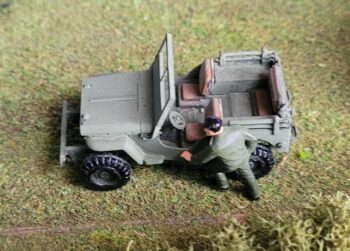
The Willys MB (Model B) Jeep was only produced between 1941 and 1945 but nearly 370,000 rolled off the production line. The ¼ ton, 4x 4 army truck was the result of the US Army need for a light, cross-country reconnaissance vehicle with a specification to include capacity for a crew of three, a fold-down windshield, a weight of no more than 590 kg and a track of no more than 47 inches. It was used extensively by the US and Allied Forces and after the end of World War II, many were sold on into private use.