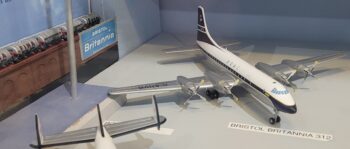
The planned expansion of Jet Age Museum, Gloucestershire, in 2021 gave me the chance to update and enrich the display of 1/144 scale airliners supporting the Hawker Siddeley Trident and its Autoland system.
On the left hand side of the Trident cabinet, the edge of the airport apron had already been defined by an N Gauge viaduct, as detailed in A Slot of Interest on this website.
This featured an advertising hoarding for the Bristol Britannia turboprop airliner, of a similar late 1950s vintage to the Brush Type 2 diesel electric hauling a train of four wheeled tank wagons across it.
In fact a 1/144 scale diecast Bristol Britannia is now parked next to the viaduct hoarding while on the right hand – and less well lit – side of the cabinet, the airliner parked next to the railway on a shallow embankment is now Boeing 737-800 D-ABBA.
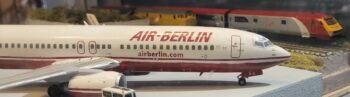
This was in service with Air Berlin from 2001 to 2011 and so it seemed apt to team it with some of the British trains of the Privatisation era in their colourful liveries.
More specifically, given the history of some of the most colourful trains available, thos tableaux would have to date from 2007 to 2011 – already a decade into history and an era of Gordon Brown and David Cameron as Prime Ministers, The Jeremy Kyle show, Girls Aloud, Amy Winehouse and Page 3 models in The Sun.
The ability to move a railway vehicle and its load along the railway tracks depends on the height and width profile, known as the loading gauge, of the route concerned. A railway vehicle must comply with the route loading gauge to ensure that it passes clear of all structures, principally over-bridges and tunnels but also features such as station platforms, canopies and overhead or lineside equipment.
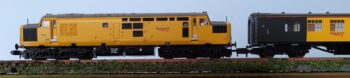
The high tech laser and light technology of the Structure Gauging Train (SGT) provide a superb picture of such infrastructure. The laser beams reflect back to the train, and should the distance that the laser travels be too small, an alert is activated. The train also measures the distance between pairs of tracks ensuring that passing trains will not foul the loading gauge
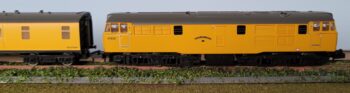
Entering traffic on 12 May 1960, D5614 became 31 191 under TOPS in the early 1970s
In April 1998 it was withdrawn for modification to Class 31/6 standard with Electric Train Supply and renumbered 31 602.
In 2000 the locomotive re-entered traffic with Fragonset, as Chimera, then became a Network Rail asset and was named as Driver Dave Green at Derby RTC in November 2007, marking 52 years of railway service by the driver. However, this name had been removed by 2013 and by 2017, yellow liveried 31602 had disappeared from the Platform 5 Combined Motive Power books.
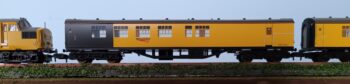
Yellow Structure Gauging Train Coach DB975081 has a section painted light absorbing black to prevent any reflection from the gauging light beam located within.
It began life as Brake Second Corridor (BSK) M35313 built to Diagram 181, Lot 30699, No.35313 by BR (Wolverton) in 1962.
Conversion to Test Coach Hermes (Laboratory 17) in 1971 included a Southern Region EMU type driving cab with air, vacuum and electro pneumatic brakes. This gave British Rail’s tribometer train a rear driving car to save the cost of operating a top-tail formation. On the Mickleover test track in Derbyshire, this train was often powered by a Class 17 “Clayton” Bo-Bo.
In 1981, Test Coach Hermes was re-built without the driving facilities and used as a loco-hauled coach as part of the Structure Gauging Train.
The present SGT had its beginnings in the mid-1970’s. Several experiments were carried out utilising the four-wheeled Wickham Self-propelled laboratory (sometimes known as the Elliot Track recording car). Using a dual-triangulation system with lights and cameras this optical method was a big improvement over the existing ways of gauging.
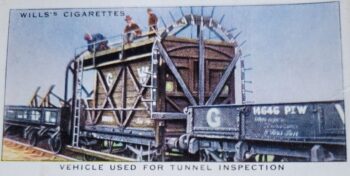
However, due to the arrival of newer SGT vehicles in 2013, DB975081 has been stored at York since July 2017.
The SGT of the early 21st Century was usually operated with locomotives at each end to avoid running round on branch lines.
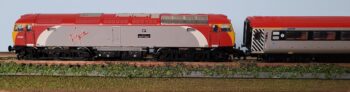
Virgin Trains was formed by Virgin Group and Stagecoach and operated the InterCity West Coast franchise from 9 March 1997 to 7 December 2019.
Having inherited former British Rail electric engines of Classes 86, 87 and 90 and Mark 2 and Mark 3 carriages – including Driving Van Trailers – the joint venture train operating company replaced these on the electrified Euston to Glasgow route with Class 390 Pendolino EMUs from 2003.
However, diesel locomotive hauled trains continued on the non electrified route from Crewe to Holyhead. From 2005 to 2012, these included Pendolino sets hauled by Virgin liveried Class 57/3 diesel electric locomotives.
Following the loss of a Class 390 Pendolino in the 2007 Grayrigg derailment, a Mark 3 set with a Driving Van Trailer was leased with a Class 90 hired from English Welsh & Scottish as required.
In 2008 Virgin looked at leasing two Class 180 DHMU sets but decided to retain the Mark 3 set.

Nicknamed the Pretendolino, this received re-upholstered seating, power points, Wi-Fi and a full external re-paint at Wabtec, Doncaster in 2009. Virgin used this set with a Class 90 locomotive hired from Freightliner on a Euston to Crewe (via Birmingham) service on Fridays only until December 2012. From 9 December 2013 it was utilised to operate a London Euston-Birmingham New Street train on Thursdays and Fridays only, until its withdrawal in October 2014.
The N Gauge vehicles now on show at Jet Age Museum, Gloucestershire, are from a Dapol book set which included 57 301 Scott Tracy as motive power and DVT 82106 and Mark 3 trailer 11007. Like the Structure Gauging Train, the Pretendolino could be driven from either end.
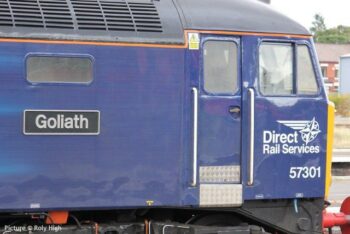
Since the withdrawal and splitting of the Pretendolino, 57 301 is now in DRS markings and named Goliath.