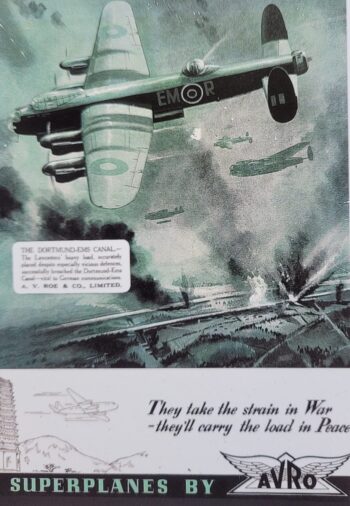
In early 2022 Jet Age Museum, Gloucestershire, was lucky enough to be chosen by esteemed modeller Piers Milne to host his extensive collection of 1/144 scale model aircraft. From the many diecast items available, the following triumph of British engineering can be illustrated.
The Avro Lancaster was the third of the RAF’s four engine heavy bombers after the Short Stirling and Handley Page Halifax. It flew better than its predecessors, was easier to pilot, more reliable and easier to mass produce.
However, the “viermot” that took the war to the heart of Germany was born out of the shortcomings of its twin engined predecessor.

The Avro Manchester (above), built to Air Ministry Specification P13/36 featured a streamlined fuselage, mid wing, large bomb bay and impressive defensive armament.
First flown in 1939, it handled even better with enlarged twin vertical tails and an even larger third central fin. Unfortunately the design was let down by its two 24 cylinder Rolls Royce Vulture engines.
Bristol Centaurus powerplants were considered as replacements but in the end four 12 cylinder Rolls Royce Merlin Vs were chosen by designer Roy Chadwick. What was originally termed the Avro Type 683 Manchester III was developed using as many Manchester components as possible to reduce time and cost.
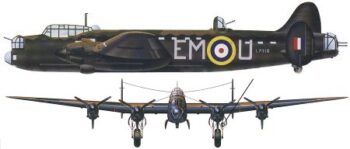
The Lancaster prototype first flew on 9 January 1941.
A second much improved example followed with Merlin X engines yielding 1 480 bhp, although production Lancasters were weighed down by the armour plate required for combat. Despite this, the new four engine bomber would eventually carry more than nine tons of bombs and retained the large bomb bay of the Manchester which had been planned with torpedoes in mind. In contrast, the Short Stirling had three much smaller bomb bays as well a wingspan of 99 feet rather than the Lancaster’s 102.
Between 1942 and 1945, Lancasters flew 156,000 sorties, dropping 608,612 tons of bombs on enemy targets. In 1945, Sir Arthur Harris revealed that two thirds of the bombs dropped on the Axis by the RAF had been delivered by Lancasters.
The 3 440 production Mark 1 Lancasters were fitted with 1 480 bhp Merlin XX engines with a two stage supercharger or, later, the similarly supercharged Merlin 22 of 1 640 bhp.

Like the Stirling and Halifax (pictured above), the Lancaster featured three defensive turrets. The Fraser Nash Mark V nose turret, like the same company’s Mark 50 mid upper installation, featured two .303 calibre Browning machine guns while the FN20 unit in the tail had four guns.
By 1946 though, the Indian based 9 Squadron Lancaster B Mark VIIs forming part of the Tiger Force ready to attack Japan had Bristol built dorsal turrets and a rear Rose Brothers turret both armed with pairs of 20mm canon.
However, an initial weakness of all the British heavy bomber designs was the lack of a ventral turret. Although early examples of Avro Lancaster had a Vickers K machine gun in a ventral position, this was soon abandoned and later replaced with the H2S radome. In contrast, ventral ball turrets were a notable feature of the USAAF’s Boeing B-17.
This lack of underside defence was later to be exploited by German night fighters, which often featured upward firing machine guns.
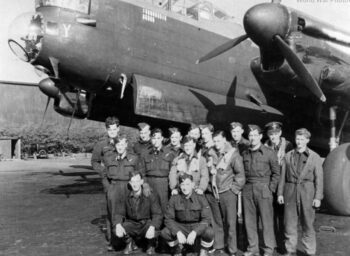
RAF Bomber Command was to receive its first Lancasters on Christmas Eve December 1941, with Waddington based 44 Squadron replacing their twin engine Handley Page Hampdens.
The 44 Squadron Lancasters first went to war with a raid on Essen on the night of 11/12 March 1942. A medium altitude daylight raid on the MAN diesel engine factory at Augsburg by 44 and 97 Squadron Lancasters on 17 April 1942 however led to seven of the twelve aircraft being shot down. After this, Lancasters mainly attacked at night.
As a result, the rows of small plexiglass windows along the fuselage of the Lancasters Mark I and II – inherited from the Manchester were deleted in later models.
Night bombing also meant a reduction in accuracy although this could be partially remedied by the use of Ground Electronic Equipment (Gee) and its successor Oboe.
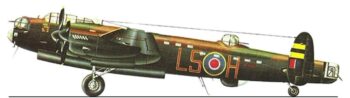
Lancasters fitted with Gee-H radio navigation equipment were distinguish by two horizontal yellow bars on the tail fins.
H2S air to ground radar later allowed each Lancaster to plot its own course, comparing radar scope returns with known maps. Lancaster engine nacelle were also fitted with flame covers on the exhausts and streamlined to minimise vapour trails.
A raid on Hamburg on the night of 24 and 25 July 1943 also saw the first use of ‘window’ – strips of aluminum foil dropped from British bombers to confuse German fighter control radar.
However, German defences soon began to catch up with and sometimes overtake these measures, the tide only turning definitively in favour of RAF night bombing in July 1944 with the widespread use of de Havilland Mosquito fighters to escort the Lancaster and Halifax formations.
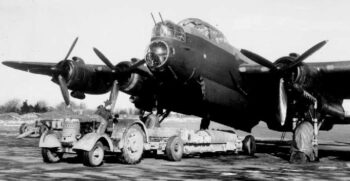
The Mark II Lancaster was recognisable by the use of Bristol Hercules VI (1650 bhp) and XVI (1735 bhp) radial engines fitted due to a lack of Rolls Royce Merlins and larger, curved, bomb bay doors. Only 302 examples of the Lancaster Mark II were built, by Armstrong Whitworth for Canadian squadrons.
The Mark III Lancaster was distinguish by the use of imported Packard Merlin engines and H2S bombing radar in a ventral dome underneath the dorsal turret. This Mark also had the flight engineer sitting on a jump seat next to the pilot. Some Lancaster Mark IIIs received an electrically powered Martin dorsal turrets with two .50 calibre Browning machine guns. These became standard on the Lancaster Mark VII at the end of 1944.
Derived from the Lancaster III was the IIIB, as used by 617 Squadron to attack the Ruhr dams on 16/17 May 1943. These were distinguished by the lack of dorsal turret and bomb bay doors along with the ventral spinning mechanism for the 9 248 lb cylindrical ‘Upkeep’ bouncing bomb.
Only 9 examples of the Lancaster VI were constructed despite being the fastest of the type courtesy of the 1 760 bhp Merlin 85/87s turning four bladed propellers. Also helping them reach 345 mph was the lack of nose and dorsal turrets.
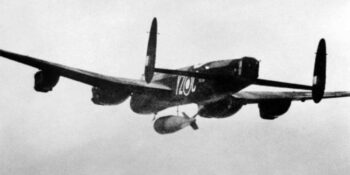
These defensive positions, H2S radar and bomb bay doors were also absent from the Mark 1B special ‘Light” Lancasters constructed to carry the 22 000 lb Grand Slam bomb. These aircraft were used by 617 Squadron to attack U-boat pens near Bremen and Grand Slam earthquake bombs, designed by Barnes Wallis, were also used to devastating effect on German railway viaducts during early 1945.
The 180 examples of the Packard engined Lancaster Mark VIIB introduced a less cramped Rose Brothers rear turret.
The 430 examples of the Lancaster X were essentially Lancaster Mark IIIs produced by Victory Aircraft Ltd at Malton, Ontario, Canada.
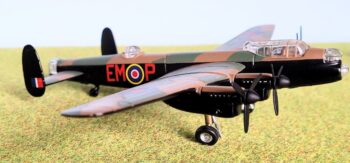
207 squadron was scheduled to form part of the Tiger Force against Japan but with the end of the war in the Far East it relocated to RAF Methwold in Norfolk in November 1945.
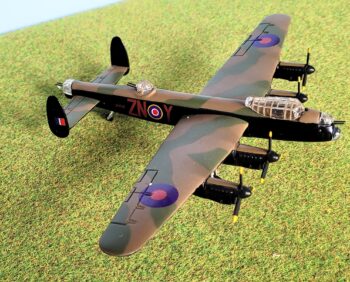
During the summer of 1942, Wing Commander Guy Gibson was the commanding officer of 106 Squadron RAF. His Lancaster W4118 (ZN-L) featured nose art of Mickey Mouse and was named “Admiral Prune”.
The name was a follow on from his earlier Handley Page Hampden, Admiral Foo Bang. The Admiral came from Admiral Benbow in “Treasure Island” and Prune was taken from Pilot Officer Prune as used in RAF training films.
On 5 February 1943 with another crew on board, W4118 went missing after an engine fire near Dijon. Another Lancaster, ED593, then became W/C Gibson’s aircraft. This Lancaster carried the same nose art but was named “Admiral Prune II”. Although only 25 year old, Gibson had completed over 170 operational sorties and had accumulated in excess of 600 flying hours. Many were flown in “Admiral Prune” and “Admiral Prune II”. In early 1943, Wing Commander Guy Gibson became the leader of the newly formed 617 Squadron.
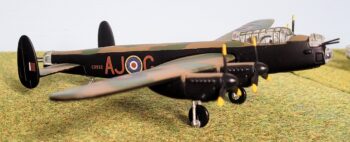
16/17 May 1943 witnessed the most publicised bombing raid of the Second World War when the great Ruhr Valley dams that supplied the hydroelectric power to the heart of Germany were attacked.
The expertise of Wing Commander Guy Penrose Gibson was called upon once again, this time to form a special squadron, later known as the Dambusters.
Nineteen modified Lancasters (including Gibson’s own, AJ-G) of 617 Squadron took off from Scampton, Lincolnshire, for Operation Chastise.
Each aircraft carried an ‘upkeep’ mine (also known as a bouncing bomb) developed by Dr. Barnes Wallis and the raid was deemed a great success. Both the Mohne and Eder Dams were breached, releasing a torrent of water along the whole valley, causing great disruption to industry and communications.
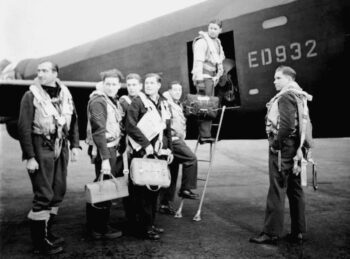
Gibson, at the controls of ED932 – coded AJ-G – was the first to attack the Mohne dam but his bomb exploded on impact with its wall rather than sinking first. However, he kept on circling to suppress German anti aircraft fire before the fifth Lancaster was able to make a textbook strike, the explosion sending millions of gallons of water into the valley below.
The aircraft were adapted Avro Lancaster Mk IIIs, known as B Mark III Special. To reduce weight, much of the armour was removed, as was the mid-upper turret. The substantial bomb and its cylindrical shape meant that the bomb doors were removed and the bomb itself hung, in part, below the body of the aircraft. It was mounted in two crutches and before dropping, it was spun up to speed by an auxiliary motor. What Avro referred to as its Type 464, first flown on 8 April 1943, were also fitted with Rolls Royce Merlin engines developing 1 300 bhp.

Bombing from 60 ft (18 m) at 240 mph (390 km/h), at a very precise distance from the target, required expert crews, intensive night and low-altitude flight training, and the solutions to two technical problems. The first was to know when the aircraft was the correct distance from the target. The two key dams at Möhne and Eder had a tower at each end. A special aiming device (with two prongs making the same angle as the two towers at the correct distance from the dam) showed when to release the bomb. The second problem was to measure the aircraft’s altitude (the usual barometric altimeters lacked sufficient accuracy). Two spotlights were mounted, one under the nose and another under the fuselage, such that at the correct height their light beams would converge on the surface of the water.
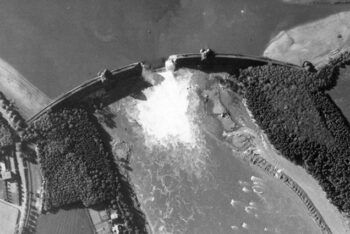
Of the 19 Lancasters taking part in Operation Chastise, only 11 returned home. 53 aircrew were lost and 3 taken prisoner. Similarly, the flood waters released from the Mohne and Eder Dams killed hundreds of German civilians and Russian slave workers.
Beyond those casualties however, the impact of the Dambusters was twofold. Firstly, scarce material and labour was used to rebuild the dams that could otherwise have strengthened Hitler’s Atlantic Wall – as breached by the Allies on D-Day. Secondly, it gave rise to a film that would immortalise the Lancaster.
Premiered in London on the 13th anniversary of the raid in 1955, the film “The Dam Busters” was directed by Michael Anderson and starred Richard Todd as Guy Gibson and Michael Redgrave as bouncing bomb inventor Barnes Wallis. It also had a stirring theme tune, “The Dam Busters March”, written by Eric Coates and was released just as the British public were becoming aware of the diminished status of their country in a world dominated by the USA and USSR. As such, the monochrome movie was a reminder of the time when Britain was not only great, but clever too. The Dam Busters became the most popular cinema film in Britain in 1955 and although not shown on British television until 1971, it soon became a firm favourite in the schedules and later succeeded on VHS and DVD. The Dam Busters film even became well known enough to be parodied in TV commercials as well as spawning many books and models.
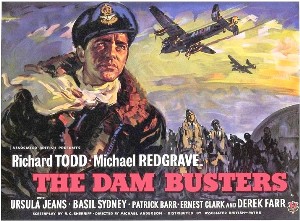
In practical terms, the mid 1950s was the perfect time for The Dam Busters to be made as the RAF had only just finished using Lancasters for patrol duties and many wartime aerodrome were little changed.
Four Lancasters BVIIs were brought out of storage and made airworthy for the film (but sadly scrapped afterwards) and examples of the larger Avro Lincoln – stored at RAF Hemswell where much of the filming took place – made up the numbers of ‘Lancasters’ on the ground. The previously stored Lancasters had their dorsal turrets removed to make them look like the Operation Chastise aircraft, and three of them had been used in the Dirk Bogarde film ‘Appointment in London in 1953. However, they are seen being loaded with .50 calibre ammunition rather than the .303 that the real Dambusters would have used.
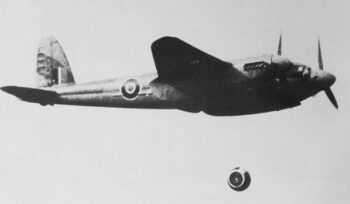
Similarly, although the film is broadly true, the Upkeep bombs were shown as nearly spherical rather than cylinders as the design of the real ordnance was still an Official Secret at the time. However, The Dam Busters does include actual wartime footage of Mosquito aircraft dropping spherical Highball bombs, a design that was never used but was planned to attack shipping.
Likewise, the real Barnes Wallis mentioned cannon balls being bounced off the sea in the 16th and 17th Centuries but not by Lord Nelson, as Michael Redgrave says in the film. Not all bomb aimers used the ‘ coat hanger’ gadget to line up with the towers on the Mohne Dam and the converging spotlights used to judge height were proven by Coastal Command, not inspired by Guy Gibson visiting the theatre.
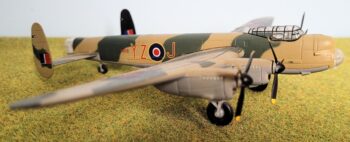
On 27 March 1945, 617 Squadron bombed the U-Boat Pens at Farge, Germany. These pens were one of the largest concrete structures on Earth at the time and of the 20 Lancasters used on the raid, 14 Mark 1Bs were equipped with the huge, 22 000lb Grand Slam Bombs – the highest number ever used on a single mission.
Two Grand Slams found their target and detonated, rendering the pens unusable. No aircraft were lost.
The raid was led by Group Captain Johnny Fauquier, a Canadian who assumed command of 617 Sqn in December 1944. He flew PD119, YZ-J, which was possibly the most distinctive of 617 Sqn, B1 (Special) Lancasters.
While the aircraft wore a daylight camouflage, its port rear rudder was damaged, probably by flak on the 21 March 1945, and with no replacements readily available one was “borrowed” from another plane which wore a black night camouflage scheme. It remained this way until the end of the war.
The raid of 21 March 1945 saw Grand Slam bombs being dropped on the Arbergen railway viaduct spanning the River Weser near Bremen.
617 Squadron’s code letters changed from AJ to KC in late 1943 and YZ was reserved for its Grand Slam carrying Lancaster B1s. These were applied in red with yellow outlining on both the fuselage sides and the upper horizontal surface of the tailplane.
PD119 also served with 15 Squadron and after the war with the Royal Aircraft Establishment, Farnborough, before being struck off charge in 1950.
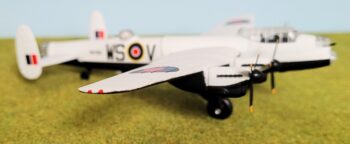
Before the atomic raids on Hiroshima and Nagasaki in August 1945 effectively ended the Second World War, Bomber Command of the Royal Air Force was mustering a large fleet for a conventional offensive against Japan. With the cessation of hostilities, this Tiger Force was reduced in size but with squadrons rotated through Middle and Far East bases both for training and to maintain a British military presence.
As it was, British India became the independent nations of India and Pakistan in 1947 while 1948 saw the start of a long insurgency by Communist terrorists in Malaya.
At the end of the war in Europe, 9 Squadron was allocated to Tiger Force and arrived at Salbano, India, in January 1946. Their Lancaster B Mark VIIs carried out photographic duties and returned to Britain in April 1946.
These aircraft had Bristol built dorsal turrets and a rear Rose Brothers turret both armed with pairs of 20mm canon. Most notably, Tiger Force markings retained the black underside used in Europe, where 9 and 617 Squadrons had attacked the German battleship Tirpitz with Tallboy bombs, but replaced the brown and green upper camouflage with heat reflecting white.
The Lancasters allocated to Tiger Force also had a crew of six rather than seven, undercarriages of the same design as the larger Avro Lincoln (first flown in 1944), Merlin 24 engines and new radio and navigation equipment.
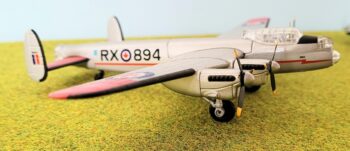
A total of 430 Avro Lancaster Mk. X’s were built in Canada by Victory Aircraft Limited at Malton, Ontario.
The first order placed was for a total of 300 aircraft. Their serial numbers were from KB700 through KB999. These Lancasters were delivered between September 1943 and March 1945. The Lancasters with serial numbers KB700 through KB774 were fitted with Merlin 38 engines. All subsequent aircraft were fitted with Merlin 224’s.
Major changes were made beginning with KB855. The U.S. built, electrically powered Martin mid-upper turret with two .50 calibre machine guns replaced the Fraser-Nash mid-uppers. As well, “4000 pound” bomb bay doors replaced the “8000 pound” doors that were on earlier aircraft. These had enabled the aircraft to carry larger bombs and gave the Lancaster a somewhat pregnant appearance. The possibility of having a mid-under gun turret was eliminated and H2S radar was installed below the fuselage. The changes to accommodate the Martin turret were extensive as the location of the turret had to be moved forward necessitating changes to the rear centre section structure, the capacity of the electrical system had to be increased, the ammunition supply system had to be changed, and the former mid-upper turret hydraulic system eliminated.
The second order placed was for a total of 200 aircraft although only 130 were built. Their serial numbers were from FM100 through FM229. They were delivered between April 1945 and August 1945.
None of the 430 aircraft were lost while being tested at Malton. Almost all of the Lancaster Mk. X’s were ferried to England and none were lost in transit.

Following the end of the war in Europe, the Lancaster Mk. X’s in service were flown to Canada by their crews. Many were to be used as part of “Tiger Force” that was to be the Commonwealth’s contribution to the bombing war in the Pacific. Following the end of the war with Japan, almost all of the Mk. X Lancasters were put into storage. Western Canada, and in particular southern Alberta, was a preferred location because of the dry climate and the abundance of former BCATP facilities. Beginning in 1946 many of the Mk. X Lancasters were taken out of storage and modified to a variety of configurations for various duties with the RCAF.
The Mark 10 Maritime Reconnaissance/ Maritime Patrol variant included radar operator and sonobuoy operator stations in rear centre section, nose and tail turrets only, a 400 Imperial gallon bomb-bay tank, and 15 bomb carrier positions.
KB 894 ( Constructors number 37195) was issued to 425(B) Squadron RCAF on 1 May 1945 with the code KW-A. It was then converted to Mk10MR specification and issued to 407 (Maritime Reconnaissance) Squadron in July 1952 as code RX894. It was further updated to Mk10MP standard by Fairey Aviation in March 1955 with an APS radar system. RX894 was struck off charge on 10 April 1961 and sold to General Smelting of Hamilton.

Currently the only Avro Lancaster flying in North America is officially called the Mynarski Memorial Lancaster but is better known as VeRA after its restored squadron code as KB726 and civilian registration C-GVRA.
This was also built by Victory Aircraft at Malton and first given the identity FM213 by the RCAF on 21 August 1945 before being put into storage at CFB Trenton. By January 1952 however it had been upgraded to 10MR standard by de Havilland Canada at Downsview and after some post landing accident repairs was allocated to 107 Rescue Unit at RCAF Torbay, Newfoundland, eventually with the code CX-213. Before retirement on 6 November 1963, CX-213 crossed the Atlantic on several occasions, escorting both the British Royal Family and Canadian jet fighters being delivered to Europe. CX-213 is pictured above at Prestwick, Scotland, in May 1957, having arrived with some Lockheed designed T-33s.

Following the end of the Second World War and the expiration of Lend-Lease, Britain was obliged to return, buy or destroy the war materials given to her by the US. Amongst other things, this meant that the long-range Catalinas and Liberators that had been used by the RAF’s Coastal Command for maritime patrol were given up. The only replacement available in large enough numbers were surplus Lancaster bombers, sitting idle on remote airfields awaiting their date with the scrapman. Some 50 of these were converted to the air-sea rescue/maritime patrol role, and initially, many of these were fitted with a lifeboat slung under the bomb bay doors. These served from around 1945 to 1954. The subject of this Corgi Aviation Archive model is SW324, coded C-B, of 203 Squadron RAF in 1952. 203 had a proud heritage of maritime patrol, having flown Consolidated Liberators until 1947 and converting to Lockheed Neptunes in 1954. The Squadron went on to operate Avro Shackletons, Hawker Siddeley Nimrods and Westland Sea Kings.
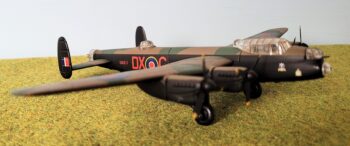
Built at Austin Motors, Longbridge, Birmingham, in April 1945, NX611 was one of 150 Avro Lancaster B Mk VIIs destined for the RAF Tiger Force. Due to Japan’s surrender, the four-engine bomber became surplus to requirements and was stored at Llandow until bought by the French Government and painted midnight blue for maritime patrol duties.
In 1962, she went to Noumeau, New Caledonia, was painted white and used for air sea rescue and cartography duties until 1964 when the French presented NX611 to the Historic Aircraft Preservation Society and flew her to her new home in Sydney where she was overhauled before being flown back to Britain. It took nine days to complete the 12,000 mile journey back to her homeland- seventy flying hours- landing at Biggin Hill on 13 May 1965.
Temporarily grounded, due to expiry of permitted flying hours, it was 1967 before NX611 flew again, but even then public appearances were brief because of prohibitive costs.
Eventually NX611 flew to Lavenham, Suffolk, and in 1972 to Squires Gate, Blackpool, where the Lancaster was to be auctioned off.
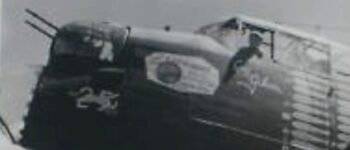
Meanwhile, in Lincolnshire, determined to commemorate the death of their brother Chistopher who was killed on the Nuremburg Raid in March 1944, and all of the men who served in Bomber Command, Fred and Harold Panton had decided to purchase a Second World War Bomber. At one time, they had had their eyes on a Halifax which was coming up for sale, but their father told them, in no uncertain terms, they would not be permitted to keep one at his farm.
The years passed, but the brothers still held on to their dream. Eventually, Fred and Harold became co-owners of their own farm. When some land came up for sale which included part of the defunct RAF East Kirkby airfield they bought it. Some areas of concrete and a few buildings still stood on the old airfield, in a state of disrepair. They used part of the area to set up a poultry farm. However, with the idea of owning an exhibition aircraft still foremost in their in their minds, they also began to renovate the “working area” of the airfield. That included building a new hangar, where an original T2 hangar had stood during the war years.
Learning about the forthcoming auction, via an advertisement, Fred and Harold decided to try and purchase the old Lancaster. This aircraft could be the perfect monument to their brother’s memory. When Fred saw NX611 for the very first time at Blackpool, she stood lonely and forlorn, waiting to be auctioned off to the highest bidder. Around her, a great crowd stood- some hopefully putting in bids, but most just watched- curious to see one of the country’s finest types of bomber at close range.
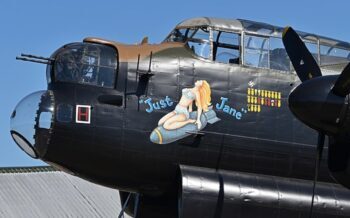
Sadly, due to the reserve not being reached, she was withdrawn from the auction and later privately sold to the Rt Hon Lord Lilford. Fred and Harold kept in contact with her new owner and eventually, whilst she stood Gate Guardian at RAF Scampton, near Lincoln, and after one or two hiccups in the furtherance of their ambition to own her, a deal was struck with Lord Lilford’s agent.
In September 1983, NX611 was finally purchased by Fred and Harold and, four years later, after completing an agreed total of ten years gate guardian at RAF Scampton, she was brought to East Kirkby, courtesy of the RAF. It was sixteen years since Fred had seen her at Blackpool auction.
The first moves towards restoring one of her four engines were made in 1993. Two ex RAF engineers were brought in to do the job. They began work on number 3 engine. Although it had been idle for 22 years, they were confident they could bring it back to life. Accessing the spare parts was organised, the engine rotated to ensure it would still turn and the cam shaft covers removed. Both camshafts had to be replaced, although the engine cylinders were in good working order. Then the propeller was removed, stripped down and examined and – apart from having to adjust the blade settings – everything proved to be in fine order and was rebuilt.

Local contractors were brought in to check the wiring and make good where necessary. That alone was a ten-day job.
The engine’s starter motor, magnetos, fuel booster pump and ignition harness were removed and checked, the fuel tank was pressurised and the fuel jettison system reset. When the throttle controls between the cockpit lever and the engine were uncovered, it was discovered that almost a third of the small control rods had to be replaced.
However after about seven hundred man hours and at a cost of £7,000 the engine was finally ready. This work was then completed for all four engines and NX611, now known as Just Jane, is now at a fully operational taxiing standard.