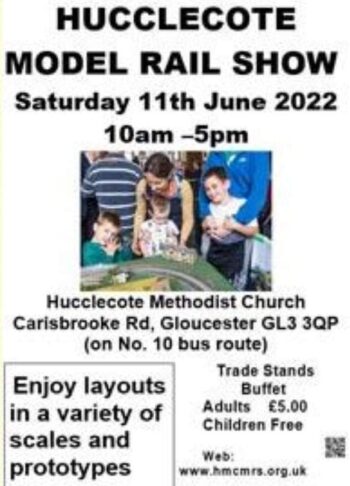
The 12th Hucclecote Model Railway Exhibition was held at Hucclecote Methodist Church, Carisbrooke Road, Hucclecote, Gloucester GL3 3QP – on the Number 10 bus route from Gloucester to Cheltenham – from 1000 to 1700 on Saturday 11 June 2022. Admission £5.00. Children free. Visitors who attended in previous years could confirm the warm welcome and the quality of the refreshments. 2022 was to be no different! Similarly, the range of exhibits at this charity show appealed to both keen modellers and local families.
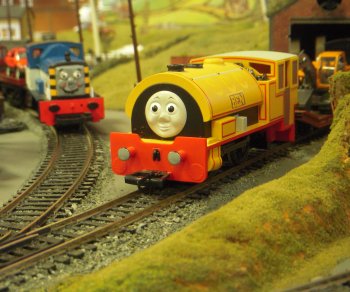
The 2022 poster showed the well-known child friendly 00 gauge Thomas layout Summer on Sodor. Although the Reverend Wilbert Vere Awdry (1911-1997) is well remembered in Gloucestershire as a resident of Rodborough, Stroud, and a patron of the Dean Forest Railway, his childhood association with the Great Western Railway is less well known. However, when Wilbert was six years old, his father, also an Anglican vicar, moved the family to his new parish of Box in Wiltshire. By 1920 their house- “Journey’s End” – was only 200 yards from the western end of Box Tunnel and the nine year old Wilbert could lie awake at night and hear eastbound freight trains being banked up the two mile long 1 in 100 incline, engine crews communicating by coded whistles. Awdry related: “There was no doubt in my mind that steam engines all had definite personalities. I would hear them snorting up the grade and little imagination was needed to hear in the puffings and pantings of the two engines the conversation they were having with one another: ‘I can’t do it! I can’t do it! I can’t do it!’ ‘Yes, you can! Yes, you can! Yes, you can!’”. Here was the inspiration for the story of Edward helping Gordon’s train up the hill, a story that Wilbert first told his son Christopher some 25 years later, and which appeared in the first of the Railway Series books.
ATTRACTION REVIEW
CHURCH ROAD SIDINGS
by Rob Mills
0 Gauge 7mm Scale
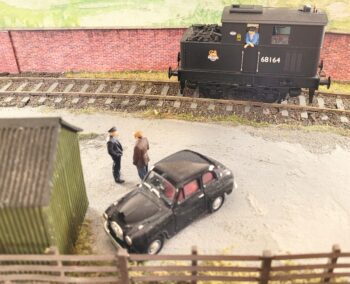
Two speed Sentinel 0-4-0T 68164 was introduced in 1927 as one of the 12 strong LNER Y3 Class. Weighing in at 20 tons 16 cwt, its 275 psi superheated vertical boiler fed two 6 3/4″ x 9″ cylinders acting through gears on 2’6″ wheels to yield a maximum tractive effort of 12 600 lb.
TONY’S FOREST
by Robin Edwards
16mm Gauge 7mm Scale
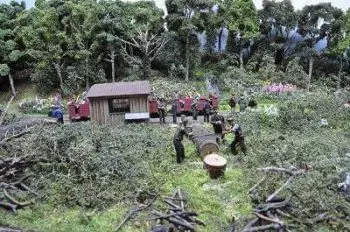
The layout portrayed the line coming up the hillside to a passing loop with the old track forward now disused and overgrown. The line reversed and continued up the hillside while a newer branch led to a quarry which supplied Shropshire County Council with road stone. The area is still known as Tony’s Forest, but the railway remains known only to a few enthusiasts and the local population. There were some rare locomotives still in use and unknown to railway fandom. However, this was the late 1950s and modernisation was on the way. Who knew how long this little backwater would survive before being noticed by someone in the Council? The future was very uncertain.
Emphasis was placed on scratch built scenery and structures while most of the rolling stock was built from kits.
Track was hand built using Peco nickel silver rail on copper clad sleeper strip obtained from the 7mm Narrow Gauge Association. Buildings used wood, embossed card or plastic sheet and Grandt Line windows again from the 7mmNGA. Locomotives and rolling stock were mainly kit built and locomotive chassis were fitted with high ratio gearboxes and flywheels where possible. Passenger coaches were converted Bachmann 0n30 Trolley bodies mounted on bogies from the 7mmNGA while the quarryman’s open coaches were from S&D Models. Wagons were from KB Scale and Wrightlines. The Greenwhich couplings were activated remotely by permanent magnets set into the track bed.
ABBOTS MORTON
by Paul Fogg
4mm 00 Gauge
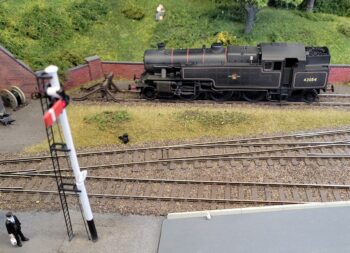
This 00 Gauge 4mm Scale layout depicted part of what might have been a Midland cross country line from Broom (between Barnt Green and Evesham) built west towards Worcester. However, rather than making Broom a railway crossroads with trains running east to Stratford Upon Avon, the money for the line to Worcester ran out and Abbots Morton became a branch terminus.
By the late 1950s it would have been transferred to Western Region with most visiting locomotives being based at Saltley, Gloucester Barnwood or Bournville.
Abbots Morton was designed for digital operation and uses a SPROG device to provide the train control with tablets fitted with the Engine Driver app. Locomotive decoders were from Bachmann, Hatton and DCC Concepts.
Layout trackwork was SMP Code 75 Bullhead, points being SMP plastic kits operated by Trainstronics point motors. The one signal was from Dapol, other structures being sourced from Hornby Skaledale, Wills and Ratio.
AIMFORD END HALT
by Amelia Chamberlain
00 Gauge 4mm Scale
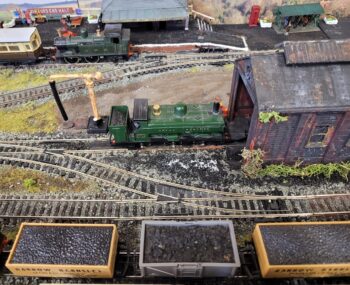
This 35 year old layout, originally built by Amelia’s dad, represented a fictional Western Region Cotswold branch line terminus in the 1950s and 60s.
ALSTONE SERVICING DEPOT
by Robert Webb
00 Gauge 4mm Scale
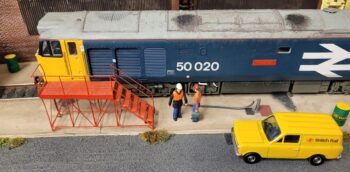
Robert and his dad Roger have been stalwart helpers in the organisation of the Cheltenham GWR Modeller’s Exhibition for as long as I can remember and this 6′ x 2′ two-board 4mm scale layout is easy to set up and play with at home as it is to exhibit. Alstone Servicing Depot was inspired, as Robert explained, on many Western Region and other depots that he visited with his father and friends in the early 1980s. The very impressive scratchbuilt water tower was based on the one visible from Bristol Temple Meads station at Bath Road while other scenic items – including magpies, woodpeckers, wood pigeons and a cat – were from Woodland Scenics, Busch and Penduke models. Track was Peco Streamline, and I also liked the way that Robert incorporated his keen interest in fairground rides. As well as his perseverance in making that red access platform from a brass kit!
BARNWOOD HALT ENGINE SHED
by Barnwood Model Railway Club
4mm 00 Gauge
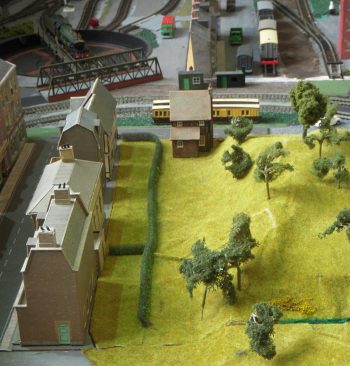
This layout allowed the younger audience members to drive a selection of 0-4-0 driven passenger and freight stock.
GLOUCESTER REMEMBERED
by Mike Joyner
00 Gauge 4mm scale
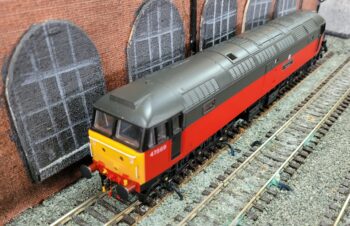
Gloucester Remembered combined a model of Horton Road steam locomotive depot and the nearby gated level crossing with all the locomotives to bear ‘Gloucester’ names.
For me, the sole diesel was of special interest as on 1 July 1990 I was present to witness 47 569 being named “The Gloucestershire Regiment” by Brigadier S.D.A. Firth OBE at Gloucester Horton Road Open Day after a repaint in red and dark grey Parcels livery. 47 569 thus became the first, and so far only, diesel to bear a “Gloucester” title.
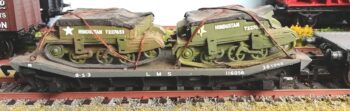
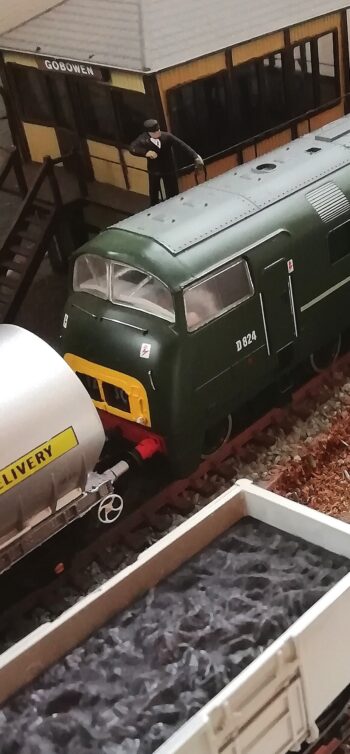
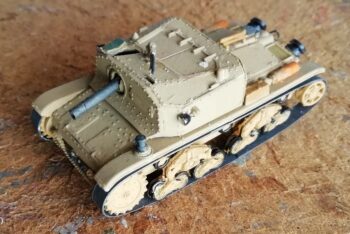
GREAT WESTERN AT WAR
CONCRETE PROGRESS
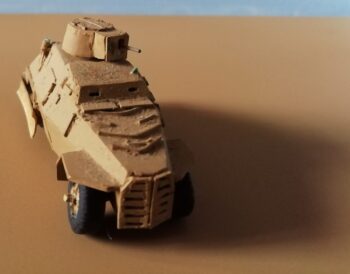
DESERT VICTORY
DICTATORS IN THE DESERT
by Alan Drewett
00 Gauge 4mm Scale
HILLTON TMD
by Rhys Harries
00 Gauge 4mm Scale
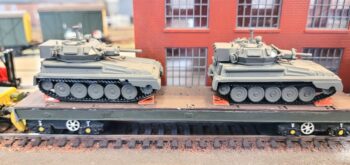
During the 1950s Hillton was a thriving terminus station with a turntable and shed but post Beeching was closed and left to decay. In the mid 1990s however, both EWS and Network Rail needed a new site for a new Traction and Maintenance Depot and so the old steam depot site was flattened and redeveloped for this purpose. Also used by other train operating companies from South Wales and the West of England, Hillton TMD was very busy with locomotives arriving and departing for turns of duty, maintenance and refuelling.
Due to public pressure and a grant from the Welsh Assembly, the old station was also re-developed as a transport hub and terminus on a single branch line off the main Gloucester to Newport route.
PAYNESTOWN
By Reg Owens 00 Gauge 4mm Scale

Paynestown was a fictional South Wales valley terminus served by one of the pre-grouping railway companies which later became part of the G.W.R and in turn Britush Railways Western Region. Paynestown was modelled around the 1960s, which enabled the operators to run steam and diesel locos in the transition period. Because Paynestown was supposedly situated at the northern part of the South Wales coalfield it was assumed that the connection with the former London & North Western / London Midland and Scottish Railway was made, which allowed the operators to run a greater variety of locos and rolling stock. The layout used Peco code 100 track and points. Buildings – such as the non conformist chapel seen here – were mostly scratch built using different types of materials. Control of the layout was originally analogue but has been converted to D.C.C.(Digitrax system) which allows the operation of some sound locos.
THE END OF THE LINE
by Martin Nash
00 Gauge 4mm Scale
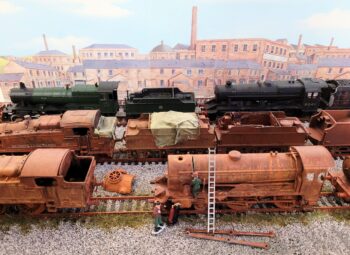
Martin Nash said that his new display was a work in progress with a Peco back scene more reminiscent of Huddersfield than Barry Island but despite this it evoked the days of Dai Woodham storing and eventually dismantling the giants of steam that became redundant in the 1960s. Fortunately, a number of the hulks were saved from rusting away to nothing in the salty air by dedicated railway preservationists for us now to enjoy.
NASH ESTATES
by Martin Nash
4mm Scale
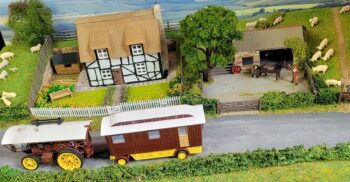
The charm of a rural England gone by is celebrated in this diorama with a diecast Showman’s engine hauling a living van past the classic Airfix half timbered cottage and a horse being shod outside a village forge.
RETURN TO THE RAILS, SOUTHDOWN 1960S AND THE WEDDING SCENE
by Vincent Tweed
00 Gauge 4mm Scale
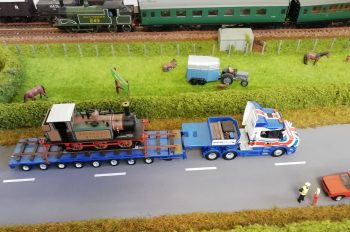
Return To The Rails featured a Brighton Terrier 0-6-0T coming home to its heritage line on a low loader while in The Wedding Scene the Sussex village church of St Michael has just hosted a wedding with the happy couple posing for photographs by the west door.
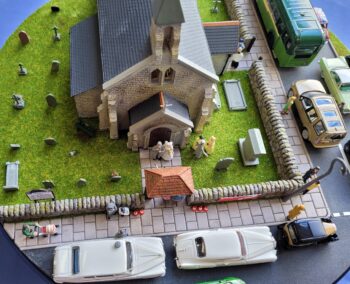
Their transport to the reception will be the white Bentley S1 Continental Fastback and Daimler DS420 parked outside while some of the other guests will ride in the 1947 vintage Leyland PS1/1 bus with South downs livery painted on its ECW coachwork.
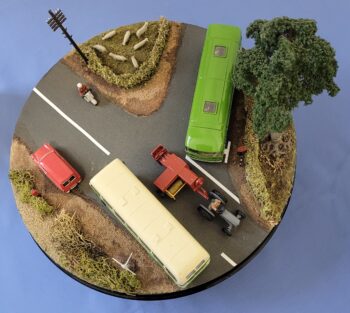
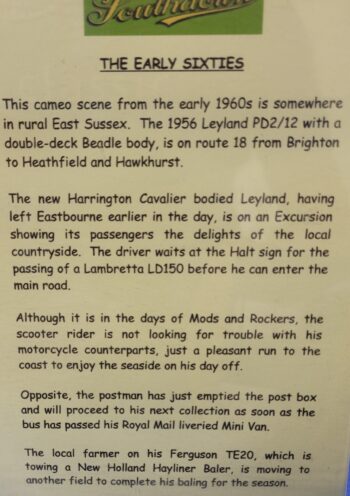
HILLSIDE EXCHANGE
by David Griffin
4mm P4 Gauge/ 009 Gauge
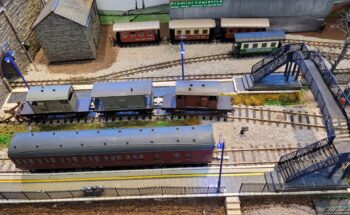
An interchange between standard and narrow gauge preserved lines.
GLB BITTERFELD
3.5mm H0 Gauge by Eric Bird
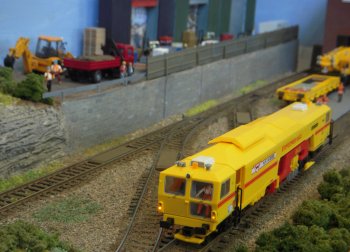
GLB Bitterfeld represented a small permanent way yard and servicing depot for on track plant in Germany from 1980 to the present day. The points used were recycled from a second-hand American layout. Bitterfeld was built primarily to demonstrate German DCC items of rolling stock and advances in model technology, as well as the Kadee magnetic uncoupling system. The layout was powered by Roco Multimaus or NCE DCC control systems. Models shown were straight ”out of the box” or may have had some weathering. Like their opposite numbers in Britain, these on track machines are painted yellow and often built by Plasser and Theurer, one of Austria’s biggest exporters. Their tasks include lifting, cleaning and replacing ballast and tamping down new track – all jobs done more intensively by human labour many decades ago. A small DVD player was utilised to show the real life items and their use
Deutsche Bundesbahn, the West German Federal railways, benefited greatly from American Marshall Aid during the years of reconstruction after the Second World War and as a result embraced electrification to a much greater extent that Britain, which had to pay war debts to the USA while eventually modernising its national railway system.
JAEGER STRASSENBAHN
by Andrew Hunt
3.5mm Scale HO Gauge
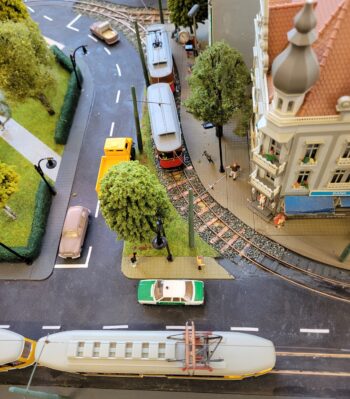
A freelance European tramway with a three track depot situated at the rear of ghe layout. All trams pick up current from the overhead catenary and return it through the rails. The yellow pick up truck above is a Mercedes Unimog (not a cat who goes to college, obviously)
A TASTE OF AMERICA
by Vincent Tweed
1/87 Scale (3.5mm to the foot)
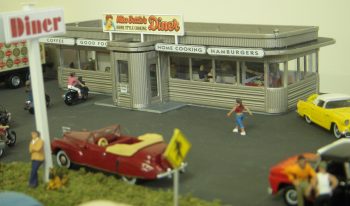
Having impressed us over the years with his Southdown buses and transport rally dioramas, Vincent took Hucclecote visitors to Miss Bettie’s Diner, Colorado, USA with a dazzling array of chrome and tailfins parked outside. He commented:
“Since my first visit to the United States I have held a fascination for diners, especially those constructed with a stainless steel finish. Miss Bettie’s Diner is found on a busy highway sometime in the 1960s. The now disused rail track will eventually become an extension to a nearby preserved railroad. The ranch is a stud for breeding racehorses and also houses a collection of vintage tractors and farm machinery which is open to visitors at weekends. The diner is a grey Walther’s Cornerstone kit sprayed to achieve a stainless steel finish and with added detail. The cars are from the Oxford Diecast range and various US manufacturers with the majority of figures by Woodland Scenics.”
LAMMAS LANE
by Oliver Honer
N Gauge 2mm Scale
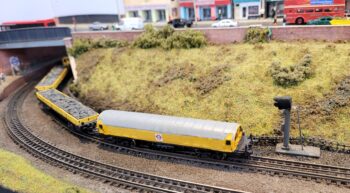
Lammas Lane depicted a small fictional section of the London Underground network in the late 1990s. The layout was acquired in 2017 and has since been fitted with conductor rail and lineside cabling. Rolling stock is a mixture of ready to run, modified and kit built representing tube and surface stock as well heritage trains. The layout is analogue with a single track and passing loop. Points are controlled by rods.
ST WICK
N Gauge 2mm Scale
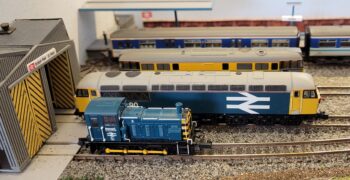
St Wick featured a two-platform station and a small locomotive/servicing shed. The layout was 5ft x 1ft and could be set up on a 6ft table or its own legs. The original idea behind this layout was to design a layout which could be set up and taken down within 10 minutes and maximising the small space available on the main board.
The track, points and point motors were all Peco and the stock used was a mixture or Dapol and Graham Farish based around the 1980s and 1990s.
VINE STREET
by Chris Sharp
N Gauge 2mm Scale
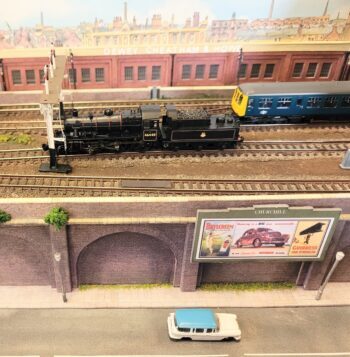
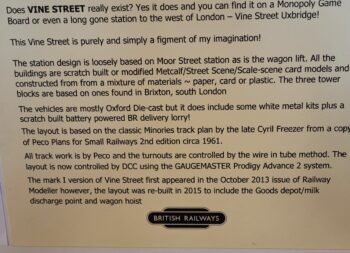
A busy urban end to end DCC layout based on tqhe late Cyril Freezer’s Minories plan. Point control was by wires in tube.
RAILWAY ARTIST
ROB ROWLAND
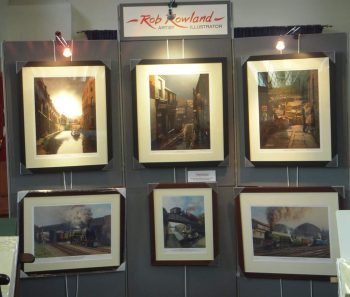
A member of the Guild of Railway Artists, based in Gloucestershire who impressed visitors with his detailed and highly atmospheric paintings.
This 00 Gauge 4mm Scale layout depicted part of what might have been a Midland cross country line from Broom (between Barnt Green and Evesham) built west towards Worcester. However, rather than making Broom a railway crossroads with trains running east to Stratford Upon Avon, the money for the line to Worcester ran out and Abbots Morton became a branch terminus.
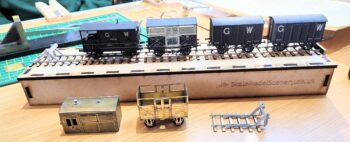
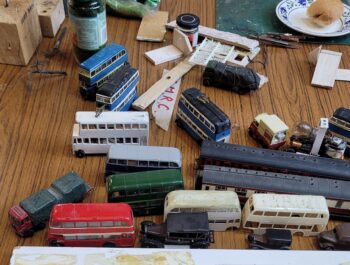
Also attending was the Dean Forest Railway with trade support from Stewart Blencowe, Ian Carter, Clive Reid’s Pre Enjoyed Railways Bob’s 3D Models and Penduke Models.
The show organisers also wish to thank Hullabaluxe temporary structures and 2020 Signs.