
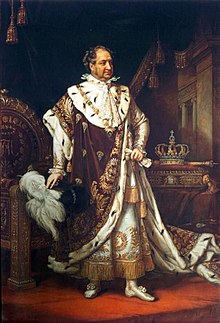
During World War I, although German U-boats sank Allied merchant shipping, the Royal Navy enforced a much tighter blockade on Germany. As a result, 1916 to 1917 became known in Germany as “The Turnip Winter” with people forced to eat the vegetables that were previously only fed to cattle. Indeed, the average weight of cattle slaughtered fell dramatically due to lack of food, bread for the human population was strictly rationed and eventually led to food riots in Hamburg- hastening the abdication of Kaiser Wilhelm II (pictured above) and uprisings inspired by the 1917 Bolshevik Revolution in Russia.
In addition, Germany had taken a huge financial risk at the start of World War One by taking the Mark off the international Gold Standard and borrowing heavily to buy armaments.
The German government believed that it would be able to pay off the debt by winning the war and imposing war reparations on the defeated Allies. This was to be done by annexing resource-rich industrial territory in the west and east and imposing cash payments on the vanquished.
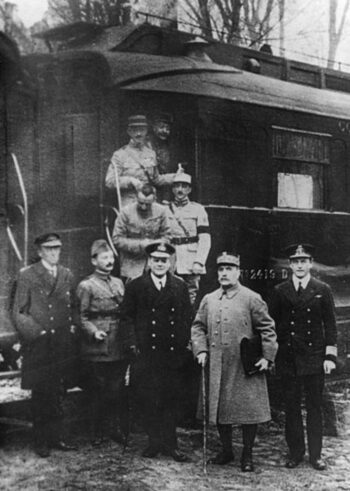
On 11 November 1918 the Armistice ended the conflict with the surrender of the Central Powers and the 1919 Treaty of Versailles stripped Germany of its overseas colonies, returned many debatable European territories to the Victors and other powers and imposed huge reparation payments on Germany.
The map of Europe itself looked very different from its form of 1914, with new nations emerging from the ruins of the Austro-Hungarian, German and Ottoman Empires and some of the countries that fought alongside Britain and France being disappointed by the lack of territorial reward for their intervention.
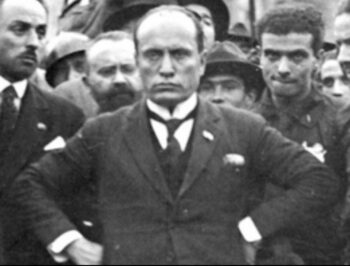
28 October 1922 marked the Fascist March on Rome, with Benito Mussolini being appointed Prime Minister by King Victor Emmanuel. This in turn formed the template for the Munich Beer Hall Putsch by the German National Socialist Worker’s Party on 8-9 November 1923.
Between these two events came the French and Belgian occupation of Germany’s western industrial Ruhr region, lasting from 11 January 1923 to 25 August 1925.
Since the First World War had been fought predominately on French soil, German reparations imposed at Versailles were being paid primarily to France. The Inter- Allied Reparations Commission had initially overseen the gradual payment of 226 billion gold Marks (972 billion US Dollars at 2022 prices). However, in 1921 the amount was reduced to 132 billion Marks (US $442 billion or £284 billion in 2022). Even with the reduction, the debt was huge.
As some of the payments were in exported raw materials, German factories were unable to function, and the German economy suffered, further damaging the country’s ability to pay. As a result of hyper inflation due to the German government printing too much money, the Mark was virtually worthless by 1923.
In 1919, one US Dollar was worth 48 Marks. By June 1921, one US Dollar was worth 330 Marks. In December 1922 one US Dollar was worth 7 400 Marks.
A loaf of bread in Berlin that cost around 160 Marks at the end of 1922 cost 200,000,000,000 Marks by late 1923.
By November 1923, one US Dollar was worth 4,210,500,000,000 German Marks.
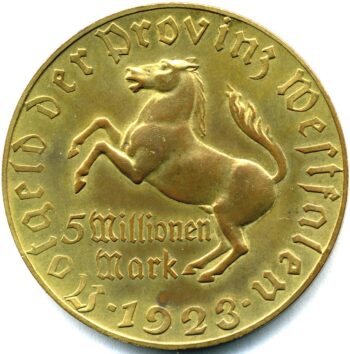
The government and the banks had two unacceptable alternatives. If they stopped inflation, there would be immediate bankruptcies, unemployment, strikes, hunger, violence, collapse of civil order, insurrection and possibly even revolution. If they continued the inflation, they would default on their foreign debt.
France was also suffering from a high deficit accrued during World War I, which resulted in a depreciation of the French Franc. France, increasingly desperate, looked towards the prospect of German reparations payments as a way to stabilize its economy.
By late 1922, the German defaults on payments had grown so regular that a crisis engulfed the Reparations Commission. The French and Belgian delegates urged occupying the Ruhr as a way of forcing Germany to pay more, while the British delegate urged a lowering of the payments.
As a consequence of a German default on timber deliveries in December 1922, the Reparations Commission declared Germany in default, which led to the Franco-Belgian occupation of the Ruhr in January 1923. Particularly galling to the French was that the timber quota the Germans defaulted on was based on an assessment of their capacity that the Germans made themselves and subsequently lowered. The Allies believed that the government of Chancellor Wilhelm Cuno had defaulted on the timber deliveries deliberately as a way of testing the will of the Allies to enforce the Treaty.
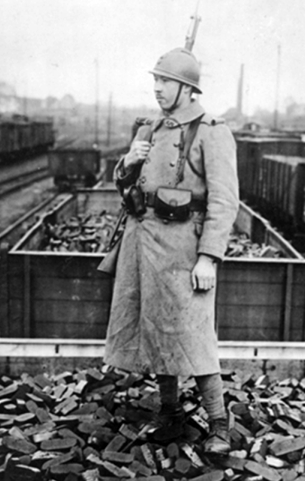
The entire conflict was further exacerbated by a German default on coal deliveries in early January 1923, which was the thirty-fourth coal default in the previous thirty-six months.
Frustrated at Germany not paying reparations, Raymond Poincare, the French Prime Minister hoped for joint Anglo-French economic sanctions against Germany in 1922 and opposed military action. However, by December 1922 he saw coal for French steel production and payments in money as laid out in the Treaty of Versailles draining away.
Indeed, French iron ore and German coal were less valuable separately than united as iron and steel. The supply chain that brought the two raw materials together had become tightly integrated during the industrialization of Germany after 1870, but the problems of currency, transportation and import/export barriers threatened to destroy the steel industry in both countries. Eventually, this problem was resolved in the 1950s with the European Coal and Steel Community, a forbear of today’s EU.
After much deliberation, Poincaré decided to occupy the Ruhr on 11 January 1923 to extract the reparations himself. The real issue during the Ruhrkampf (Ruhr campaign), as the Germans labelled the battle against the French occupation, was not the German defaults on coal and timber deliveries but the sanctity of the Versailles Treaty.
Poincaré often argued to the British that letting the Germans defy Versailles in regards to the reparations would create a precedent that would lead to the Germans dismantling the rest of the Versailles Treaty.
Finally, Poincaré argued that once the chains that had bound Germany in Versailles were destroyed, it was inevitable that Germany would plunge the world into another world war.

The invasion of 11 January 1923 was led by General Alphonse Caron’s 32nd Infantry Division under the supervision of General Jean-Marie Degoutte.
Following France’s decision to invade the Ruhr, the Inter-Allied Mission for Control of Factories and Mines (MICUM) was set up as a means of ensuring coal repayments from Germany.
The French occupation was greeted by a campaign of both passive resistance and civil disobedience from the German inhabitants, of whom approximately 130 were killed by the French occupation army.
In addition, the German government paid workers in the Ruhr to do nothing by printing more and more Mark banknotes, thereby making inflation worse.
A Rhenish Republic was also declared in October 1923 although its prospective government soon collapsed due to differing agendas.
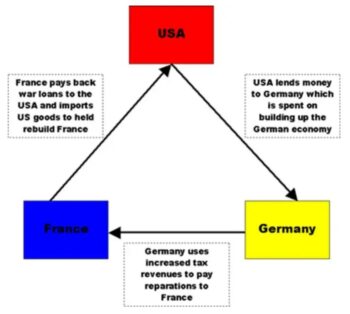
Although the French managed to extract items of value from their Ruhr Occupation, financial pressure from broth Britain and the USA and World disapproval led to France being forced to adopt the American Dawes Plan to substantially reduce German reparations.
Under the Dawes Plan, Germany paid only 1 billion Marks in 1924, and then increasing amounts for the next three years, until the total rose to 2.25 billion marks by 1927.
The last French troops left the Ruhr on 25 August 1925, leaving behind a discredited German government and a popular desire for stronger leadership, eventually to be fulfilled by Adolf Hitler’s National Socialist German Worker’s Party after the economic disaster of the 1929 Wall Street Crash.
OTHER VOICES

From The Times of 27 July 1922
‘Delegates to the 22nd International Peace Conference attended a service at St Paul’s Cathedral yesterday, at which the preacher was Dean Inge. He said that most people now felt that something was wrong about the war. As Europeans, Christians, civilised men, all were called to penitence – a penitence in which all might find reconciliation. The war, while it lasted seemed to have been caused by the deliberate wickedness of an abstract demon called Germany. The Germans believed that similar abstractions called Russia, France and England were the criminals. Now it seems to most people that they were all stark mad together. Referring to indemnities, Dean Inge said that Bismark declared that if he made another successful war, Germany should pay a large indemnity to the losers. To demonstrate the economic lunacy of war was not to appeal to low motives. Perhaps the business community would not again make the mistake of thinking that war could ever be good business. But the liability to attacks of war fever was so great, and the irrationality of human beings so intractable, that they could not rely only on appeals to common sense. The moral appeal must come first, in the form of penitence and reconciliation. Europe has deep cause for penitence.

We should have offered the Germans terms which seemed unexpectedly generous, and said “We have given you no excuse for plotting revenge. Join us in establishing a League of Nations for universal disarmament and let us all help each other to gather up the fragments that remain.” The Dean proceeded:
“We say the Germans showed no signs of repentance. Did we make it easy for them to repent? The human heart is like water; it freezes at a certain temperature and melts under the influence of warmth. The Christian method is to overcome evil with good. It does not always succeed, but the opposite, of driving out devils with Beelsebub invariably fails. I have no wish to talk politics. But, if it pleases God, if it is not yet too late. The gate of repentance is not yet shut. We have all sinned and suffered together; we may all repent together.” Justice, common sense and good will were the qualities needed, not sentimentality.
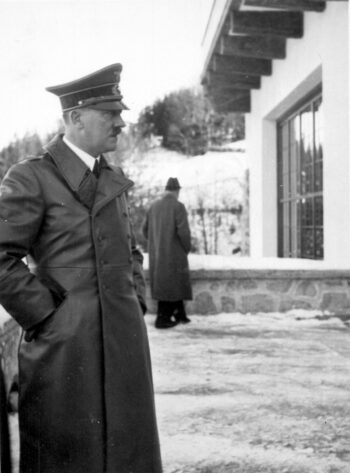
Introducing his February 1939 translation of Adolf Hitler’s book Mein Kampf, Abbots Langley based writer James Murphy commented:
“It was the hour of Germany’s deepest humiliation, somewhat parallel to that of a little over a century before, when Napoleon had dismembered the old German Empire and French soldiers occupied almost the whole of Germany.
In the beginning of 1923 the French invaded Germany, occupied the Ruhr District and seized several German towns in the Rhineland. This was a flagrant breach of international law and was protested against by every section of British political opinion at the time. The Germans could not effectively defend themselves, as they had already been disarmed under the provisions of the Versailles Treaty. To make the situation more fraught with disaster for Germany, and therefore more appalling in its prospect, the French carried on an intensive propaganda for the separation of the Rhineland from the German Republic and the establishment of an independent Rhenania. Money was poured out lavishly to bribe agitators to carry on this work, and some of the most insidious elements of the German population became active in the pay of the invader. At the same time a vigorous movement was being carried on in Bavaria for the secession of that country and the establishment of an independent Catholic monarchy there, under vassals to France, as Napoleon had done when he made Maximilian the first King of Bavaria in 1805.
The separatist movement in the Rhineland went so far that some leading German politicians came out in favour of it, suggesting that if the Rhineland was thus ceded it might be possible for the German Republic to strike a bargain with the French in regard to Reparations. But in Bavaria the movement went even farther. And it was more far reaching in its implications, for if an independent Catholic monarchy could be set up in Bavaria the next step would have been a union with Catholic German Austria, possibly under a Hapsburg King. Thus a Catholic bloc would have been created which would extend from the Rhineland through Bavaria and Austria into the Danube Valley and would have been at least under the moral and military, if not the full hegemony of France. The dream seems fantastic now, but it was considered quite a practical thing in those fantastic times. The effect of putting such a plan into action would have meant the complete dismemberment of Germany; and that is what French diplomacy aimed at. Of course, such an aim exists no longer. And I should recall what must now seem “old, unhappy, far-off things” to the modern generation, were it not that it were very near and actual at the time Mein Kampf was written and were more unhappy then than we can even imagine now.
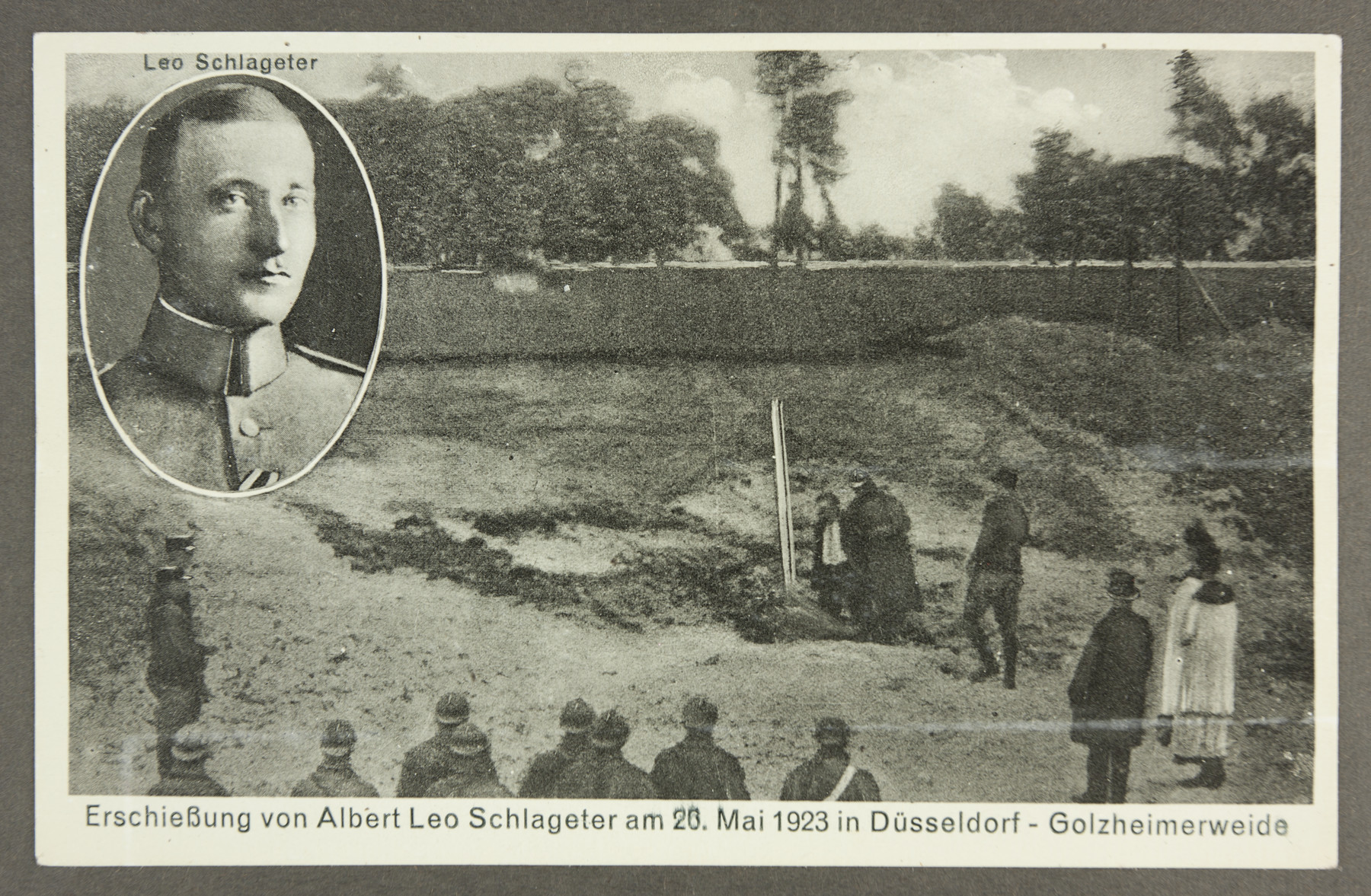
James Murphy’s first footnote in his 1939 translation of Mein Kampf also shed light on the historical background of the 1923 Occupation of the Ruhr, and in particular two selfless individuals:
From 1791 to 1814 the French Revolutionary Armies overran Germany. In 1800 Bavaria shared in the Austrian defeat at Hohenlinden and the French occupied Munich. In 1805 the Bavarian Elector was made King of Bavaria by Napoleon and stipulated to back up Napoleon in all his wars with a force of 30 000 men. Thus Bavaria because the absolute vassal of the French. In 1806 a pamphlet entitled “Germany’s Deepest Humiliation” was published in South Germany. Among those who helped circulate the pamphlet was the Nuremburg bookseller, Johannesburg Phillipp Palm. He was denounced to the French by a Bavarian police agent. At his trial he refused to disclose the name of the author. By Napoleon’s orders, he was shot at Branau-on-the-Inn on 26 August 1806. A monument erected to him on the site of the execution was one of the first public objects that made an impression on Hitler as a little boy.
Albert Leo Schlageter’s case was in many respects parallel to that of Johannes Palm. Schlageter was a German theological student who volunteered for service in 1914. He became an artillery officer [Wikipedia says he was an emergency medical worker] who won the Iron Cross of both classes. When the French occupied the Ruhr in 1923 Schlageter helped organise the passive resistance on the German side. He and his companions blew up a railway bridge for the purpose of making the transport of coal to France more difficult. Those who took part in the affair were denounced to the French by a German informer. Schlageter took the whole responsibility on his own shoulders and was condemned to death, his companions being sentenced to various terms of imprisonment and penal servitude by the French Court. He was shot by a French firing squad on 26 May 1923.
WEIMAR GERMANY
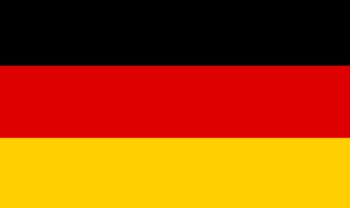
Following the devastation of the First World War, Germany was exhausted and sued for peace in desperate circumstances. Awareness of imminent defeat sparked a revolution, the abdication of Kaiser Wilhelm II, formal surrender to the Allies and the proclamation of the Weimar Republic on 9 November 1918.
In its initial years, grave problems beset the Republic, such as hyperinflation and political extremism including political murders and two attempted seizures of power seizures of power by contending paramilitaries.
Internationally, the Republic declared in Weimar suffered isolation, reduced diplomatic standing, and contentious relationships with the great powers.
By 1924 however, a great deal of monetary and political stability was restored, and the republic enjoyed relative prosperity for the next five years This period, sometimes known as the Golden Twenties was characterised by significant cultural flourishing, social progress, and gradual improvement in foreign relations.
Under the Locarno Treaties of 1925, Germany moved toward normalising relations with its neighbours, recognising most territorial changes under the Treaty of Versailles and commited itself to never go to war again.

In 1926 Germany joined the League of Nations which marked its reintegration into the international community.
Weimar Germany was thus at the same time an exciting and frightening place to live. After the abdication of the Kaiser, anything seemed possible, from the cabaret clubs eventually made famous by Christopher Isherwood to Josef Goebbel’s public relations campaign for the nascent Nazi Party and the experimental rockets of Fritz Opel and Wernher von Braun.
In art, Expressionism flourished. Its typical trait was to present the world solely from a subjective perspective, distorting it radically for emotional effect in order to evoke moods or ideas. This spread from painting to a genre of film, ranging from Fritz Lang’s Metropolis (1927) to Nosferatu (1922) and The Cabinet of Dr Caligari (1920)
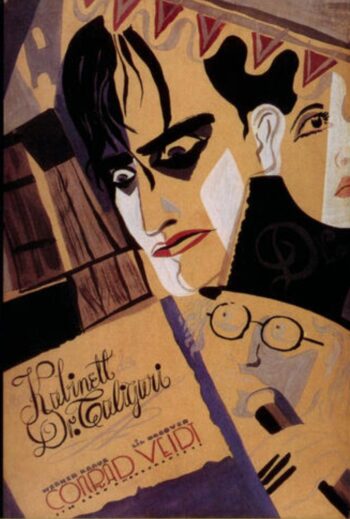
The first Expressionist films, which lacked a generous budget, used set designs with wildly non-realistic, geometrically absurd angles, along with designs painted on walls and floors to represent lights, shadows, and objects.
The plots and stories of the Expressionist films often dealt with madness, insanity, betrayal and other topics triggered by the experiences of World War I as opposed to the standard action-adventure and romantic films produced in Hollywood.
This dark, moody school of film making was then brought to the United States when the Nazis gained power and many German filmmakers emigrated to Hollywood. The result was the film noir genre of private detectives such as Raymond Chandler’s Philip Marlowe, played by Humphrey Bogart and the Universal Studios horror films of the 1930s.
In fact the classic 1942 Hollywood film Casablanca with Humphrey Bogart running a nightclub full of desperate refugees and criminals can also be seen as film noir. Its other links to German Expressionist Cinema are appearances by Peter Lorre who had starred in Fritz Lang’s 1931 crime thriller M and Conrad Veidt who was Ceasare the somnambulist in The Cabinet of Dr Cagliari.
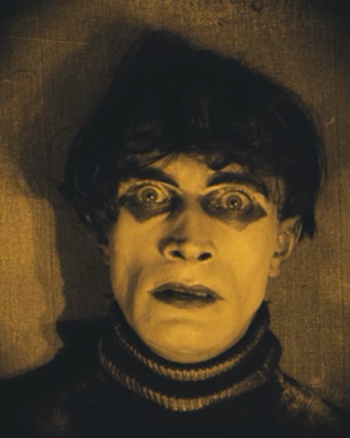
After Hitler Rose to power in 1933, Conrad Veidt (pictured) fled first to Britain and then the USA. Ironically, in Casablanca he played Strasser the Nazi.
As well as being hailed as the first horror film, writers and scholars have argued that The Cabinet of Dr Caligari reflects a subconscious need in German society for a tyrant, and is an example of Germany’s obedience to authority and unwillingness to rebel against deranged authority. Some critics have interpreted Caligari as representing the German war government, with Cesare symbolic of the common man conditioned, like soldiers, to kill. Other themes of the film include the destabilized contrast between insanity and sanity, the subjective perception of reality, and the duality of human nature.
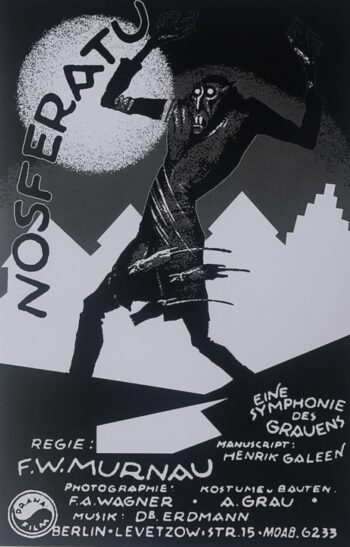
Nosferatu (1922) meanwhile was a retelling of Bram Stoker’s Dracula but with the main character, Count Orlok, arriving in a German town with a plague of disease- spreading rats. Some film historians have seen this as an allegory of the German mistrust of Jews, but in any case the estate of Bram Stoker sued the producers of Nosferatu and a court ordered that all copies of the film be destroyed. Fortunately some copies survived and today Nosferatu is considered a classic of its genre.
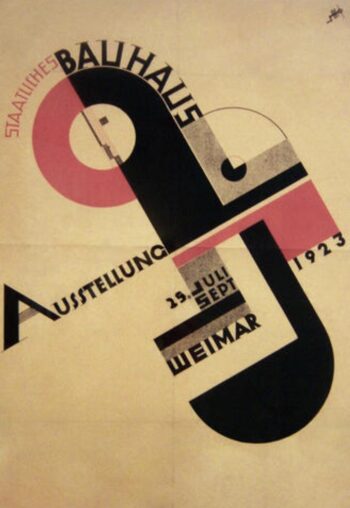
The Staatliches Bauhaus, commonly known as the Bauhaus (German for house of building) was an art and design establishment and movement founded in Weimar in 1919. It was famous for its attempts to unite crafts and fine arts with mass production to produce beautiful yet practical items for everyday use.
Although influenced by the Arts and Crafts Movement of William Morris, Bauhaus style tends to feature simple geometric shapes like rectangles and spheres, without elaborate decorations. Buildings, furniture, and fonts often feature rounded corners and sometimes rounded walls. Other buildings are characterized by rectangular features, for example protruding balconies with flat, chunky railings facing the street, and long banks of windows. Furniture often uses chrome metal pipes that curve at corners.
Founded by Walter Gropius, Bauhaus staff included prominent artists such as Paul Klee Wassily Kandinsky and Laszlo Moholy-Nagy at various times.
Although Walter Gropius protested that he was a German patriot, Bauhaus had links with a similar design school in the USSR and was seen by the Nazis as a hotbed of Jewish internationalism and Communism. Under political pressure, Bauhaus was disbanded in 1933 with many of its members emigrating to the USA. However many of the bridges and service stations on Hitler’s new autobahn were influenced by Bauhaus design.

Gropius, who survived until 1969, was one of several refugee German architects who provided information to confirm the typical construction of German houses to the RE8 research department set up by the British Air Ministry. This was used to improve the effectiveness of air raids on German cities by RAF Bomber Command. The research was to discover the most efficient way of setting fire to houses with incendiary bombs and the results were used in planning the bombing of Hamburg in July 1943.