Once again model railway enthusiasts from all over Gloucestershire travelled to the Cheltenham GWR Modellers April 2023 Exhibition in aid of CLIC Sargent at St Margaret’s Hall, Coniston Road, Cheltenham, GL51 3NX on Saturday and Sunday 1 and 2 April 2023 for the following attractions.
Rachel’s injuries were the result of a freak home accident. After an unsuccessful operation in Leeds, an anonymous benefactor loaned £100 000, allowing Rachel’s husband Guy to convert a vehicle into an ambulance to drive her to Barcelona for more treatment. Thankfully, she is now on the road to recovery.
Cheltenham GWR Modellers would also like to thank Burnham on Sea Model Railway Club for their donation of £100 towards this cause.
QUEEN STREET YARD

by Gerald Maher
0 Gauge 7 mm Scale
This layout began life as a 7mm scale test track for newly built locomotives and rolling stock that Gerald likes to construct. It then developed into a fully scenic cameo layout with purpose built fiddle yard, backscenes, LED lighting and a fully functioning power box instead of the temporary wiring used in his workshop. Queens Street Yard was modelled as a typical Victorian small back street goods yard not aligned to any particular railway company thus allowing Gerald to run a variety of stock. During the pre grouping period as there was such a wide variety of locomotives and rolling stock in many different liveries.
Most of this was London and North Western Railway with the occasional Great Eastern interloper. All stock is now fitted with automatic couplings instead of traditional three links for ease of operation at shows. The locomotives and rolling stock – including the Lowmac wagon carrying the traction engine – were all built from brass or plastic kits modified where necessary to improve the detail. All were spray painted and then weathered to suit. All the scenery was constructed from card, foamboard or plasticard faced with embossed plastic sheet to give the brick or stone textures. Some of the details were from cast kits as are the vehicles and figures. The two turnouts were hand built and operated manually by slider switches connected to the tracks with brass rodding. Most of the plain track was Peco but some was hand built. As a test track everything was made of spares box items so it was a real hotch potch! Including the wiring. This was laid across the surface of the board so is consequently now buried under scenery! Not ideal. But apart from that – a first class layout!
HOOKWOOD

by Jim Bryant
EM Gauge 4 mm Scale
When the South Eastern Railway reached the small village of Westerham in July1881 it was assumed by the local populace that it was only a matter of time before the branch line from Dunton Green ( on the London Victoria – Sevenoaks – Tonbridge main line ) via Brasted would be extended south west for four miles to Oxted on the London Victoria -Croydon – Newhaven main line. In fact this never happened due to the huge cost of extensive engineering works required but Hookwood imagines that the line had been built as a secondary route from London to the Channel Ports. Hookwood station itself would have been located about a mile north east of Oxted on the Kent / Surrey border and the layout depicted the scene in the mid1960s with scratch-built station and goods shed buildings based on those at Westerham and BR Southern Region third rail electrification.
The locomotives were mainly modified ready-to-run examples using Ultrascale EM wheels and A1 detailing kits. The 2BIL ( 2 cars, Both Including Lavatories ) EMU was an Ian Kirk kit with Branch Lines motor/gearbox and extra detailing and wagons are mostly super-detailed kits with EM Society wheels. Spratt & Winkle couplings were used with strategically placed electromagnets placed around the 11′ x 1’6″ layout for uncoupling.
Hookwood also featured simulated third-rail arcing, a station cat, working semaphore signals and a decidedly non-working gardener!
BILSTON ROAD ENGINE SHED

by Roger and Robert Webb
00 Gauge 4 mm Scale
This layout was built by Peter Cullen when he was a member of Solihull MRC. It represents a typical sub-shed located somewhere in the industrial West Midlands on the Western Region of British Railways during the mid-1960s. Locomotives return for overnight servicing and simple running repairs. Some locos have been re-numbered and the majority have real coal added. Since the layout was sold by Peter, Robert Webb has spent time re-furbishing it.
QUARRY LANE
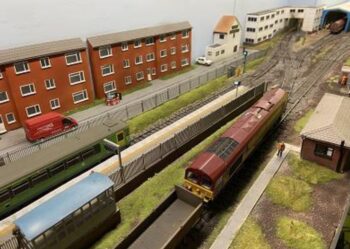
by Gwynne Chivers
EM Gauge 4 mm Scale
Quarry Lane is a fictional end of branch set somewhere in the West Midlands. Since the demise of Round Oak steelworks that it is now supplied from South Wales and is now a steel stockholder and produces structural steel members for the construction industry. Supplies are brought in either by covered steel carriers or in the smaller sliding wall vans. The fabrication side of the business uses a large quantity of lubricating oil supplied in bulk from Fawley. The yard is also used at times by Network Rail as a layover and unusual stock workings may be seen. Although the passenger service was closed during the Beeching era recent residential re-development in the area has brought a re-introduction of services to both Birmingham Snow Hill and New Street. Various passenger stock may be seen on this line with class 150, 153 and 158 stock being used. The trackwork is all EMGS ‘ready to lay’ and all the stock is ‘ready to run’ with just the wheelsets replaced by
commercially available EM sets. The layout is DCC operated but the point control is traditionally switched with ‘slow acting’ point motors. Couplings are Kadee® for hands-free shunting operations
DENT
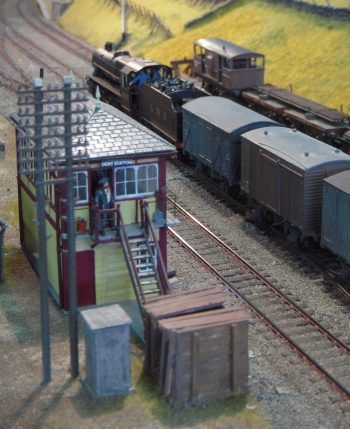
by Bristol MRC
00 Gauge 4 mm Scale
Completed in 1877 the Midland Railway’s Settle to Carlisle line is renowned for the rugged Moorland, its tunnels, viaducts, amazing scenery and snow. Along the way, Dent station serves the villages of Cowgill and Dent. Cowgill village is half a mile away while Dent itself is nearly 5 miles further to the west. The lack of passengers reflect this. The stone station building – complete with Up platform waiting room – itself is famous for being the highest on the English railway network at 1,150 feet and must also be one of the most modelled stations on the British Railways network! The layout – with its Blea Moor style landscape of dry stone walls and snow fences – was inspired by the work of David Jenkinson and built to provide a circular layout so that Phil could sit back and watch trains run round. Construction featured Peco fine scale track and point motors and Ratio signals.
Passing Dent Station signal box with a train of vans is LMS Stanier 2-6-0 2965,one of a class introduced in 1933 with Walschaerts valve gear actuating piston valves fed with superheated 225 psi steam by a taper boiler.
LANSDOWN YARD
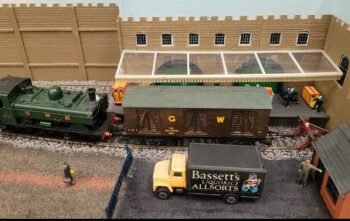
by Forest of Dean MRC
00 Gauge 4 mm Scale
This layout was built during lockdown as a project to occupy time and fulfil a desire to be doing something constructive during the enforced idleness. The plan was to model a busy but sleepy local station and yard with some industrial activity to support and justify the retention of the facility. The station was to serve a small town population with services to other areas provided by steam and diesel railcar trains, depending on the routes and destinations the services were heading for. Goods and provisions would arrive at the provender store for forwarding by local lorry services. Similarly, rail would serve the general engineering works, bottled water factory and nearby oil depot. With any passenger trains isolated in the station platform, there would be plenty of room for goods movements.
MEETH
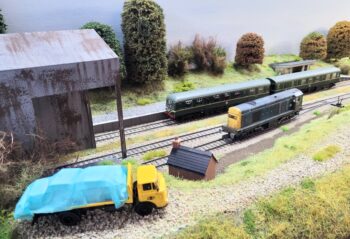
by Finn Watkins
00 Gauge 4 mm Scale
Meeting is a small village roughly 8 miles north west of Okehampton and 25 miles north west of Exeter. It lies to the west of the River Torridge. In the past, china clay mines were the main source of employment, but all mines closed in 2004.
From 1925 until 1982, the branch railway line from Halwill Junction to Torrington, the North Devon and Cornwall Junction Light Railway, ran through Meeth, allowing clay from the mines to be transported to Bideford dispatch by sea. Passenger services ran to Meeth Halt until 1965 and today it is at one end of the Tarka Trail footpath to Bideford, skirting Meeth Quarry and Ash Moor Nature Reserve. This layout combines Meeth Halt and the China clay load barn which was in reality a few hundred yards away.
NEWTON PRIORS
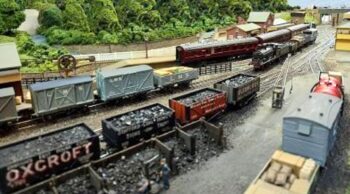
by Ted Olney
00 Gauge 4 mm Scale
Newton Priors was an imaginary through station – inspired by Highley on the Severn Valley Railway – on a former Midland Railway single line branch, located somewhere on the Central Division of the London Midland and Scottish Railway. The station is now a terminus as the line beyond Newton Priors has closed and the tracker as far as the tunnel is used as a headshunt.
Set in the 1930s, the station serves a thriving local community: justifying frequently freight and passenger services to the junction. It features a dairy, gasworks, warehouse and normal goods facilities.
Track was Peco code 75 with a mixture of ready to run , kit and scratchbuilt rolling stock and buildings and hills and embankments formed of expanded polystyrene topped with fabric soaked in plaster filler.
PAYNESTOWN
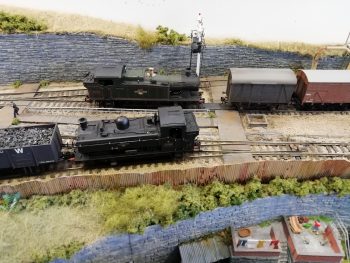
by Reg Owens
00 Gauge 4 mm Scale
Nothing to do with 1990s glamour model Louise Payne, Paynestown was a fictional small Western Region terminus set somewhere in the South Wales mining area. I particularly liked the scenery, buildings and weathering on this layout, perfectly lit with warm tones to enhance the rich saturated Technicolour feel of 1960s photography.
As well as such fascinating features as an engine shed with built in water tank, Paynestown recalled an era when railway vans delivered bananas to goods depots and Wales was full of chapels that people both went to and did not go to.
On the more technical side, Paynestown featured Peco Code 100 track and points, scratchbuilt buildings and Digitrax Digital Command Control.
TELLINDALLOCH
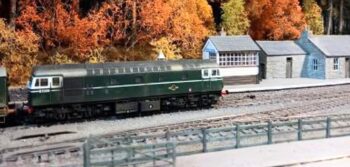
by Terence Tew
00 Gauge 4mm Scale
Tellindalloch was a fictional station set on a former Great North of Scotland branch in North East Scotland and depicted during the period 1948 to 1965. Most of the buildings were scratchbuilt including the station – which was loosely based on Carron – typical GNSR goods shed and signal box. Almost all of the 70 plus trees were hand made. Rolling stock included ex Caledonian and GNSR vehicles and British Standard steam and diesels.
THOMAS

by Hucclecote Model Railway Enthusiasts
00 Gauge 4mm Scale
Harold the helicopter first appeared in the book Percy the Small Engine. Martin Clutterbuck suggests that the inspiration for the story in which Harold races Percy came from the British Department of Transport’s claims that the helicopter would soon render railways obsolete.
Harold is based on a Sikorsky S-55 helicopter built in the UK as the Westland Whirlwind. This was one of the most successful early helicopters, with examples being used all over the world. The character’s name may arise from the fact that variants of the Whirlwind in UK military service were designated HAR 1, HAR 3, HAR 10 etc.
The first S-55s received by the Royal Navy in 1950 were built by Sikorsky, but Westland acquired a license in 1950 and the first British-made S-55 flew at Yeovil in November 1952. Like the American models, the first Whirlwinds had Pratt & Whitney engines and were delivered to No.705 Squadron based at Gosport.
The RAF also ordered this helicopter for transport and rescue missions: the Whirlwind HAR Mk.2 (the same as the naval version except for some differences in equipment) joined the Transport and Coastal Command Units from 1955. With Wright R.1300 engines, the Whirlwind Mk.3 went into production for the Royal Navy in 1953 and operated for many years from both ship and shore bases. The subsequent RAF HAR Mk.4 version was modified for use in the tropics and fitted with a new variant of the Pratt & Whitney R-1340. It was used in Malaysia.
CASTLEDERG

by Andy Cundick
12mm Gauge 4 mm Scale
The town of Castlederg was at the end of the Castlederg and Victoria Bridge Tramway. The railway was built in 1884 as a three foot roadside tramway to connect the town with the Great Northern station seven miles away at Victoria Bridge. The tramway closed in 1933 following a railway strike. All locomotives with one exception were scratch built with the rolling stock built entirely from Worsley Works kits including Andy’s superb model of the Castlederg and Victoria Bridge Tramway’s All Irish paraffin fuelled Fordson railcar.. The self supporting layout was 12′ long by 2′ wide and a crate of Guinness has been known to assist with the Irish ambiance on the model railway.
Castlederg itself is in County Tyrone, Northern Ireland, and lies on the River Derg and is near the border with County Donegal. It stands in the townlandsof Castlesessagh and Churchtown in the historic barony of Omagh West and the civil parish of Urney. The village has a ruined castle and two ancient tombs known as the Druid’s Altar and Todd’s Den. It had an estimated population of 2,935 people in 2008. The village hosts some of the district’s key events each year, including the Derg Vintage Rally, Dergfest musical festival, Derg Soapbox Derby and the traditional Apple Fair which sees the apple growers of County Armagh visit to sell their wares. Traditionally, Castlederg was a traveller’s stop along the ancient pilgrimage route to Station Island on Lough Derg The town boasts ancient ruins and monastic settlements.
RYDERS GREEN WHARF
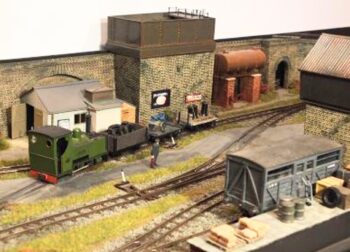
by Peter Cullen
009 Gauge 4 mm Scale
Ryders Green Wharf represented a distribution point for engineering works in Birmingham and included a branch of the Birmingham Canal. The ‘setts’ around the canal were made with Slater’s plastic sheet and Peter made a great job of these.
BITTERFELD
by Eric Bird
H0 Gauge 3.5 mm Scale
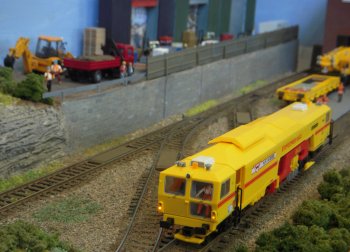
GLB Bitterfeld represented a small permanent way yard and servicing depot for on track plant in Germany from 1980 to the present day. The points used were recycled from a second-hand American layout. Bitterfeld was built primarily to demonstrate German DCC items of rolling stock and advances in model technology, as well as the Kadee magnetic uncoupling system. The layout was powered by Roco Multimaus or NCE DCC control systems. Models shown were straight ”out of the box” or may have had some weathering. Like their opposite numbers in Britain, these on track machines are painted yellow and often built by Plasser and Theurer, one of Austria’s biggest exporters. Their tasks include lifting, cleaning and replacing ballast and tamping down new track – all jobs done more intensively by human labour many decades ago. A small DVD player was utilised to show the real life items and their use
Deutsche Bundesbahn, the West German Federal railways, benefited greatly from American Marshall Aid during the years of reconstruction after the Second World War and as a result embraced electrification to a much greater extent that Britain, which had to pay war debts to the USA while eventually modernising its national railway system.
WELTON
by John Perrett
N Gauge 2 mm Scale
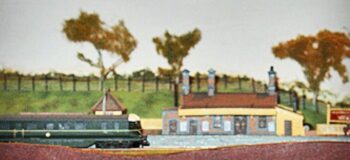
Welton (later Midsomer Norton North) station, was situated in the valley immediately to the north of Midsomer Norton, about ten miles south of Bath.
The Bristol & North Somerset Railway was opened in 1873, to tap the output of the north Somerset coalfield. As well as domestic use, coal was widely used in industries around the city of Bristol and later at Portishead power station.
Traffic handled at the station included printed goods, shoes, gloves, roof tiles, bricks, also all manner of general merchandise and parcels for a fast growing town. Quite an industrial area in rural Somerset, with many new industries springing up. The model was built in the 1970s, to British N gauge, using traditional methods. Built on an open top base, the track was Fleischmann (bought as a second hand lot). The main ground cover was box card covered in dyed lint and scenic materials. The buildings were my first scratch built structures.
Mainly proprietary rolling stock was used, but kit built vehicles may be seen, some from the N Gauge Society.
The model was self supporting, with an angled board frontage displaying prototype information
BOB’S 3D MODELS
by Bobby Barnard
00 Gauge 4 mm Scale
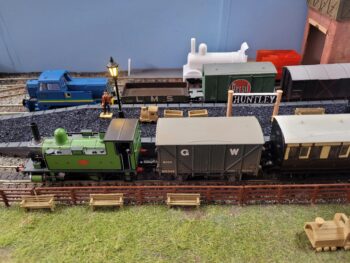
Huntley was a small railway centre in Gloucestershire with a strong military history. The local volunteers restored the railway to running order in the early 21st Century.
COAL MINE
by Roger Webb
00 Gauge 4mm Scale
DESERT VICTORY
by Alan Drewett
4mm scale
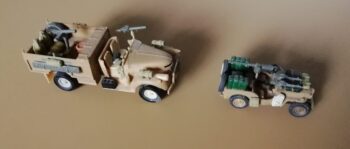
This display charts the Allied victory over the Italian Fascist forces and German Afrika Korps from 1940 to 1943 and puts the North Africa campaign into the wider context of the Second World War.
One of the most remarkable Allied units in Noth Africa was the Long Range Desert Group.
Originally called the Long Range Patrol (LRP), the motorised Long Range Desert Group was founded in Egypt in June 1940 by Major Ralph Alger Bagnold under the direction of Commander in Chief of British forces in the Middle East. Bagnold had spent much of the 1930s exploring the desert in vehicles and developing the necessary operation, maintenance, navigation and communication techniques.
The role of the Long Range Desert Group was deep penetration, covert reconnaissance patrols and intelligence missions from behind Italian lines, although they sometimes engaged in combat operations. Because the LRDG were experts in desert navigation, they were sometimes assigned to guide other units, including the Special Air Service. From December 1940 to April 1943, the LRDG only missed 15 days of combat. After the DAK surrender in Tunisia, the LRDG were redeployed to Italy, Greece and the Balkans.
BRS DEPOT

by Martin Nash
00 Gauge 4mm Scale
A static display of a busy British Road Services Depot set in a town scene evoked the road transport company formed by the nationalisation of Britain’s road haulage industry, under the British Transport Commission, as a result of the Transport Act 1947. British Road Services was consequently formed and set about acquiring 41,265 vehicles 80,212 staff and 3,766 undertakings. Six years after the 1947 Transport Act was introduced however, Parliament reversed this decision – another Transport Act was passed in 1953 providing for the return to free enterprise.
By the 1960s British Road Services was made up of four main operating areas: British Road Services Ltd, BRS Parcels Ltd, Pickfords and Containerway and Roadferry.
Back in the 1950s though, the Ayers Red freight lorries and green parcels vans of British Road Services were a familiar sight all over Britain, linking towns and cities by A roads before the first Motorways were built.
The 1950s was also a golden era of British lorry building and British Road Services was to employ such famous heavy goods vehicles as the AEC Mammoth Major, Mandator ( with articulated flatbed trailers) and the same company’s drawbar trailer towing Mark III and Mark IV four axled rigid trucks. The latter vehicles were allocated to a number of British Road Services depots including the one at Mitcheldean, Gloucestershire. Other lorry manufactureers embraced by British Road services were Atkinson, Leyland, Bedford, Bristol and ERF. These in turn were replaced by various guises of Bedford TK and more modern AEC lorries with ergonomic cabs. Martin’s diorama also embraces the architecture and road scene of the 1950s including a dilapidated house near to where a small flatbed BRS lorry is being loaded – although probably not in a way that the Twenty First Century Health and Safety Executive would approve of!
THE SCRAPYARD
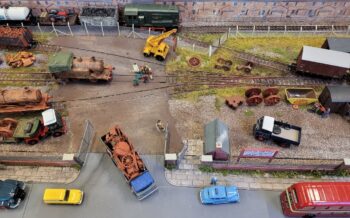
by Martin Nash
00 Gauge 4mm Scale
“We’d like to buy this Great Western Prairie Mr Scrapman!”
A huddle of railway preservationists were a new feature of Martin Nash ‘s splendid diorama.
GLOUCESTERSHIRE WARWICKSHIRE RAILWAY
12″ to the foot scale

Among the many vehicles operating on Gloucestershire’s longest preserved railway is Gloucester RCW built Class 122 railcar 55003.
MODELLING DEMONSTRATIONS

by Mark Begley, Steve Harrod, Trevor Hale, Richard Self and Tom Kennison
TRADE SUPPORT
by Hereford Model Centre, Penduke Models, RCSW Pre owned models and Stewart Blencowe railway books and photographs.