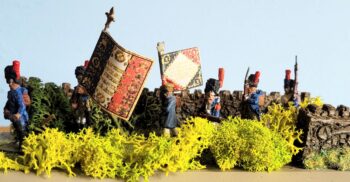
On Bank Holiday Monday 6 May 2024 I had the pleasure of exhibiting some of my 4mm scale dioramas at the Toy and Model Railway Collectors Fair at Abergavenny Market Hall.
Near to my table was the permanent fixture of Dragon Painter Models, the shop on which Hannah very kindly sold me six Napoleonic 4mm scale metal figures.
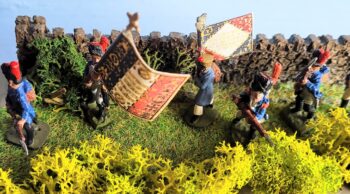
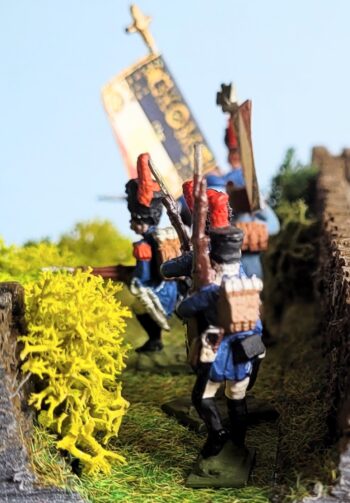
Once home, I created a diorama – pictured above – for the figures based on an Oxford Diecast jewel box and featuring dry stone walling by Javis of Stockport, lichen and grass mat.
It portrays Napoleon’s Old Guard Grenadiers advancing up a bridleway near Waterloo in 1815.
The larger tricolour based flag is that of the 1st Grenadier Regiment carries such battle honours as Marengo, Ulm, Austerlitz, Jena, Vienna, Madrid and Moscow.
The smaller flag with the white diamond is that of the Regiment’s First Battalion with the motto ‘Valour and Discipline’.
Further research revealed that The Old Guard (Vielle Garde) was an elite military formation within Napoleon’s Imperial Guard, and were the soldiers of the Napoleonic era most respected and feared by both their opponents and their compatriots within the regular French army.
The Old Guard was created in 1804 from the Consular Guard, (Garde Consulaire) and consisted of many veterans who had fought alongside Napoleon in his Italian campaigns of 1796-97, Egypt and the second Italian campaign in 1800. For the next decade it remained a model for the Grande Armee to look up to, as well as the French nation’s ultimate and apparently invincible reserve.
The 1st Grenadiers and the 1st Chasseurs a Pied (light infantry) were the first Old Guard regiments and were unique in being awarded Eagle insignia.
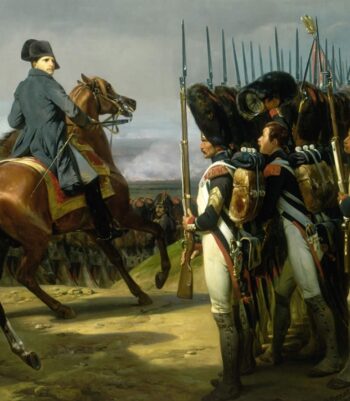
The Old Guard was truly an elite within an elite. Accordingly, Napoleon pampered them as if they were his own children, showering them with gifts and rewards, as well as tending to their smallest needs with fatherly attention.
He showed his gratitude to them if they showed themselves deserving. In return, Napoleon’s Old Guard gave him a level of devotion that was unparalled in history. To them he was more than a mere general or emperor. To them, he was their father or even an unfallible demigod. Even as the French Empire crumbled away in its death throes, the soldier’s self belief and devotion to their emperor remained unshakeable to the very end.
The Consular Guard, which became Imperial in 1804, was blooded at the Battle of Marengo in 1800, but in the early years of the empire, the Old Guard was frequently left out of combat, only to be used as a last reserve.
At the Battle of Austerlitz in 1805, the Old Guard raged at being left out of the fighting, hence it’s nickname ‘The Grumblers’ (Les Grognards)
After the catastrophic losses in Russia, the Imperial Guard came to the forefront of the action, and the Old Guard was itself used more frequently in an offensive role, instead of being used as a last reserve, as Napoleon fought his war of survival.
Only in 1815 did the Imperial Guard, and most especially the Old Guard return to its traditional role as a tactical reserve in their final battle at Waterloo.

It was perhaps fitting that the Old Guard was called upon to stand firm as the French army fell apart around them. Even in defeat they stood like heroes, defying the odds as they fought a tenacious rearguard action, against the combined might of two allied armies, many of them giving their lives so their compatriots could escape.
Though Waterloo was a defeat, the Old Guard marched into history with their reputation considerably enhanced.
The Old Guard was founded in December 1799 when Napoleon, having been in power as First Consul for less than six weeks, ordered the creation of his own version of the Praetorian guard.
Known as the Garde Consulaire, it was comprised of elite veterans recruited from the regular army. But Bonaparte envisioned the new regiment as being more than just a ceremonial palace watch – it would also fight with him on the front lines.

The Consular Guard marched into battle for the first time on 14 June 1800 at Marengo, in what is today Northern Italy.
Eyewitnesses described how the unit advanced against the Austrians with parade-square precision and held off enemy counterattacks “like a redoubt made of granite.”
When Napoleon crowned himself emperor in 1804, the guard first achieved its ‘imperial’ designation. Napoleon later established guard cavalry units, engineers, gendarmes, light infantry or chasseurs a pied and line infantry, as well as his famous grenadiers.
By 1812, soldiers wishing to join the vaunted Old Guard had to have at least 10 years of service. They were also required to be a minimum six-feet-tall and in top physical shape. Typically in their 30s and 40s, soldiers in the Old Guard were seasoned veterans of as many as 20 campaigns and had fought for Bonaparte since his earliest battles.
By 1815, the average age of a soldier in the First Grenadier and Chasseurs a Pied was 35. However, promising recruits without years of service were sent to Bonaparte’s still elite but more junior Middle or Young guard.
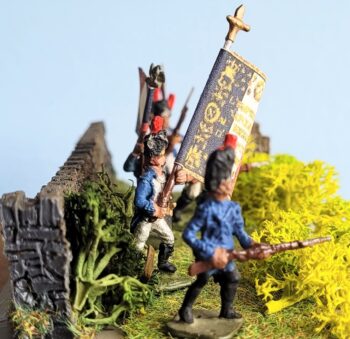
The men of the Old Guard cut impressive figures on the battlefield. Their long-tailed jackets and waistcoats set them apart from the shabbier rank-and-file soldiers, as did their regulation powdered white ponytail wigs and gold ear rings.
Like the British Grenadier Guards, the distinctive black bear skin hats of the Old Guard made the already tall guardsmen even more menacing to friend and foe alike.
Contemporary observers also noted that the soldiers’ solid muscular legs, honed by a lifetime of marching, were handsomely set off by their fine fitted breeches and gaiters, which looked much sharper than the ordinary trousers worn by Napoleon’s regular troops.
Guard regiments drew more generous salaries than other units in the Grande Armée.
A typical non-commissioned officer in the Old Guard earned more than two francs a day which was roughly the same as a regular army lieutenant’s pay. Additionally, a soldier’s rank in the Old Guard was automatically equal to the next higher rating in any other regiment.
For example, an Old Guard private enjoyed corporal status elsewhere in the army. Guardsmen officers were also more likely to have been promoted up from the ranks for heroism.
The perks didn’t end with money and promotions. All other units in Napoleon’s army were required to show their deference to the Old Guard.
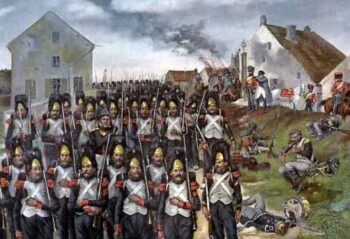
Regular regiments were obliged to clear the road, dip their colours, and sound a salute on fife and drum as the elite soldiers approached. On the other hand, Guard formations were obliged to render honours to no one, save for the emperor himself. Even lowly privates were addressed by the honorific monsieur by NCOs and officers.
The men of the Guard were not held to the same standard of discipline as their regular army counterparts. Ordinary rankers in the elite corps were permitted to openly fraternize with their officers; something unheard of in other regiments. And while not on campaign, soldiers could assemble for morning roll call out of uniform and then return to their bunks to sleep late. More astonishingly, because of their special status, guardsmen could gripe freely about army life, even in front of officers. In fact, it’s this license that earned the men of the Old Guard their famous nickname: les Grognards or “the Grumblers.”
Despite les Grognards’ complaining privileges, guardsmen likely had far fewer grievances than their ordinary compatriots. Their barracks were typically cleaner and more spacious than other soldiers’ cramped hovels.
Napoleon himself ordered larger bunks for taller members of the corps after noting that his soldiers’ feet were hanging over the end of their beds. Bonaparte also assigned France’s preeminent army surgeon, Dominique Jean Larrey, to oversee their health. Better food and drink was also a perk of life in the Old Guard.
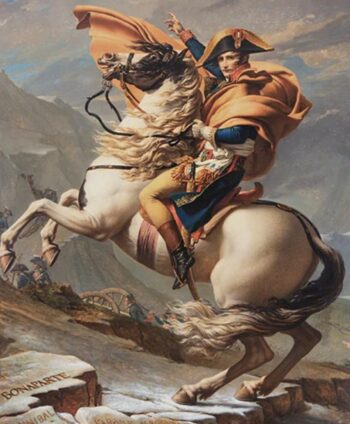
Guardsmen also had access to their emperor unlike other soldiers. On campaign, Bonaparte enjoyed chatting with his Grognards at every opportunity and reportedly knew many by their first names. He joked with them, shared their sorrows and listened closely as they brought their personal problems to his attention.
In one story, a guardsman complained to the emperor that he’d not yet received a citation that was promised to him months earlier. Napoleon not only remembered the trooper’s name, he could recount the man’s heroism before pledging to have the late honours finally bestowed.
In another account, a guardsman by the name of Jean-Roch Coignet was entrusted with guarding emperor’s own infant son at the Château de Saint-Cloud near Paris. The soldier recalled in his memoirs how a nurse once asked him to hold the toddler, at which point the young prince tugged on the plume attached to his bearskin hat. Coignet considered it as one of the proudest moments of his life.
Although the Old Guard enjoyed rights and privileges unheard in the wider army, Napoleon expected his beloved Grognards to lay down their lives without hesitation. Yet, instead of using his Old Guard as shock troops or cannon fodder, the emperor usually only committed his famed immortals in the final minutes of battle, often to deliver the coup de grâce to a wavering enemy. In other instances, he called upon his elite corps to save the day when all hope seemed lost. In several engagements, Napoleon kept the Old Guard out of harm’s way altogether.
During the bloody battle of Borodino during his Russian campaign, Bonaparte bristled at the idea of deploying them. “If there should be another battle tomorrow, where is my army?” he demanded.
Still, the Old Guard managed to deliver victory to their emperor in a number of major battles including Ulm, Austerlitz, Eylau Wagram and Dresden.
Les Grognards also flocked to the colours after Bonaparte’s escape from exile on the island of Elba and took part in the Battle of Waterloo on 18 June 1815.
Amazingly, Napoleon’s immortals were thrown back in the 11th hour and, for the first time ever, fled the field. “The Guard is retreating,” ordinary French soldiers cried at the unbelievable spectacle. “Every man for himself!” Remnants of the guard attempted to rally, but were surrounded by British, Prussian and other allied troops. When offered a chance to lay down their arms, their commander, famously replied: “The Guard dies. It does not surrender.”

However, a handful of ageing Grognards (such as this Grenadier in an 1857 photograph) donned their uniforms once last time in 1840 when the remains of Napoleon returned to France from the South Atlantic island of Saint Helena to be laid to rest at Hotel des Invalides in Paris.