The Cheltenham GWR Modellers Exhibition April 2026 will see the return of the my much loved lunar landing diorama with some other cosmic guests.
The background to these can be found in the articles on this website Goes Like A Rocket and Fly Me To The Moon.
All this comes at a time of renewed interest in lunar exploration, especially with America’s Artemis programme planning to send manned expeditions round the Moon and eventually to land on ghe surface after a gap of almost 60 years.
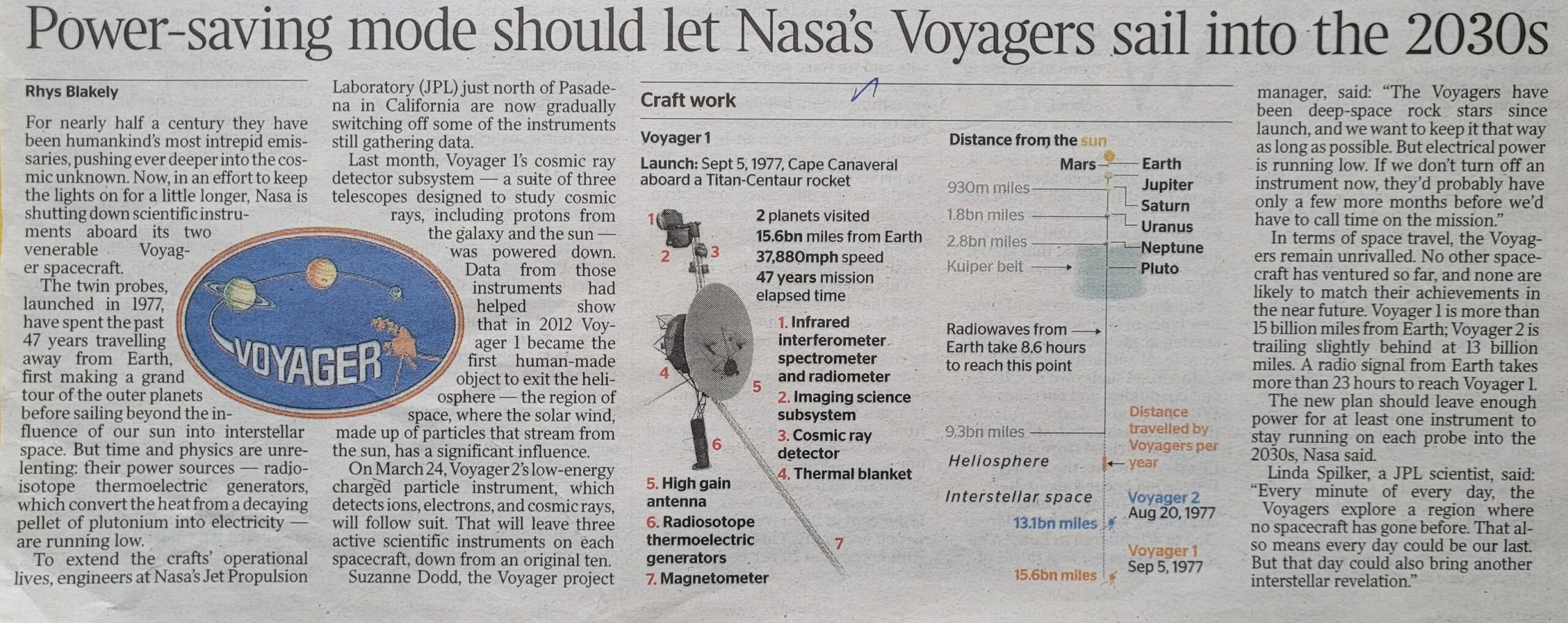
Meanwhile, unmanned vehicles from private companies, China and India have reached the Moon while the International Space Station continues to provide important scientific data and the two Voyager spacecraft – launched in 1977 to explore the outer planets of the Solar System – are beyond the influence of the Sun and travelling through interstellar space.
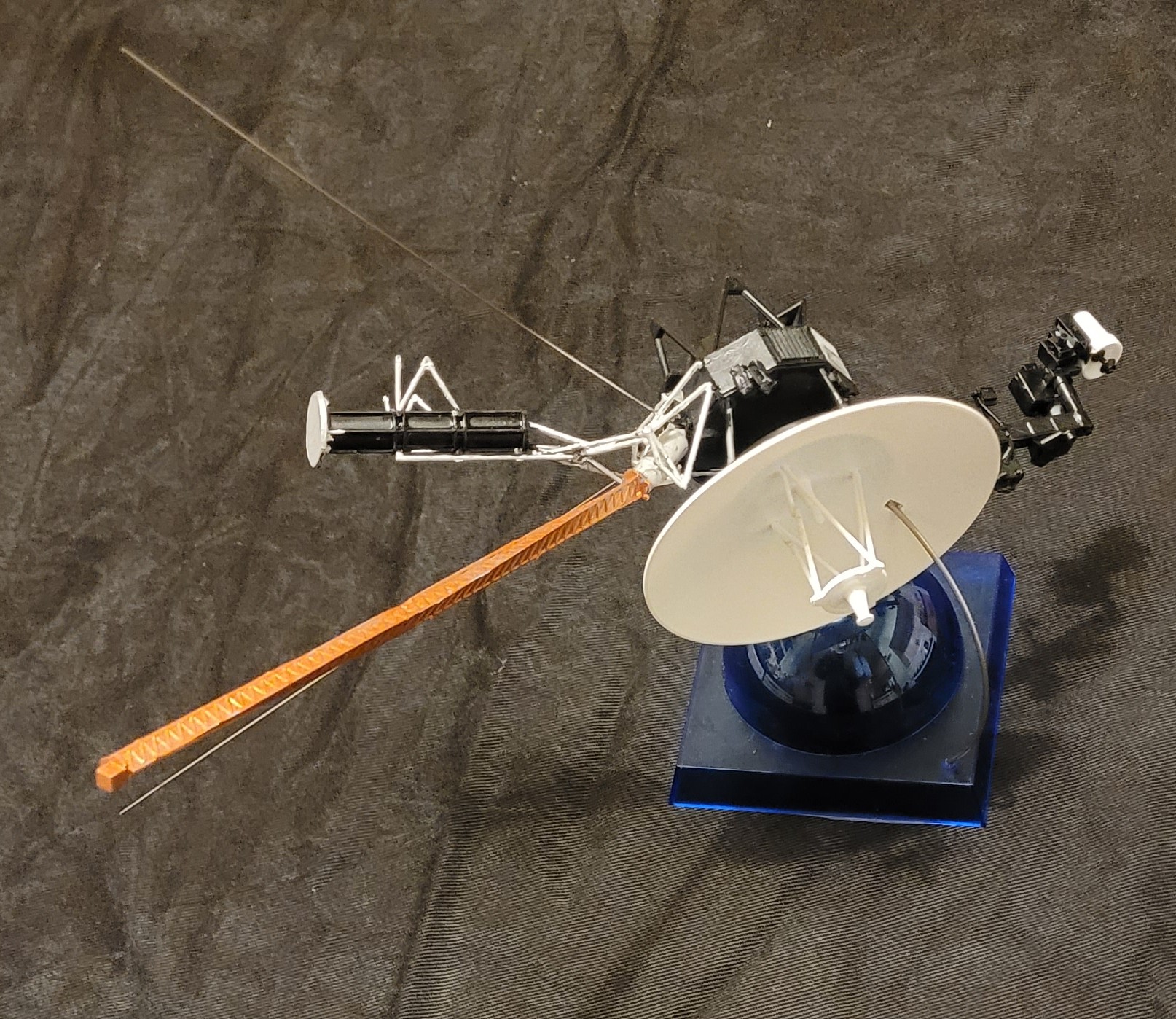
Having acquired a 1/48 scale model of the NASA Voyager spacecraft, skillfully built by Mr John Barnfield of the Gloucester Branch of the IPMS, I thought I would add some background information to the project.
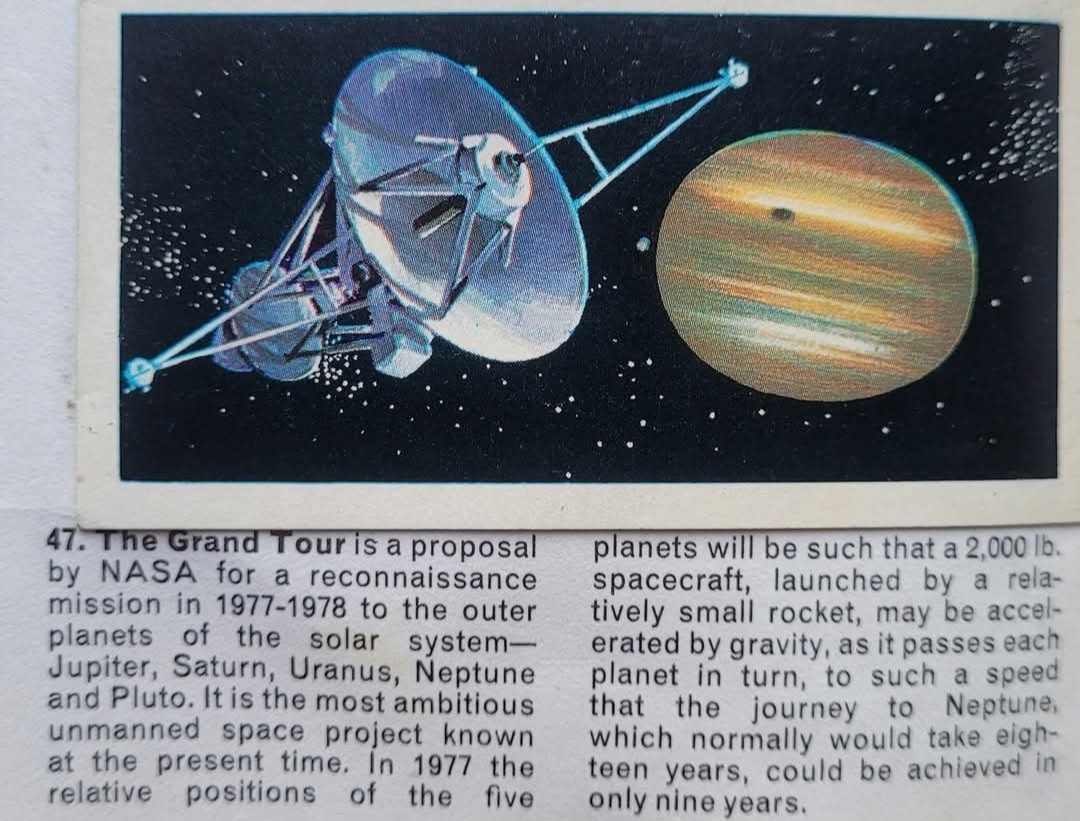
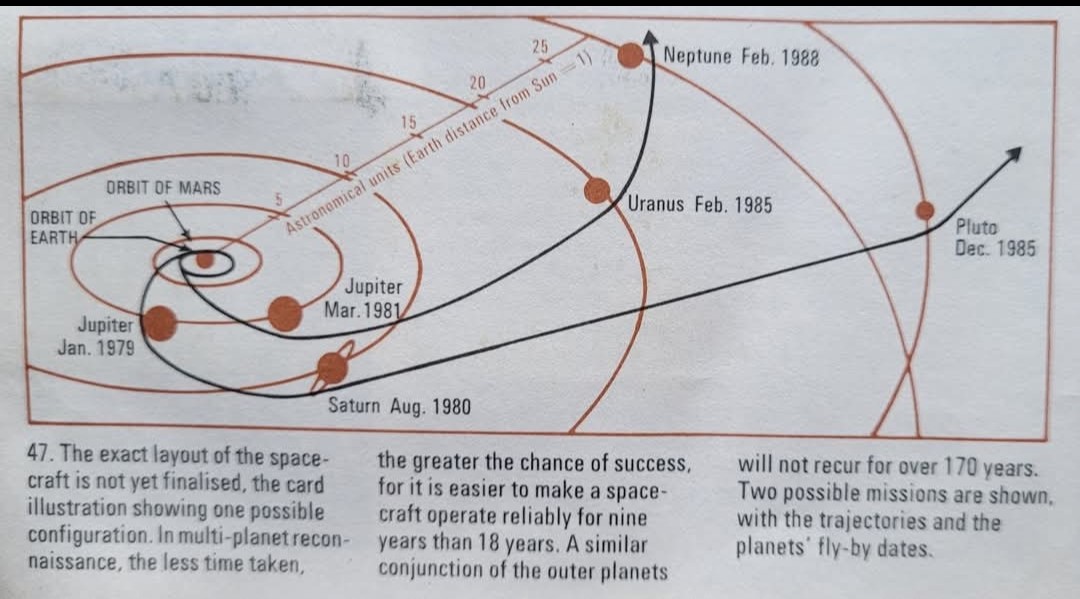
My own first encounter was in the 1970 Brooke Bond tea card album The Race Into Space with card 47 discussing a future project then termed The Grand Tour.
Jeremy Clarkson would have been ten at the time, but astronomers had realised that an alignment of the outer planets was approaching that would allow a relatively small spacecraft launched by a similarly modest rocket to visit the gas giants of the solar system quickly using gravity assists as it went. If the launch window of 1977 was not used, there would not be a similar alignment of planets for over 170 years.
Voyager 2 left Launch Complex 41 at Cape Canaveral aboard a Titan IIIE Centaur booster on 20 August 1977. Voyager 1 was due to have been launched on the same day but technical issues put back its lift off until 5 September 1977.
The two near identical craft weighed 721.9 kg. (1591.517 pounds) and each had a radio isotope thermo electric generator producing 420 Watts.
Voyager 1 visited Jupiter in 1979 and Saturn in 1980 while Voyager 2 flew by Uranus in 1986 and Neptune in 1989.
Voyager 1 had been scheduled to continue to Pluto, then still considered as the ninth planet, but its course was changed for an encounter with Saturn’s moon Titan instead. This put the two Voyagers on paths which today make them the most widely spaced man made objects.
Pluto was then left for the separate New Horizons probe to encounter in 2015.
Among other revelations, Voyager 1 discovered thin rings around Jupiter while Voyager 2 discovered similar structurs around Uranus and Neptune. Voyager 2 discovered that Triton, a moon of Neptune, had an atmosphere while Voyager 1 found volcanic activity on Io, a moon of Jupiter.
Currently it has taken almost 50 years for the two Voyagers to cover the distance that light will travel in less than an Earth day despite Voyager 1 travelling at 17.06 km (10.6 miles) a second and Voyager 2 travelling at 15.56 km (9.67 miles) a second.
To put that into perspective, Gloucester to Cheltenham via the A40 is 8.5 miles. This brings home how big space is. One Astronomical Unit (AU) is the distance from the Earth to the Sun – 93 million miles – and Neptune alone is 25 AU from the Sun.
Both Voyagers have passed beyond the influence of the Sun and are now travelling through interstellar space but will not even be close to another star for thousands of years.
In case they do encounter intelligent extraterrestrial life though, each Voyager has a gold plated copper disc that contains sounds, music, pictures and greetings in 55 languages. The music includes Bach’s Brandenburg Concerto and Chuck Berry’s Johnny B. Goode.
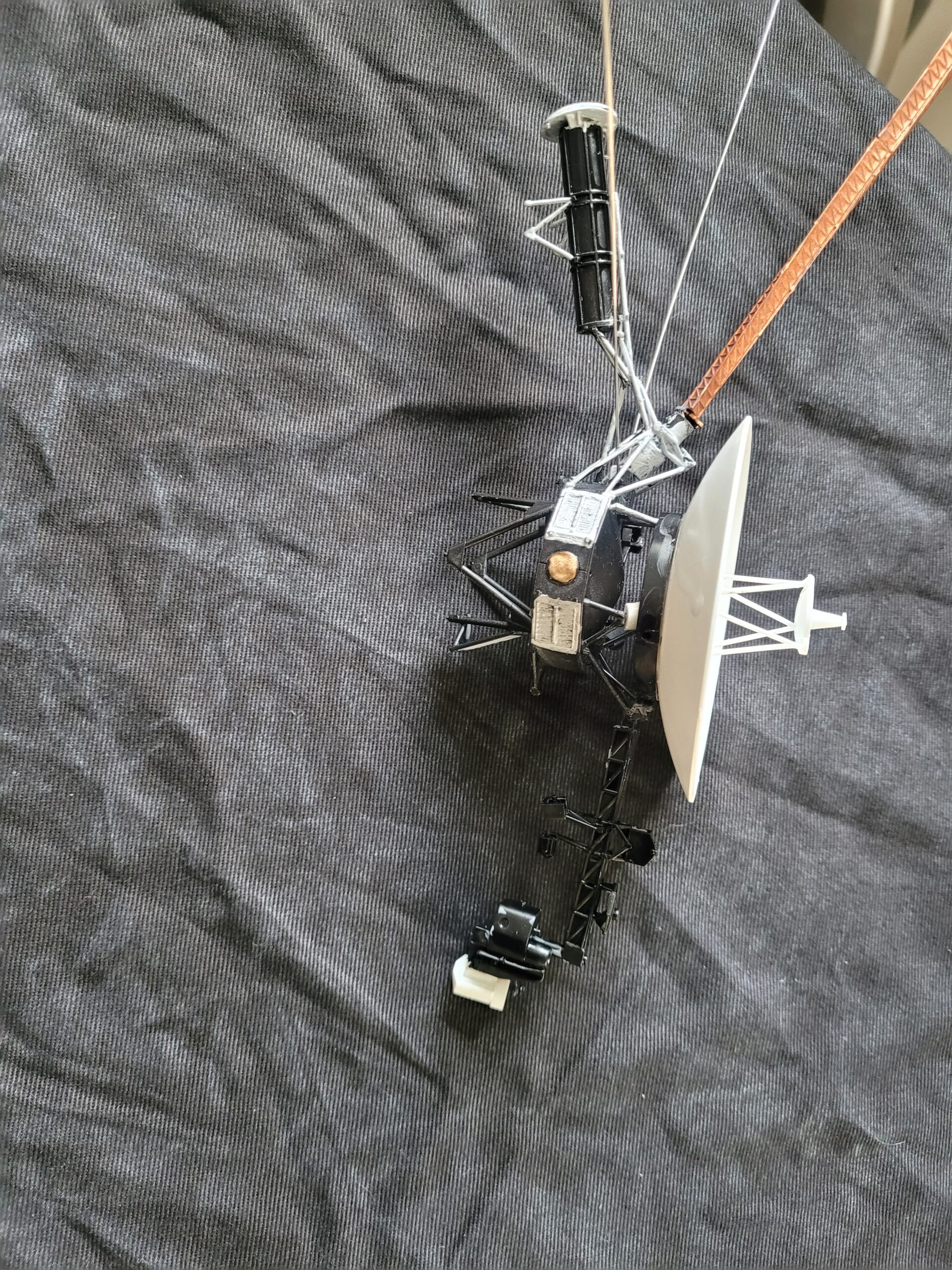
Looking round the Voyager spacecraft, the short boom at the top with the disc shaped end is the radio isotope thermo electric generator, the golden record set between two silver panels and at the bottom of the picture is the narrow and wide angle camera boom.
The cameras have not been used for many years now to save the dwindling electricity supply. However, this boom also carries an infrared interferometer, spectrometer and radiometer (white drum shaped structure near to the cameras) bracket- like low energy charged particle detector, and cosmic Ray and plasma instruments.
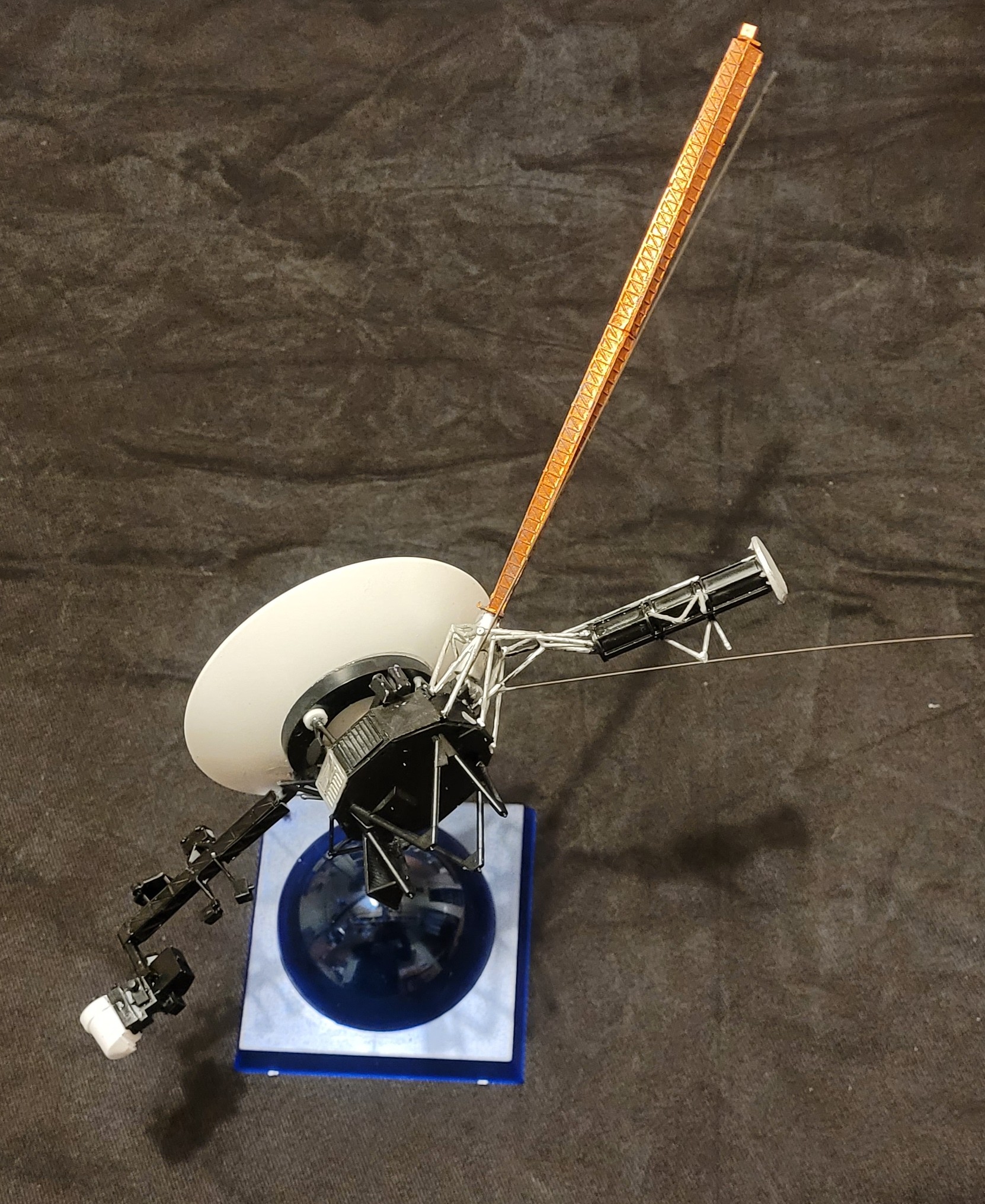
The long copper lattice boom is a magnetometer and the whisker like antenna are for planetary radio astronomy and detecting plasma waves.
The round white dish is the high gain antenna used to communicate with Earth.