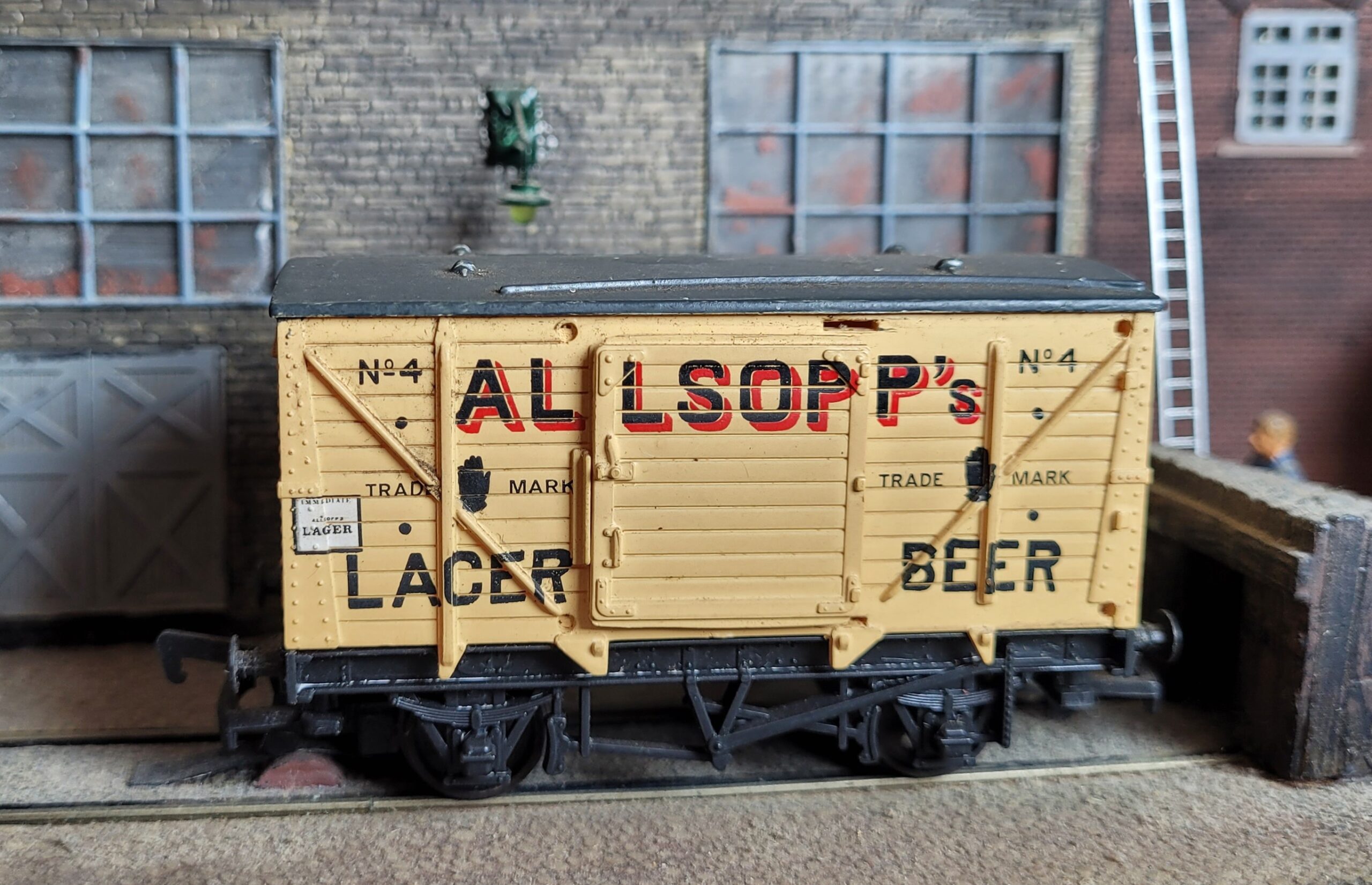
Posed on Capital Works is this 1970s model of a vintage single vent van with sliding doors in the pale yellow livery of Allsopp’s Burton-on-Trent brewery (Mainline catalogue number 37-138)
The 12-ton single vent beer vans used by Samuel Allsopp & Sons were leased from and built by the London Midland and Scottish Railway (LMS) at their own Derby and Wolverton railway workshops to Diagrams D1832A and D1663 between 1929 and 1931. The railway companies built them to transport perishable goods safely by circulating fresh air through vents on either end of the van.
Allsopp Brewery, founded in the 1740s, is famous for pioneering India Pale Ale (IPA). Samuel Allsopp recreated the popular hoppy export in 1822. By the 1880s, it grew into Britain’s second-largest brewery. After declining in the 1900s, the brand was brilliantly revived in 2020 using its original yeast.
In the 1820s, a London brewer named Hodgson dominated the export of beer to India. He made a special, bitter pale ale that survived the long sea journey. Samuel Allsopp got his hands on a bottle, took it home, and famously tried to copy it using a teapot in his kitchen. He succeeded, and his version became a massive global hit. This made Burton-on-Trent the brewing capital of the world.
Allsopp’s beer was so tough and rich it was chosen for polar expeditions. The brewery crafted a special “Arctic Ale” that was so thick it had to be scooped out of copper pots with buckets. Legend says the sailors on polar ships would freeze-distill the beer in the snow to make it even stronger when their rum ran out.
In the 1890s, the chairman, Percy Allsopp, decided that IPA was a dying trend. He thought the future was in lager. He built a state-of-the-art, custom lager brewery. Sadly, the British public was not quite ready for lager. The factory failed. This forced the company into heavy debt, and the Allsopp family lost control of the business.
By 1934, Allsopp merged with Ind Coope to form Ind Coope and Allsopp. Over time, the Allsopp name was dropped. However, in 2020, Jamie Allsopp (the 7x great-grandson of the founder) bought the family name and iconic “Red Hand” logo back. He dug up the original yeast from the National Yeast Archives and started brewing the famous ales again.
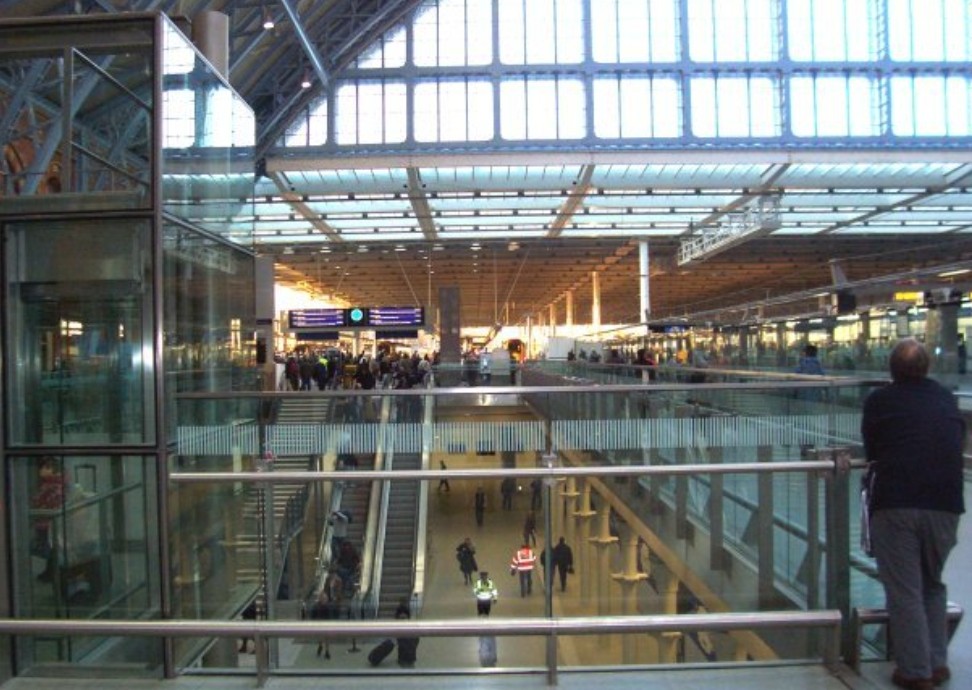
In fact the coming of the railways transformed the brewing industry by turning small, local businesses into massive national operations. Trains brought raw materials like barley and coal straight to the breweries. More importantly, they allowed breweries to ship fresh beer across the country before it could spoil. One example of this the fact that the pillars holding up the train shed of St Pancras Station were spaced with beer barrel storage in mind.
Before trains, brewers only sold beer within a few miles. Because beer is heavy and spoils quickly, breweries were small. Railways meant brewers could sell beer nationwide. This caused small local brewers to shut down as big factories took over.
Trains made it very cheap to move heavy goods. Brewers could easily get clean water, hops, and large amounts of coal to power their steam engines.
Moving glass bottles and large wooden casks by horse cart caused them to break or leak. Trains provided a much smoother and faster ride, which made shipping bottled beer safer.
The building of the railways themselves involved Navvies working long hours in dangerous conditions and being refreshed by up to eight pints of beer a day. However, local innkeepers often watered down the beer that they served to the thirsty workers to make it go further and then tried to disguise their fraud with anything from hallucinogenic berries to rat poison.
Some types of coal, particularly those rich in pyrite (an iron and sulphur mineral) or mined with high organic matter, naturally contain arsenic. When burned, the arsenic turns into a toxic vapor.
This affected the brewing industry in the 1900s through the famous English Beer Poisoning Epidemic.
In the past, malted barley was dried (kilned) using direct heat from coal or coke. If the coal contained arsenic, arsenic fumes would float up and coat the barley grains.
During the 1900 outbreak, tainted malt and a contaminated batch of brewing sugar sickened over 6,000 people and killed at least 70 drinkers.
Doctors originally thought the drinkers had “alcoholic paralysis” from heavy drinking but Dr E.S. Reynolds of the Crumpsall Workhouse Infirmary, Manchester first noticed that patients had skin lesions, which are classic signs of arsenic poisoning.
This tragedy forced the brewing industry to make major changes to how it operated. Brewers stopped using cheap, high-arsenic “gas coke” and raw coal for kilning. They switched to cleaner fuels like anthracite or indirect heating methods to keep fumes away from the grains.
Chemists also developed rigorous testing methods to check raw ingredients—including malt, hops, and water—for heavy metals. Today, brewers monitor for naturally occurring arsenic in brewing filtration aids, such as diatomaceous earth (kieselguhr), to ensure safety.
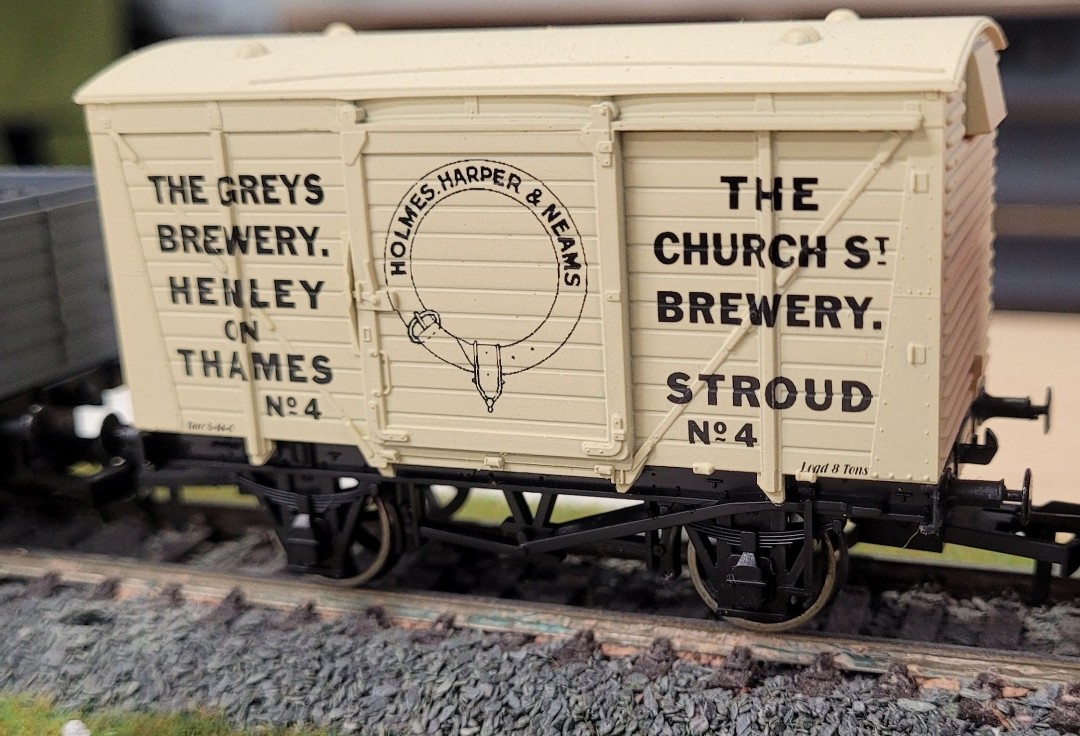
Possibly the only covered vans made for use in Gloucestershire by the Gloucester Railway Carriage and Wagon Company Limited were two examples from September 1886 with wooden solebars and a short lived oval workplace. These cost the partnership of Holmes, Harper and Neame £160 each.
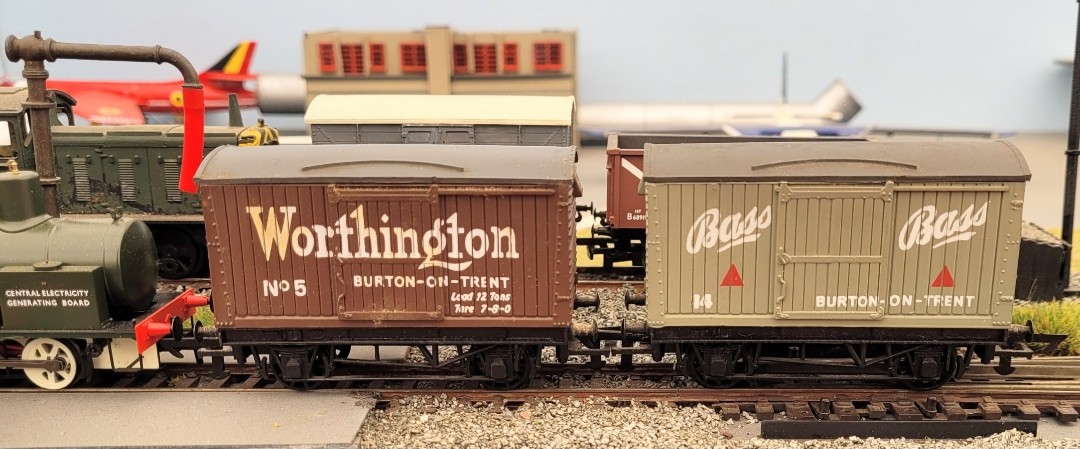
Acquired from Cheltenham Model Centre at the 2026 Vintage and Country Extravaganza at South Cerney were two 12 ton ventilated vans from the Graham Farish 00 gauge era of the 1970s. Bass fleet 14 had the catalogue number 12311 while Worthington number 5 was Graham Farish catalogue 12312
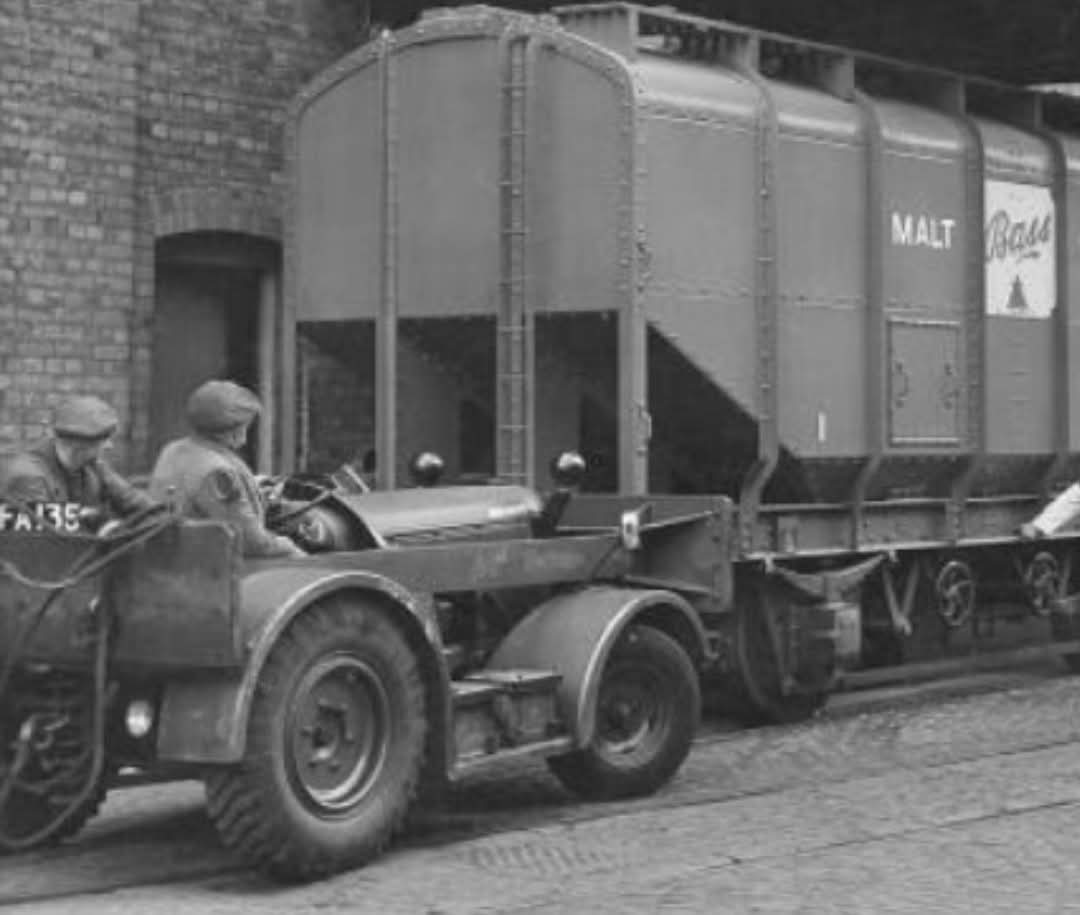
Bass Brewery in Burton-upon-Trent was founded in 1777 by William Bass initially branching out from a transport and carrying business. It grew into the largest brewery in the world by 1877. Annual production surpassed one million barrels, cementing Burton as the beer capital of England. Bass also achieved fame for its iconic Red Triangle – the UK’s first registered trademark on 1876.
Bass sold its brewing empire in 2000; the brand rights belong to AB InBev, while historic production infrastructure transitioned through Interbrew and Molson Coors. Bass Pale Ale is brewed locally in Burton-upon-Trent at Marston’s Brewery.
Portions of the historic older brewery real estate have shifted away from active industrial brewing toward mixed-use urban regeneration.
Even earlier, in 1761, Coopersmith William Worthington purchased a small brewery on Burton’s High Street. By the 1830s, the company was exporting its famous India Pale Ale (IPA) to the Baltic states and Cairo. In 1872, chemist Horace Tabberer Brown established Worthington as the world’s first brewery to systematically use an in-house laboratory for pure yeast cultivation. Facing severe commercial pressures, the brewery merged with its prominent local rival, Bass, in 1927. The original physical Worthington brewery buildings were closed and demolished in 1965, though the beers survived production transfers to Coors (now Molson Coors) who assumed total ownership of the Worthington brand portfolio from Bass in 2002.