This is an in depth look at part of the model presentation Aeroplanes Without Runways displayed at the Jet Age Museum, Staverton, GL2 9QL in the autumn of 2020.
OVERVIEW

In the early days of flying, water was an alternative to runways – which were at first rare and later vulnerable to attack.
The Czech Letov S-328V was a seaplane on floats while the Grumman Widgeon (pictured above) and Supermarine Walrus were flying boats. During World War 2, Supermarine Walruses were built by Isle of Wight based Saunders Roe, which had be founded in 1929 by Sam Saunders and Alliott Verdon Roe: also the man behind Avro aircraft.
The Saunders Roe SRA1 jet flying boat first flew in 1947 and was powered by two Beryl axial flow gas turbines. These were built in Manchester by Metropolitan Vickers, who went on to produce the Class 28 diesel locomotive with its unique Co-Bo wheel arrangement in 1958.
Arthur Gouge designed the SRA1 as a jet powerful enough to overcome the drag of a traditional flying boat hull, which could be made more shallow as no propeller clearance was needed.
In 1957, Saunders Roe built the SR 53 experimental interceptor which featured both rocket and gas turbine propulsion. However, this was made obsolete by the arrival of surface to air missiles.

More successful was the Saunders Roe SRN1, the World’s first practical hovercraft, although from 1964 the company made components for aeroplanes like the Britten Norman Islander and Handley Page Jetstream. From 1953, too, Saunders Roe had built lightweight bodies for Leyland Tiger Cub buses. By the 1970s, Saunders Roe expertise was united with that of the Gloster Aircraft Company to create Gloster Saro road tanker lorries and fire appliances.
Although the SRA1 flying boat was not mass produced, the jet engine today powers such “guerrilla” aeroplanes as the Harrier (derived from the Hawker P1127) and Yakovlev Yak-38 which can take off and landing Sukhoi Su-25 and Fairchild Thunderbolt, both of which can operate from straight roads and rough runways.
SEAPLANES AND FLYING BOATS
The stories of the Supermarine Walrus and Grumman Widgeon are explored in the Gloucestershire Transport History article Britain’s Lost Seaplanes while the Letov S-328V represents a landplane that was converted to marine use.
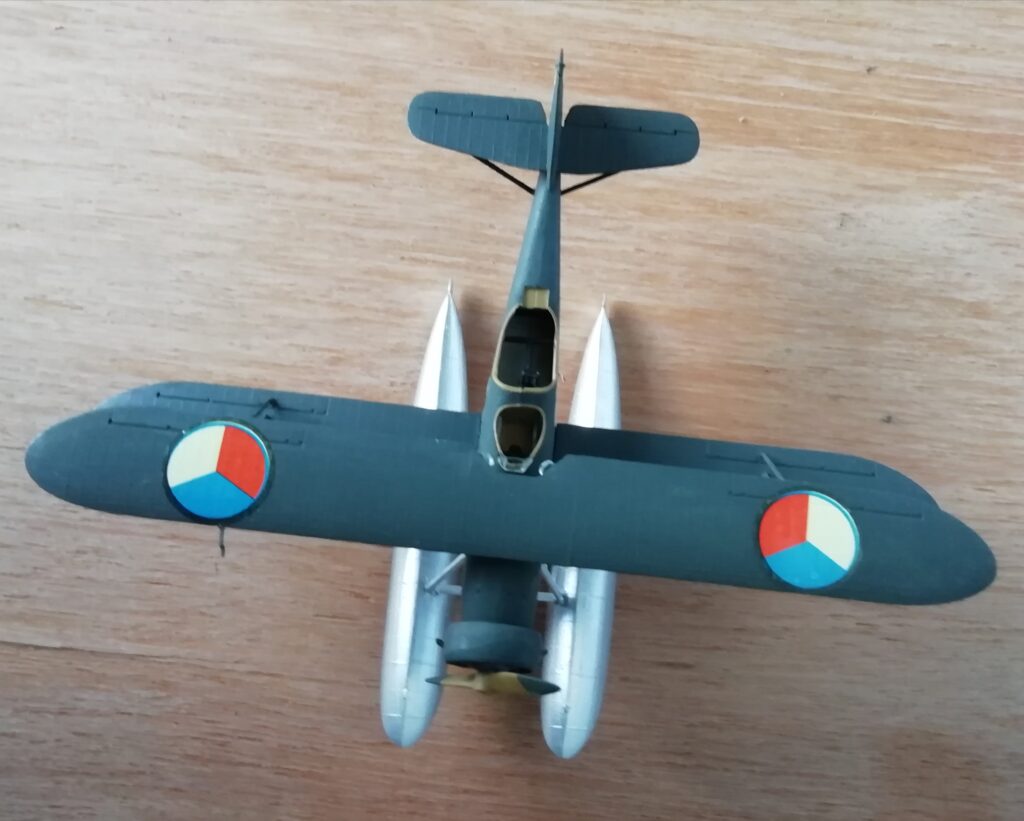
Design work on the Letov S-328 started in 1932 to meet a requirement from the Finnish Air Force, which in fact never accepted the type. However, after a maiden flight in 1934, the S-328 began to equip the Czechoslovak Air Force in 1935: the same year that the Luftwaffe was revealed in Nazi Germany.
Although Czechoslovakia was a land-locked nation, four floatplane target tugs were needed for a Czechoslovak anti-aircraft artillery training depot in the Bay of Kotor, nowadays in Montenegro. The v in the Š-328v designation stood for vodní, or water.
The wheeled Letov S-328s were used as a reconnaissance aircraft, light bomber and ground-attack aircraft for the Czechoslovakia Air Force during late 1930s and in that same role during the early months of World War II, when the Slovak Air Force came under German control following its occupation of Czechoslovakia in March 1939.
SAUNDERS ROE SRA1

Towards the end of the Second World War, the Western Allies were forced to attack one heavily defended but widely separated Pacific Island after another in their campaign to defeat Japan.
This offensive relied on aircraft carriers and either capturing or building island airfields. However, a single seat flying boat fighter bomber independent of both these expensive and vulnerable assets would have proved invaluable, especially one with the performance offered by the jet engines then under development. All it would need as a base would be a sheltered stretch of water. Jet propulsion would also remove the need for a high mounted piston engine and a corresponding deep hull. In turn, a smaller, more aerodynamic fuselage would require less fuel to move.
As history records, Japan surrendered in 1945 after both Hiroshima and Nagasaki were devastated by atomic bombs delivered by long range land based aircraft. But Saunders Roe pursued the jet flying boat fighter concept alongside the larger Sea Princess transport flying boat.
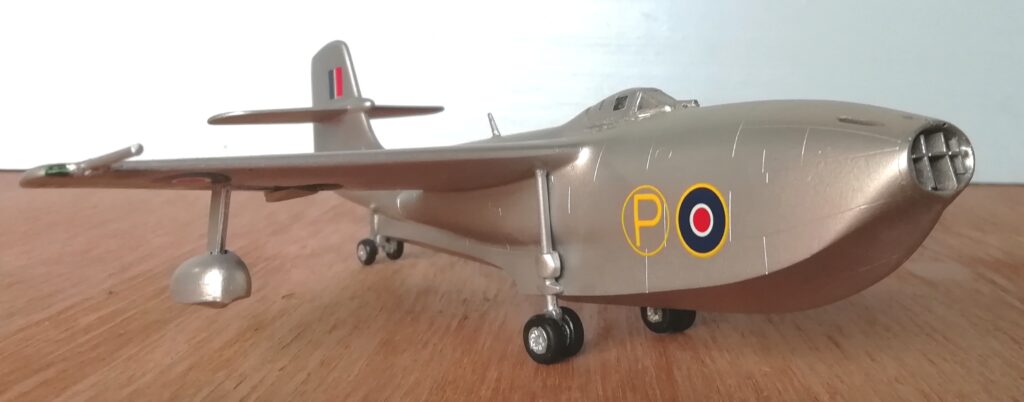
In fact the prototype SRA1, with Geoffrey Dyson at the controls, stunned the 1947 Farnborough Air Show crowd with its agility. However, despite two more examples being built – and subsequently lost – and a swept wing transonic version planned, the SRA1 last flew in 1951.
Designer Arthur Gouge joined Saunders Roe in 1943 after resigning from Short Brothers in protest at the Rochester based company being nationalised. This was at the same time as discussions between Saunders Roe, the Marine and Armament Experimental Establishment and the Gas Turbine Department of Metropolitan Vickers, resulting in Air Ministry Specification E6/44 being issued in May 1944.
A conventional beam to length ratio of 6:1 was selected over a more slender aerodynamic and hydrodynamic hull design to preserve longitudinal stability and the hull step was moved aft to prevent porpoising after model tests.
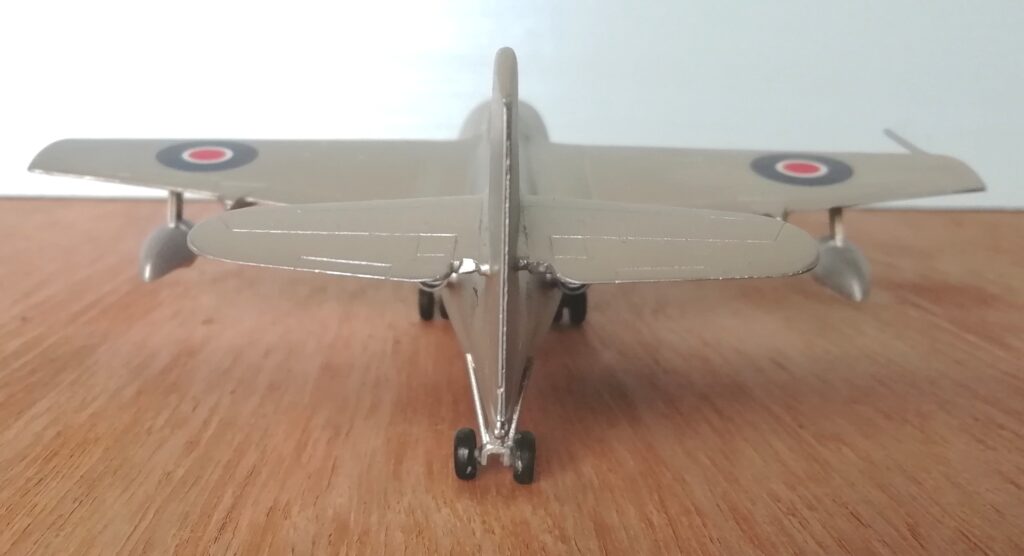
The hull beam of the SRA1 was defined by two Metropolitan Vickers F2/4 Beryl turbojets, side by side with a maintenance walkway in between. The Beryl, first run in January 1945, was one of the first axial flow gas turbines and considerably thinner than the centrifugal jet engines being mass produced by Rolls Royce for the Gloster Meteor at the time.
Both Beryl engines took air from a common nose intake but had separate exhausts, angled out at 5 degrees to keep the hot efflux away from the hull. Similarly, the tailplane was set high up on the single tail fin and the Goldstein aerofoil section high speed wings – which also contained the fuel tanks – were shoulder mounted with a front spar passing through the fuselage.
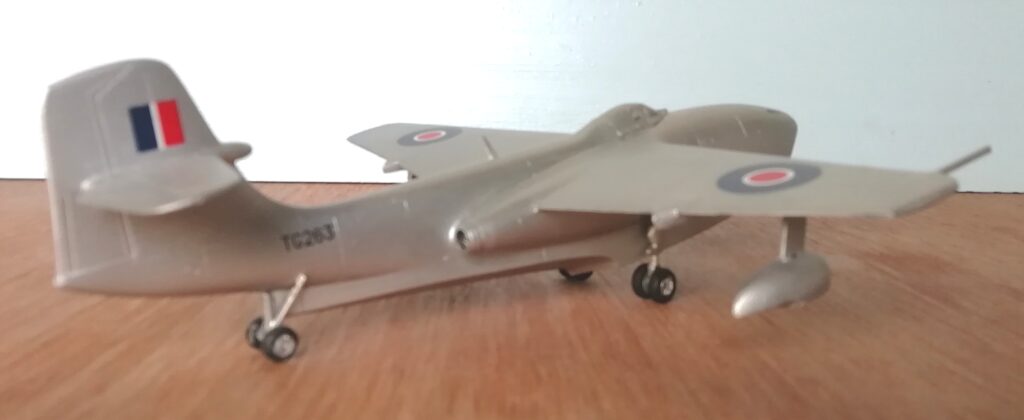
As the inboard position of the two Beryls meant that they could not be used for steering like the Grumman Widgeon, a water rudder was added aft of the planing hull. This could work in unison with the air rudder in the tail on water but be locked in a central position for flight.
The intake was designed with a retractable 10 inch aluminium snout to prevent water ingress but as the SRA1 was designed for calm water, rather than choppy or rough, and slow taxied with a tail down attitude this component was found to be unnecessary. However, on the third prototype, TG271, the snout mechanism was linked to that of the folding wingtip floats.

These retracted more like the undercarriage of a landplane than those on the Catalina flying boats that Saunders Roe had maintained during the Second World War. The legs hinged inward 90 degrees to fit flush with the underside of the wings while the floats themselves rotated through 180 degrees. As such, only the rounded top parts were exposed to the underwing air flow while the less aerodynamic planing sections were buried within the depth of the wings.
Unlike the Walrus and similar biplane flying boats, the SRA1 was designed for a crew of one and lacked a low level manned gun position in the nose which could also be used for mooring.
Instead, “The Squirt”, as the Saunders Roe workers called it, featured a retractable hook on the bow of the keel just below the water line. This allowed the flying boat to taxi over a cable stretched between two marker buoys, which could then be used to pull it to a dock or pontoon nearby. A similarly retractable hook was fitted to the nose of the SRA1 to allow it to be towed.
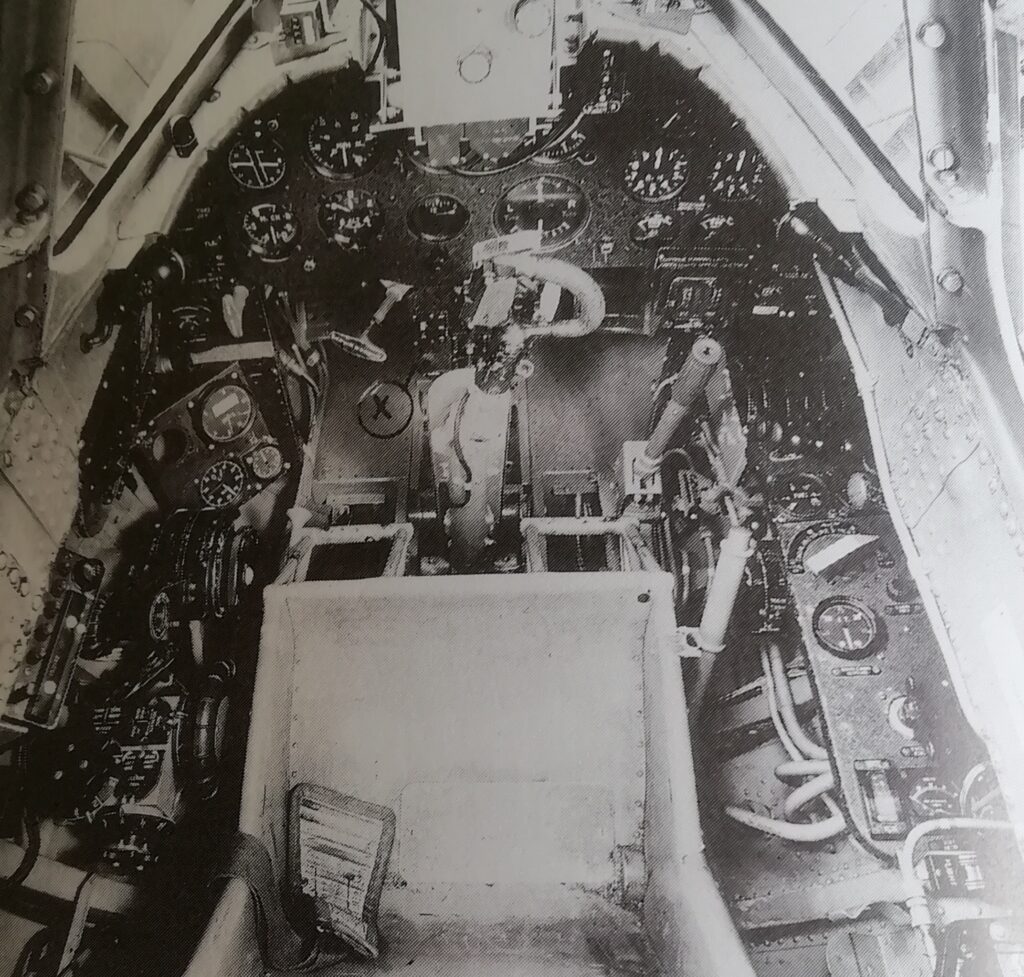
The SRA1 cockpit was a sealed unit, and built with a one piece blown Triplex canopy, automatically pressurised from 9 000 feet altitude by cooled air tapped off the engines. The World’s first jet flying boat was also the first aircraft to be fitted with a Martin Baker ejection seat, although thankfully not the first to use it in an emergency.
Four Hispano Mark V 20mm Canon were fitted to the nose above the intake and provision was made for optional underwing bomb or rocket armament or long range fuel tanks.
By early 1946 three SRA1 hulls were under construction at Cowes with components being delivered from Beaumaris and Eastleigh at the same time that the Saunders Roe design department was returning to the Isle of Wight from Anglesea.
After taxiing trials earlier in the year, test pilot Geoffrey Tyson took the first prototype, TG263, for its maiden flight on 16 July 1947. This identified a snaking tendency, which was cured by adding a Gloster Meteor style acorn fairing to the junction of the tailplane and fin in August 1947. Modifications were also made to the rudder to counteract rolling and the nose radius of the outer sections of the wing on the second prototype, TG263, was enlarged to help avoid tip stall.

Even in its original state at the end of July 1947 though, TG263 impressed representatives of the RAF, Royal Navy, Royal Aircraft Establishment, the British aircraft industry and the press on its fifth flight.
As well as low passes at 400 mph, Tyson demonstrated his short take off technique of retracting the floats just as soon as The Squirt was stable, even before it had left the water, thus minimising drag.
After appearing at the September 1947 SBAC show at Farnborough, TG263 went for trials at the Marine and Armament Experimental Establishment where it was found to be able to take off in 26 seconds and had an exceptional rate of climb.
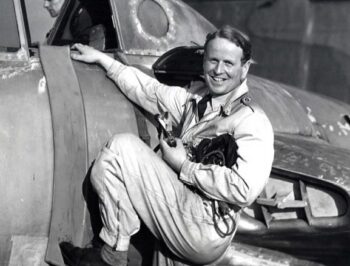
30 April 1948 meanwhile saw the second prototype, TG267, take to the air while during a test flight in May 1948 TG263 lost its transparent canopy, which was replaced with a largely metal one which has been carried into presevation. This was not unlike the canopy of the modified de Havilland Vampire which had set a new altitude record in March 1948, but would have limited the all round vision of a fighter pilot.
The third prototype, TG271, first flew on 17 August 1948 and was exhibited at the Farnborough Air Show the next month.
The Beryl engines supplied to Saunders Roe by Metropolitan Vickers had been increasing in power, with those fitted to TG263 producing 3 230 lb of thrust apiece while those inside TG267 each put out 3 500 lb. TG271 was able to offer 3 850 lb twice over, allowing Geoffrey Tyson to make a legendary high speed inverted pass over the Farnborough runway. However, this was only achievable with the installation of invertable fuel valves and extra fuel tank compartments and only one such aerobatic display could be made before refuelling.

To be fair, many of the early turbojet aircraft guzzled fuel and thus lacked range. In the context of the island hopping Pacific campaign of World War II, jet flying boat fighter bombers would have needed expensive and vulnerable depot ships to refuel them at sea. However, by the end of the 1940s, experiments were being made with probe and drogue flight refuelling for long distance flights.
Meanwhile, TG271 started 1949 at Cowes performing aerodynamic and engine testing while TG267 replaced TG263 at the Marine and Armament Experimental Establishment: the first prototype being stored.
Of the three Squirts, TG271 was the first to be lost. On 12 August 1949, Lieutenant Commander Eric M. Brown – Britain’s most accomplished test pilot and later Patron of Jet Age Museum – was alighting at Cowes after his first – and unfortunately last SRA1 test flight. The flying boat hit a submerged mast which holed the forward hull and ripped off the starboard float, causing TG271 to cartwheel across the water and end up on its back. Luckily, Lieutenant Commander Brown was saved by Geoffrey Tyson, who leapt into the Solent fully clothed from a safety launch and dragged him aboard. The wreck of the aircraft sank and has never been recovered.
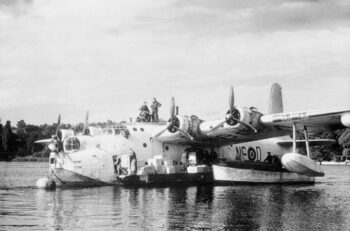
This accident highlighted the further vulnerability of high speed aircraft operating from water. While a foreign object inspection walk (or FOD plod) of a runway or aircraft carrier flight deck can reveal loose items that could be sucked into a jet engine, even a sheltered lagoon could easily hide obstacles beneath the surface. Indeed, during the Berlin Airlift of 1948-1949, Short Sunderland flying boats delivering supplies to Havel Lake were harassed by logs pushed into their paths by surrounding communists.
TG267 meanwhile was lost on 17 September 1949 at Felixstowe during aerobatic practice for a Battle of Britain display in bad weather. The aircraft plunged into the sea, killing the pilot, and although the wreckage was recovered no cause for the accident was confirmed.

Even more damaging to the long term prospects of the Squirt however was an agreement with the Ministry of Aircraft Production that saw Metropolitan Vickers transfer its gas turbine programme to Armstrong Siddeley in 1947, thereby reducing the number of British gas turbine manufacturers.
While the Manchester based firm went back to making electrical generators – and later railway locomotives – Armstrong Siddeley abandoned the Beryl turbojet in favour of an even more advanced axial flow gas turbine – the Sapphire, which was eventually to power the Gloster Javelin.
This left Saunders Roe with just the Beryls in TG263 and five spares. And redesigning the SRA1 around a single Sapphire engine would have effectively meant starting the jet fighter flying boat all over again.

Although the outbreak of the Korean War in 1950 revived American interest in the jet fighter flying boat idea for a while, advanced land plane designs were seen as the way forward.
Having said that however, William Edward Willoughby “Teddy” Petter did doodle a flying boat version on the plans of his English Electric Canberra jet bomber, which first flew in 1949. And Saunders Roe’s own six turboprop engined Sea Princess flying boat airliner did not fly until 1952 and was not scrapped until 1967.
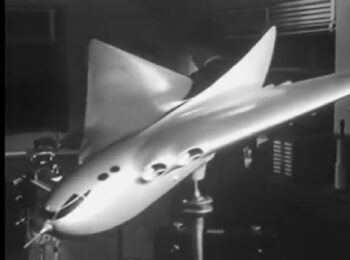
1953 also saw the release of the feature film The Net (not to be confused with the later Sandra Bullock vehicle) starring James Donald and Herbert Lom and featuring the fictional M7, a jet and nuclear powered lifting body flying boat capable of 2 500 mph.
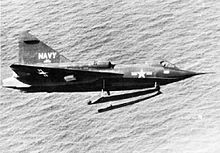
Across the Atlantic, the delta winged Convair F2Y Sea Dart seaplane, conceived as a way of taking supersonic aircraft to sea without aircraft carriers, did not fly until 1953: after which the introduction of angled flight decks, mirror landing aids and steam catapults made flat tops friendly to high performance fighters and bombers. However, the Sea Dart remains the only seaplane to have broken the sound barrier.
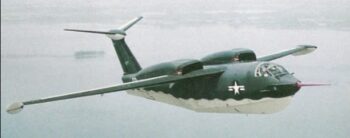
1955 meanwhile saw the first flight of the Martin P6M Seamaster four-jet flying boat bomber. Officially described as a “high speed mine layer” by the US Navy, it featured wingtip tanks that doubled as floats, a T tail rather like that of the RAF’s Handley Page Victor and a rotary bomb bay similar to that of the Blackburn Buccaneer. However, the Martin Seamaster – and a proposed support ship infrastructure – was cancelled in 1959 in favour of the Polaris submarine launched ballistic missile.
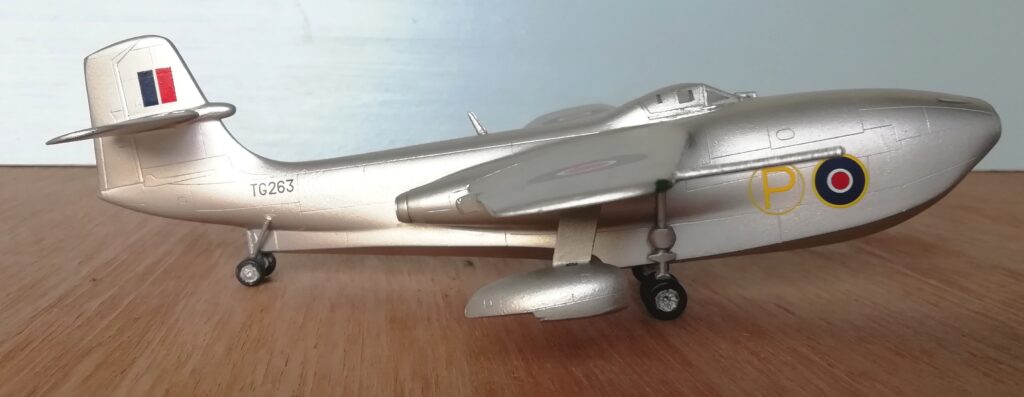
The last public flying appearance of TG263 was in June 1951 when it was landed on the Thames by Geoffrey Tyson as part of the Festival of Britain. By this time it was officially an experimental civilian aircraft with the registration G-12-1 and after the exhibition the last of the Squirts was presented to the College of Aeronautics at Cranfield.
Now with beaching gear attached, TG263 had one of its Beryl engines removed in 1955 for use in an early version of Donald Campbell’s K7 Bluebird hydroplane.
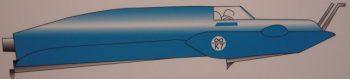
Although not the first jet propelled high speed boat, Bluebird K7 was the most successful of the time, breaking 7 World Water Speed Records up to 1964.
In 1966 the Beryl was replaced by a Bristol Siddeley Orpheus turbojet from a Folland Gnat trainer. However, just like the proposed Sapphire powered SRA1, Bluebird K7 needed considerable modification to accept the new powerplant with its increased power and different weight distribution. Tragically, Donald Campbell was to die on Coniston Water on 4 January 1967 when Bluebird K7 flipped on its back during a high speed run.

Also in 1966, TG263 left Cranfield as three separate lorry loads for preservation at the Skyfame Museum – then located at Gloucestershire Airport, Staverton, on the opposite side to the current Jet Age Museum.
This was when, as a small boy, I met the Squirt. Its height on wheels made it dominate the black corrugated hangar and the owner, Mr Peter Thomas, had thoughtfully propped a ladder against its hull so that the brave could climb up and look into the cockpit. Health and safety had not been invented then!
When Skyfame was sadly forced to close in 1978, TG263 went to Duxford as part of the Imperial War Museum but in 1991 moved to its current resting place at Solent Sky, Southampton. The one remaining Beryl engine and the pioneering Martin Baker ejection seat are displayed separately nearby.
Although the Saunders Roe SRA1 jet flying boat was never allowed to fulfil its design potential, the concept of aeroplanes without runways was to continue in the 1950s and beyond.
METROPOLITAN VICKERS CLASS 28 CO-BO DIESEL ELECTRIC
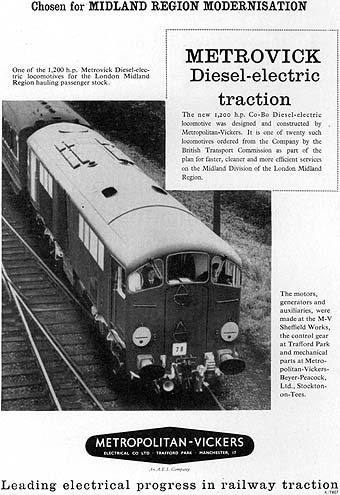
Following the completion of the Manchester Ship Canal in 1894, one of the first firms to build a factory at its eastern end was the British Westinghouse Electric Company, a subsidiary of the American enterprise founded in 1886.
The British Westinghouse Electric factory began production in 1902, George Westinghouse having also built a worker’s village on the American grid system.
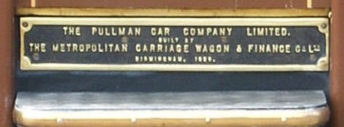
However, Westinghouse went into receivership in 1907 and in 1916 The British Westinghouse Electric Company looked to the Birmingham based Metropolitan Carriage, Wagon and Finance Company to provide the funds to buy the American shareholdings and enable the company to advance.
Then, in 1919, the Metropolitan Carriage, Wagon and Finance Company and British Westinghouse were acquired by Vickers. In September 1919 a new company called the Metropolitan-Vickers Electrical Company was formed. This added electrical engineering and railway interests to Vickers’ repertoire of ships, armaments, cars and aircraft.

In 1928 “Metrovick” merged with the rival British Thomson-Houston (BTH), also founded in 1902 but in Rugby as a subsidiary of American company General Electric. BTH was a similar size to Metropolitan Vickers, also made steam turbines and electrical generators and would go on to pioneer gas turbines and produce its own class of underwhelming diesel electric locomotives for British Railways. In the case of BTH, it was the Class 15, pictured above.
In 1929, the combined Metropolitan Vickers and BTH was purchased by Associated Electrical Equipment (AEI). However, rivalry between Metrovick and BTH continued, and AEI was never able to exert effective control over the two competing subsidiary companies.
From 1940 to 1945, Metropolitan Vickers also partnered A. V. Roe in building Manchester, Lancaster and Lincoln bomber aircraft.
In 1960 the rivalry that had continued between Metrovick and BTH was ended when the AEI management decided to rid themselves of both brands and conduct all their business as AEI.
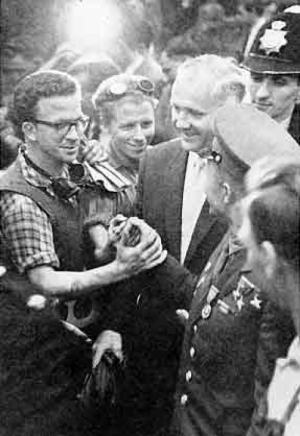
1961 meanwhile saw the Metropolitan Vickers factory visited by Soviet cosmonaut and qualified foundryman Yuri Gagarin as part of his tour of Manchester.
In 1967, AEI was purchased by GEC which changed its name to Marconi plc in 1999. The Trafford Park factory closed and was demolished as was most of the village.
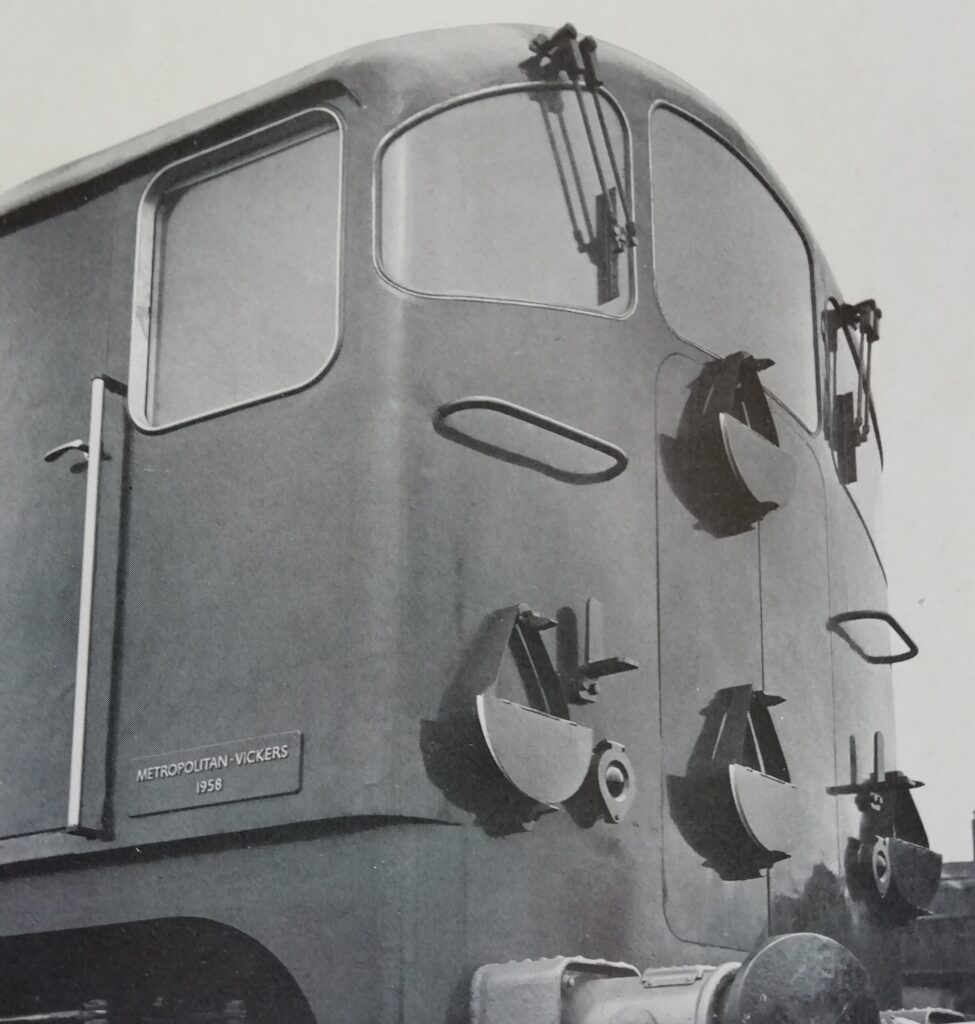
By 1961, British Railways were also regretting their purchase of twenty Co-Bo diesel electric locomotives from Metropolitan Vickers.
This was unfortunate as Metrovick had earlier produced some impressive diesel electric and gas turbine locomotives, combining their own generators and traction motors, with third-party diesel engines.
Their dedicated non steam locomotive plant was a joint enterprise with fellow Mancunian company Beyer Peacock and located at Bowesfield, Stockton on Tees, between 1949 and 1960.
First on the factory floor was a metre gauge Bo-Bo electric order for a mining railway in Brazil followed in 1953 by the narrow gauge X Class 2-Do-2 diesel electrics built for Western Australian Government Railways.
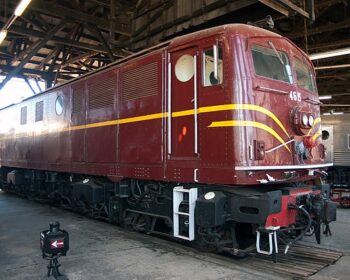
Also heading down under from 1954 were the Class 46 1500v dc electrics (pictured above) for the broad gauge New South Wales Government Railways. These were mechanically similar to the Class 76 Bo-Bo and Class 77 Co-Co engines of the Manchester – Sheffield – Wath route, for which Metropolitan Vickers also produced electrical equipment.
The final orders were placed in 1958 and 1959 for National Coal Board underground battery locomotives and a Class of 3 000 v Bo-Bo electrics for South Africa, after which Bowesfield Works shut.
1958 also saw Metropolitan Vickers 1951 vintage Trafford built gas turbine locomotives 18100 arrive at Bowesfield Works for conversion to 25 Kv ac A1A-A1A E1000 (later E2001) and the erection of the twenty-strong class of Co-Bo diesel electrics.
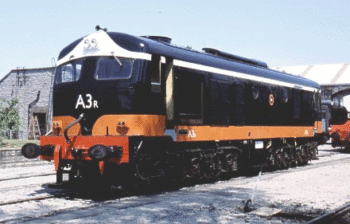
The prime mover for the Co-Bo was the two stroke Crossley HST V8 which had been fitted to Metropolitan Vickers’ Manchester built A Class Co-Co (later Class 001) for Coras Iompair Eireann, the 5’3″ gauge network of the Republic of Ireland, and also the Western Australian X Class.
In turn, the engine choice for the 1955 vintage A Class was influenced by the CIE’s Chief Mechanical Engineer O. V. S. Bullied and his admiration for the work of two stroke Crossleys in Royal Navy patrol boats.
Equally, Britain’s national shortage of foreign exchange currency meant that buying two stroke diesels from the World’s leading manufacturer, General Motors of the USA, was unaffordable. As it turned out, CIE re engined their A Class Co-Co s with General Motors two stroke engines from 1968 and the Western Australian X Class 2-Do-2s were withdrawn in 1973.

The Co-Bos were unique in the 1955 British Railways Modernisation Plan Type 2 power category in having two stroke engines, the only other examples being the Type 5 Class 55 with their opposed piston Deltic engines. Both prime movers came from a marine background but while the Deltic proved to be a success, albeit a complicated and maintenance heavy one, the noisy, smoky, unreliable Crossley two stroke HST V8 could make no such claim.
Indeed, in the 1960s, British Railways considered completely re engining the Class 28s – as had been done with the more numerous Brush built Class 31 – but by then the growth of fast InterCity passenger and heavy block freight trains militated against such a small, less powerful and peculiar class.
Ironically, from the mid 1980s onward, Britain’s mainline locomotive fleet became dominated by General Motors two stroke engines, as witnessed by 66 709 “Sorrento” pictured above.
Later, Metrovick designed the 25 Kv ac Class 82 engines built by Manchester neighbours Beyer Peacock and supplied electrical equipment to the famous Glasgow “Blue Train” EMUs.
The maximum tractive effort of 50,000 lbf generated by the Co-Bo was unusually high for a Type 2 locomotive but, as there were five (not four) driving axles, the risk of wheelslip was minimised. However, the Class 28s were more restricted because of the one six wheeled bogie than other locomotives of similar power
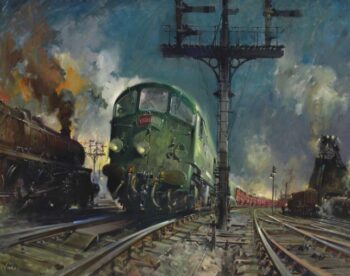
However, despite being entrusted with the crack “Condor” London to Scotland containerised freight express (as celebrated by artist Terence Cuneo in his painting “Night Freight”) the Co-Bos suffered frequent failures and by 1961 the entire class was handed back to the manufacturer for remedial work on the engines and to cure problems with cab windows falling out while running.
The cab windows were modified such that instead of wrapping round to the side the outer front windows were replaced by a flat piece of glass facing the front only.
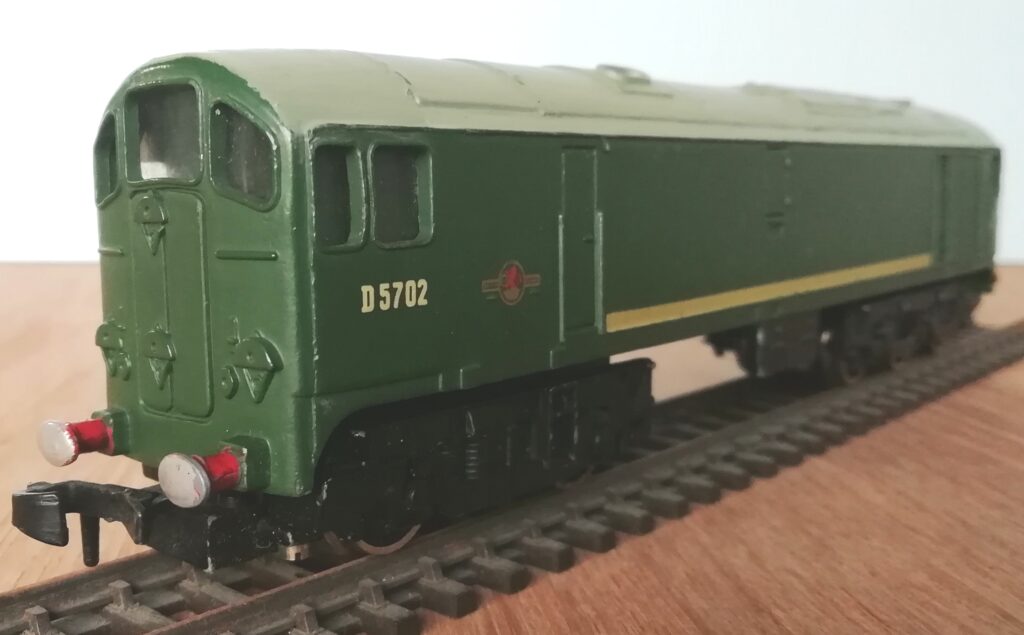
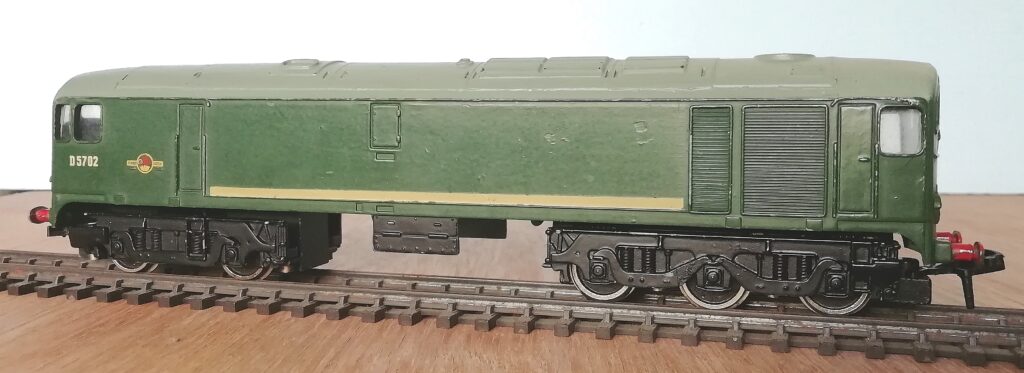
This modified condition was portrayed in Hornby Dublo model 2233, the two rail locomotive with the heavy die cast body carrying the running number D5702. Later, D5702 would be the number of BoCo, the character in the Reverend W. Awdry’s railway series stories.
Back in the real world however, all post modification Class 28s were allocated to Barrow in Furness depot and by 1967 all of D5700 – D5719 were at Carlisle Upperby, ready for withdrawal and scrapping in 1968-9.
However, D5705 would escape destruction :first as part of the tribology test train at Derby’s Railway Technical Centre and then as a carriage heater at Bristol Bath Road depot. After a period of storage at Swindon the one remaining Co-Bo would eventually find its way via Matlock to Bury on the East Lancashire Railway where it is currently being returned to service.
More details of this restoration project can be found at
http://www.elrdiesel.info/fleet-d5705.php
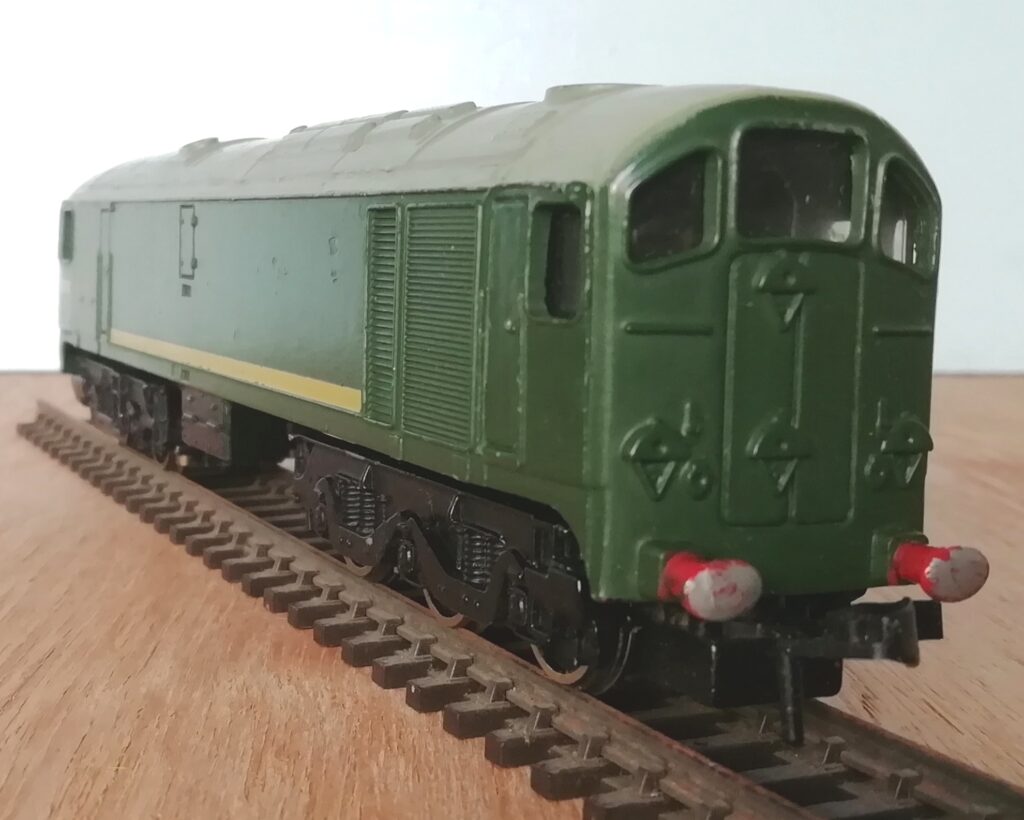
While D5705 is being restored with small yellow warning panels, the model of D5702 in as – rectified Brunswick Green green with eggshell blue bodyside stripes also correctly depicts the number and BR “ferret and dartboard” crest next to each other on the driver’s side at the Number 1 Bo bogie end.
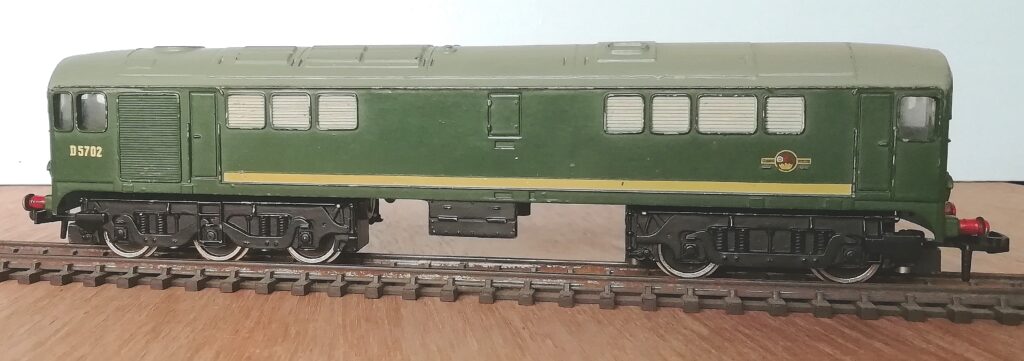
At the Number 2 Co end however, a large grille just behind the left hand driving position means that the D number is just under the driver’s left hand inner side window while the crest is just behind the door to the second man’s cab at the Number 1 end. In either case, the driver’s door is always set back along the cab much further than that of the Second man.